


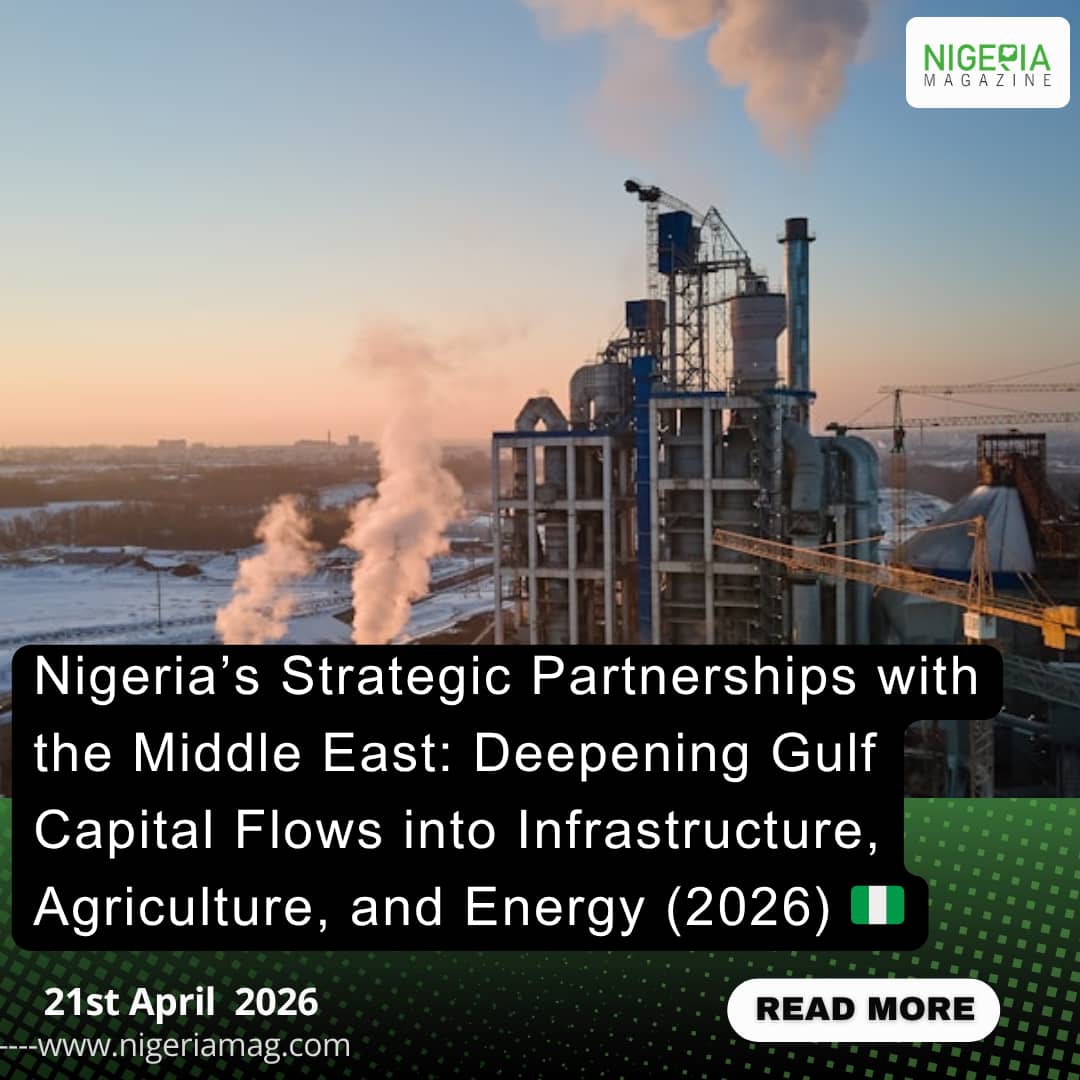
In 2026, Nigeria’s economic diplomacy is increasingly shaped by a decisive pivot toward the Middle East, particularly the Gulf Cooperation Council (GCC) states such as the United Arab Emirates (UAE), Saudi Arabia, Qatar, and Kuwait. This shift reflects a broader strategy by Abuja to diversify investment sources, accelerate infrastructure delivery, and unlock financing for agriculture and energy transitions. As global capital becomes more competitive and traditional Western funding tightens, Gulf sovereign wealth funds and private investors are emerging as critical partners in Nigeria’s development agenda.
A New Phase of Nigeria–Gulf Economic Relations
Nigeria’s engagement with the Middle East has moved beyond traditional oil diplomacy into structured, multi-sector investment partnerships. Recent bilateral agreements with the UAE and Qatar emphasize cooperation in renewable energy, logistics, artificial intelligence, agriculture, and climate-smart infrastructure, marking a significant expansion of economic ties beyond hydrocarbons. These deals are framed around long-term capital deployment rather than short-term trade gains, reflecting the Gulf’s growing role as a global infrastructure investor and Nigeria’s urgent need for development financing. (Moneycentral)
At the political level, high-level engagements between Nigerian leadership and Gulf monarchies have strengthened policy alignment on food security, energy security, and industrialization. These engagements are increasingly supported by sovereign wealth funds and state-linked investment vehicles from the Gulf, which are actively seeking high-growth frontier markets in Africa.
Infrastructure: Financing the Next Growth Wave
Infrastructure remains the most visible pillar of Nigeria’s Middle East partnerships. Gulf investors are particularly active in transport corridors, ports, real estate megaprojects, and energy-linked infrastructure. Nigeria’s infrastructure gap—estimated in hundreds of billions of dollars—makes it a natural destination for long-term, asset-backed capital from the region.
Key areas of cooperation include:
Transport and logistics infrastructure, including highways, ports, and aviation upgrades linked to trade facilitation
Urban development projects, particularly in Lagos, Abuja, and emerging industrial corridors
Public–private partnerships (PPPs), which are increasingly favored over sovereign borrowing models
Recent investment patterns show a broader trend of infrastructure monetization, where governments and operators retain control while selling minority stakes to foreign investors to unlock capital. This mirrors Gulf strategies in energy infrastructure and aligns with Nigeria’s infrastructure financing reforms under concession frameworks. (Global Practice Guides)
Agriculture and Food Security Cooperation
Agriculture is one of the fastest-growing pillars of Nigeria–Middle East cooperation. Gulf states, which import a significant share of their food, are increasingly investing in Nigeria’s agricultural value chains to secure long-term food supply chains.
Strategic areas include:
Large-scale commercial farming and agro-industrial parks
Rice, cassava, and livestock production for export and domestic processing
Cold-chain logistics and food storage infrastructure
Agri-finance partnerships to improve access to credit for farmers
Qatar and Saudi-linked investment groups have shown particular interest in food security partnerships, often combining capital investment with technical expertise and guaranteed off-take agreements. This model allows Nigeria to scale production while ensuring stable export markets in the Gulf.
Energy: From Oil and Gas to a Broader Energy Transition
Energy remains the cornerstone of Nigeria–Middle East relations, but the structure of engagement is evolving. While traditional oil and gas investments remain significant, there is increasing emphasis on gas monetization, refinery development, and renewable energy integration.
Key developments include:
Gulf participation in deepwater oil exploration and production-sharing agreements
Investments in gas infrastructure and pipeline monetization projects
Expansion of refining capacity partnerships, including downstream integration strategies
Growing interest in solar, hydrogen, and hybrid energy systems
This aligns with a broader global trend where Gulf investors—particularly from the UAE and Saudi Arabia—are repositioning themselves as energy transition financiers rather than purely fossil-fuel stakeholders. Nigeria, with its dual energy challenge of high fossil dependency and electricity shortages, is a strategic entry point for such capital.
Strategic Drivers Behind the Partnership
Several structural factors explain the acceleration of Nigeria’s ties with the Middle East:
Capital Diversification Needs: Nigeria seeks alternatives to Western development financing and Eurobond markets.
Gulf Sovereign Wealth Expansion: Funds from the UAE, Saudi Arabia, and Qatar are actively diversifying into Africa.
Demographic and Market Scale: Nigeria’s large population offers long-term consumption and production opportunities.
Energy and Food Security Alignment: Both regions benefit from shared interests in stable energy and food supply chains.
Infrastructure Financing Gaps: Nigeria’s infrastructure deficit creates large-scale investment opportunities suitable for Gulf capital.
Economic and Geopolitical Implications
The deepening Nigeria–Middle East partnership has implications beyond economics. It is reshaping Nigeria’s geopolitical positioning, making the country a key African node in South–South investment flows. It also strengthens Nigeria’s bargaining power in global energy markets by diversifying export destinations and investment partners.
However, this growing relationship also introduces strategic considerations, including the need to ensure balanced partnerships, protect local value creation, and avoid overdependence on external capital. Nigeria’s challenge will be to structure these investments in ways that maximize technology transfer, job creation, and domestic industrial capacity.
By 2026, Nigeria’s strategic partnerships with the Middle East have evolved into a cornerstone of its development strategy. Gulf countries are no longer peripheral investors but central actors in Nigeria’s infrastructure expansion, agricultural transformation, and energy diversification. If effectively managed, these partnerships could significantly accelerate Nigeria’s journey toward industrialization and economic stability—positioning it as one of Africa’s most important destinations for global capital in the decade ahead.

