


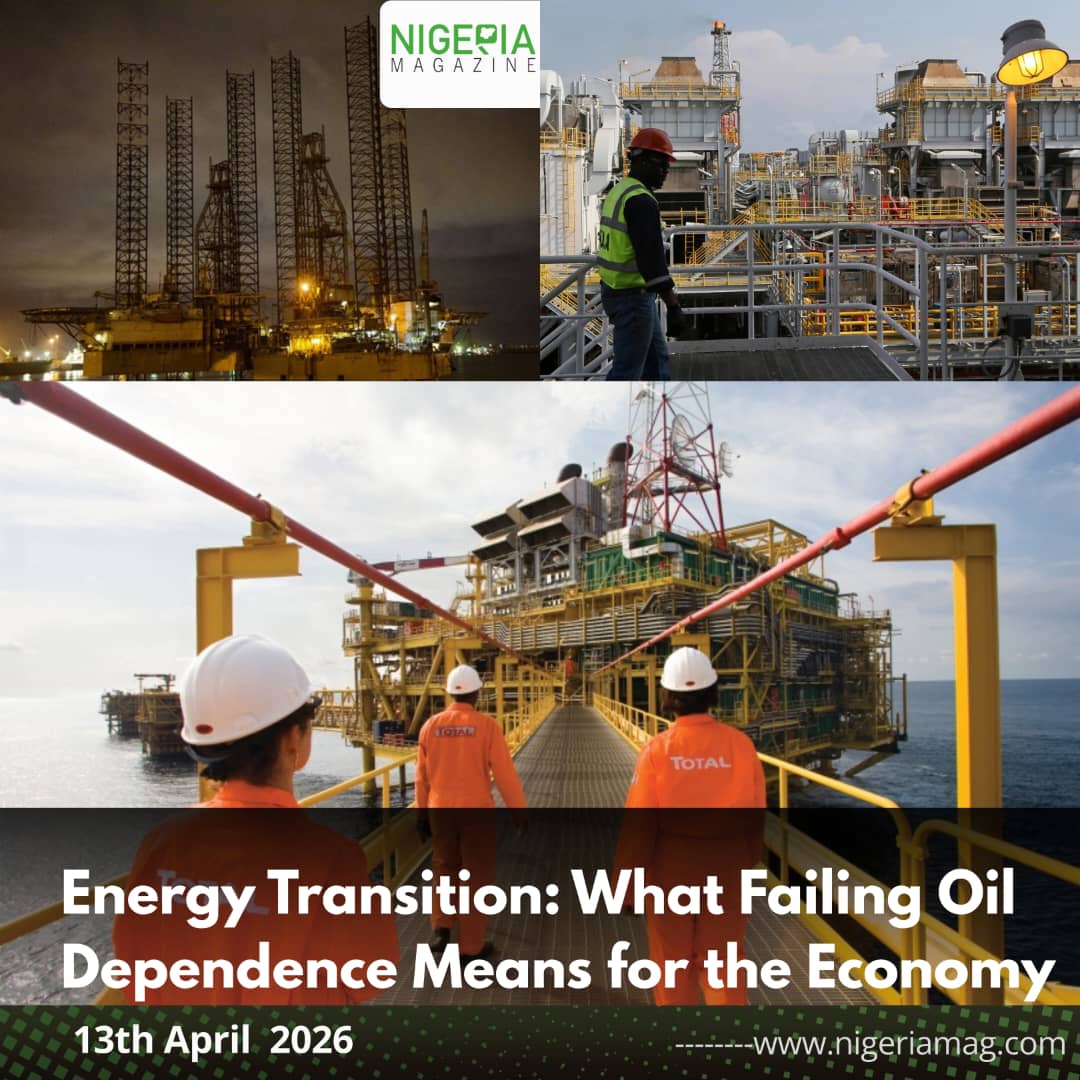
For more than six decades, crude oil has been the backbone of Nigeria’s economy. Since the discovery of oil in the late 1950s, petroleum exports have financed government budgets, supplied foreign exchange, and shaped the country’s economic structure. Even today, oil and gas generate over 70% of government revenue and more than 90% of foreign exchange earnings, making Nigeria one of the world’s most oil-dependent economies. (IJISRT)
However, the global shift toward cleaner energy is reshaping the future of oil-producing countries. Climate policies, technological innovation, and massive investments in renewable energy are gradually reducing the world’s dependence on fossil fuels. For Nigeria, this transformation presents both a challenge and an opportunity: the challenge of declining oil relevance and the opportunity to build a more diversified and resilient economy.
The Global Energy Transition and Its Drivers
The global energy transition refers to the shift from fossil fuels such as coal, oil, and gas toward renewable sources including solar, wind, hydroelectric power, and green hydrogen. This transformation is largely driven by international climate agreements and growing concerns about carbon emissions and climate change.
Major economies in Europe, North America, and Asia have adopted ambitious decarbonisation targets. Many countries have committed to net-zero emissions by mid-century, while investors are increasingly shifting capital away from fossil fuel projects toward renewable energy infrastructure.
These trends are already affecting oil markets. As global demand growth slows and climate regulations tighten, oil-producing nations face long-term uncertainty about future revenues. For Nigeria, whose public finances rely heavily on crude exports, this shift raises critical questions about economic sustainability.
Nigeria’s Oil Dependence: A Structural Vulnerability
Nigeria’s economic model has historically been built around oil exports. Petroleum revenues fund federal and state budgets, influence exchange rates, and shape fiscal planning. This heavy reliance has created structural vulnerabilities.
First, oil revenues are highly volatile because global prices fluctuate based on geopolitical events, supply disruptions, and economic cycles. When oil prices fall, government revenues decline sharply, often forcing borrowing or spending cuts.
Second, heavy oil dependence has historically slowed economic diversification. Economists often describe this phenomenon as “Dutch disease,” where large resource exports weaken other sectors such as manufacturing and agriculture.
Third, the global transition away from fossil fuels may gradually reduce long-term demand for oil. Studies suggest that declining oil demand could weaken the fiscal capacity of oil-dependent economies like Nigeria and increase unemployment in the petroleum sector if diversification is delayed. (globaljournals.org)
These vulnerabilities make the global energy transition particularly significant for Nigeria’s economic future.
Climate Policy and the Decline of Fossil Fuel Investment
International climate policy is already influencing investment decisions in the global energy sector. Governments and financial institutions are placing greater emphasis on renewable energy development, carbon reduction technologies, and sustainable infrastructure.
As a result, many international oil companies are scaling back investments in new fossil fuel projects. Some companies are divesting from onshore operations in regions like the Niger Delta and focusing instead on deepwater assets or natural gas.
At the same time, global capital flows are increasingly directed toward clean energy technologies. Solar and wind power are now among the fastest-growing sources of electricity worldwide.
For Nigeria, this shift could mean fewer large-scale oil investments in the future. While oil production remains important, long-term global trends suggest that relying exclusively on petroleum revenues is becoming increasingly risky.
Renewable Energy Opportunities in Nigeria
Despite its reliance on oil exports, Nigeria possesses vast renewable energy potential. The country has abundant solar resources, significant hydropower capacity, and opportunities for biomass and wind energy development.
Renewable energy technologies are also becoming more affordable. Solar mini-grids and decentralized systems are increasingly used to supply electricity to rural communities and businesses that lack reliable grid power.
Research shows that renewable energy adoption in Nigeria can generate multiple economic benefits, including job creation, reduced energy costs, and local economic development. (ResearchGate)
In addition, decentralized renewable systems such as solar home systems and mini-grids offer a cost-effective way to expand electricity access while reducing dependence on diesel generators. (IIARD Journals)
These developments suggest that renewable energy could become a major driver of economic growth in the coming decades.
Government Policies and the Energy Transition
Recognizing these trends, the Nigerian government has begun to implement policies aimed at supporting the country’s energy transition. One major initiative is Nigeria’s Energy Transition Plan, which aims to achieve universal energy access by 2030 and net-zero carbon emissions by 2060. (verivafrica.com)
The plan outlines strategies for expanding renewable energy generation, improving energy efficiency, and promoting cleaner fuels such as natural gas. It also emphasizes the importance of balancing climate commitments with Nigeria’s development needs, particularly the need to provide reliable electricity to millions of citizens.
Recent policy developments also reflect efforts to strengthen domestic energy infrastructure.
For example, the government has encouraged local refining capacity and reduced reliance on imported fuel, partly through projects such as large-scale refineries and regulatory reforms. (Reuters)
These initiatives suggest that Nigeria is beginning to reposition its energy sector for a lower-carbon future.
Short-Term Oil Relevance vs. Long-Term Transition
While the global energy transition is accelerating, oil will not disappear overnight. In the short to medium term, petroleum will remain a major source of global energy, particularly in developing economies where energy demand continues to grow.
Recent geopolitical events have also highlighted the continued strategic importance of oil markets. For instance, global supply disruptions and conflicts can push oil prices higher, temporarily increasing revenues for exporting countries such as Nigeria. (Reuters)
Nigeria has even increased its oil production in recent years, reaching around 1.7 million barrels per day as the government seeks to stabilize revenue and attract investment. (Reuters)
However, these short-term gains do not eliminate the long-term structural shift toward cleaner energy sources.
Economic Diversification: The Critical Imperative
The global energy transition ultimately reinforces a message that economists have emphasized for decades: Nigeria must diversify its economy.
Key sectors with growth potential include agriculture, manufacturing, technology, and services. Renewable energy itself can become a new economic pillar, supporting industries such as solar manufacturing, battery storage, and green infrastructure.
Diversification would also reduce fiscal vulnerability. By expanding non-oil revenue sources—such as taxes, industrial exports, and technology services—Nigeria could stabilize public finances and reduce exposure to global oil price shocks.
The global transition toward renewable energy represents one of the most significant economic shifts of the 21st century. For Nigeria, a country whose economy has long been dominated by oil exports, the implications are profound.
Declining global dependence on fossil fuels could gradually reduce oil revenues, exposing structural weaknesses in Nigeria’s economic model. At the same time, the energy transition opens new opportunities for investment, job creation, and sustainable development through renewable energy technologies.
The key challenge for Nigeria is managing this transition strategically. Oil will remain important in the near term, but long-term economic resilience will depend on diversification, investment in clean energy, and policies that encourage innovation and industrial growth.
If managed effectively, the global energy transition could transform Nigeria from an oil-dependent economy into a diversified energy and industrial powerhouse for the future.

