


Nigeria’s digital identity journey—anchored in the National Identification Number (NIN) and the emerging e‑ID (General Multipurpose Card, GMPC)—represents one of the Africa’s most ambitious efforts at digital inclusion. But as the scale grows, so too do concerns about exclusion, centralisation, and citizen rights.
- Scale and Access: Real Progress?
As of June 30, 2025, over 121 million NINs have been issued—up from around 115 million by late 2024, reflecting sustained momentum toward the World Bank’s target of 180 million by end‑2026 Reddit+3Reddit+3Reddit+3Tech
Policy Press+1Reddit+1LinkedIn+1Tech Policy Press+1.
The World Bank’s Digital Identification for Development (ID4D) initiative has disbursed roughly $45.5 million to NIMC between 2021 and April 2024 to support scaling up enrollment and ID integration
ITEdgeNews+3Nairametrics+3Biometric Update+3.
Use cases have expanded—NIN is now mandatory for SIM registration, passports, banking, education exams, and social welfare distributions, with high compliance among telcos (96% SIM‑NIN linkage)
LinkedIn+1allAfrica.com+1.
📈 Impact: When working, the system has been central to distributing cash transfers, student loans, and agriculture grants—reaching millions of Nigerians via digital services Biometric
UpdateBiometric Update.
- Gaps, Technical Issues & Exclusion
Despite high issuance numbers, roughly 60 million Nigerians remain unregistered, meaning millions risk exclusion from basic services
LinkedInBiometric Update.
Rural and marginalised groups face notable barriers: limited awareness, poor internet, and distant enrollment centers contribute to persistent gaps LinkedInallAfrica.com.
Biometric design constraints (fingerprint parsing) disadvantage elderly, people with disabilities, or those whose fingerprints are unreadable. Reported authentication errors often lack clear redress procedures Digital Id.
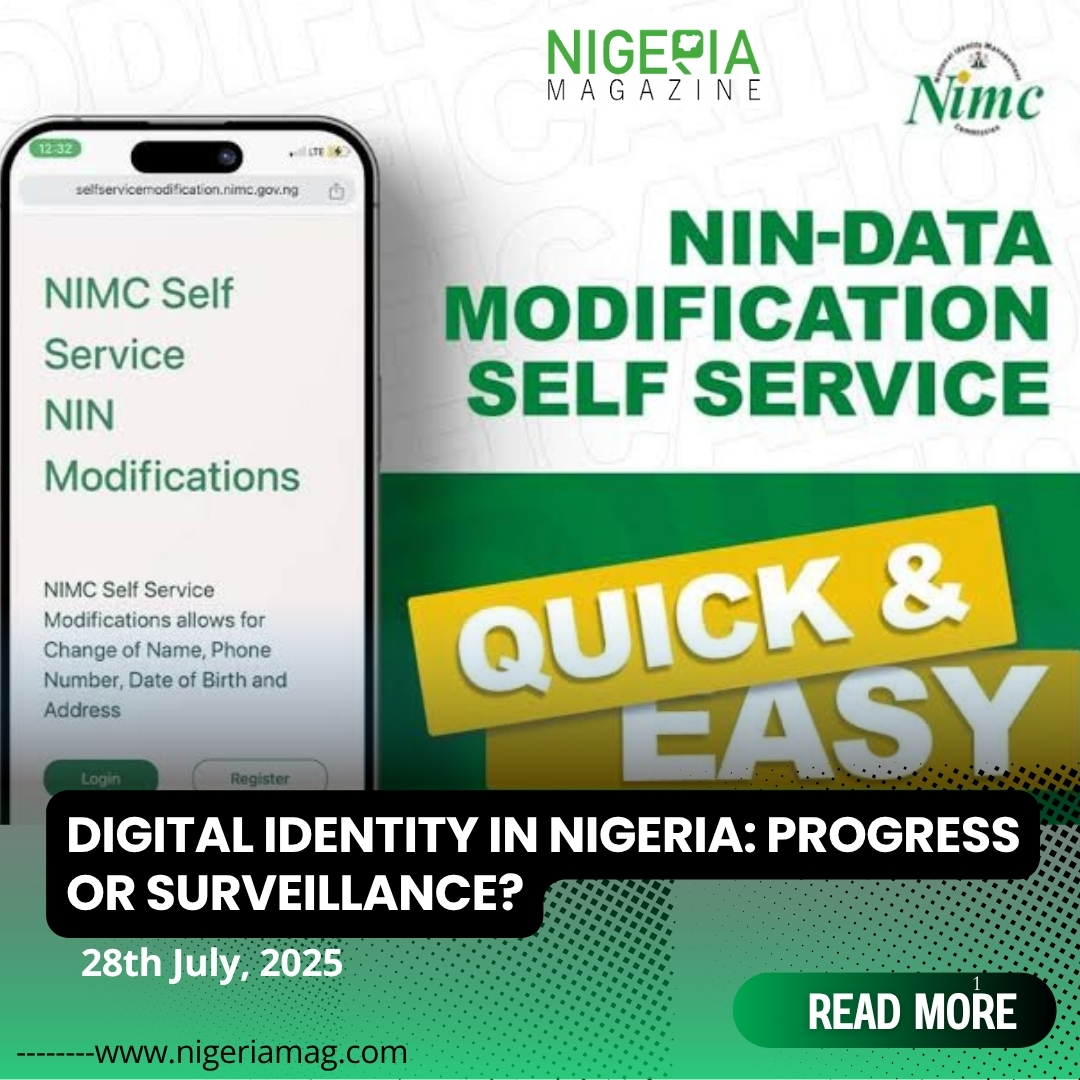
Users frequently report being unable to modify NIN data meaningfully—even after name, gender or address changes—due to disjointed integration between NIMC and banks or other agencies allAfrica.com+12Biometric
Update+12Tech Policy Press+12.
- Privacy, Surveillance & Data Security Risks
Despite Nigeria’s Data Protection Act (legalized in 2023) and the Nigeria Data Protection Commission (NDPC), experts warn of systemic privacy risk from centralized ID data
ITEdgeNews+3Nairametrics+3Wikipedia+3.
Reports suggest websites selling personal data—from names and home addresses to NIN slips of ministers—were sourcing directly from government databases. Civil-society groups have blamed weak enforcement by NDPC
Nairametrics.
The recently launched NINAuth mobile app—meant for secure authentication—has reportedly returned data belonging to other citizens, raising concerns about technical flaws and premature public rollout before adequate security audits ITEdgeNews.
Civil society organisations have filed litigation urging legal restraint on NIMC’s digital ID expansion pending formal Data Protection Impact Assessments
Punch+5ITEdgeNews+5Biometric Update+5.
Under the NIMC Act, provisions (e.g. Section 26) allow government agencies to access identity data without individual consent, triggering fears over a surveillance‑ready architecture Digital Id+13
Cambridge University Press & Assessment+13ITEdgeNews+13.
- Trade‑offs: Access vs Autonomy
Nigeria’s digital identity infrastructure offers tangible benefits—financial inclusion, streamlined services, data‑driven planning, and potentially safer, fraud‑resistant systems. It also creates powerful tools to reach underserved populations with social protection.
However, these gains come with trade‑offs:
Exclusion risk remains real when biometric authentication fails or systems are inaccessible.
Privacy risks emerge from centralisation, weak oversight, and primitive rollout of apps feeding into the NIMC database.
Without robust redress channels, those adversely affected by errors or data misuse may be effectively disenfranchised.
- Towards Balanced Digital Citizenship
What would a data‑just, citizen‑empowering digital identity system look like?
a) Improve inclusivity & reliability
Expand mobile or community‑based enrollment in rural areas.
Deploy alternative biometric solutions (facial recognition, iris, PIN fallback), and establish clear redress mechanisms for mismatches or systemic errors LinkedInDigital Id.
b) Strengthen governance and privacy safeguards
NDPC must enforce independent security audits of platforms like NINAuth before deployment Nairametrics+3Wikipedia+3allAfrica.com+3.
Amend NIMC Act to limit unrestricted data sharing under Section 26 and broaden transparency obligations.
Require publicly accessible Data Protection Impact Assessments, especially where centralised biometric ID is deployed
Cambridge University Press & AssessmentTech Policy Press.
c) Expand interoperability, with clear citizen control
Embed NIN into Nigeria’s broader Digital Public Infrastructure (DPI) framework—encompassing payments (eNaira, AfriGo), education, healthcare, social welfare—for seamless but consensual identity flow Tech Policy Press+2LinkedIn+2Wikipedia+2.
Make consent and minimal data use foundational: each agency accessing NIN data should only use what’s strictly needed, with audit trails and transparent logs.
Progress Shouldn’t Cost Rights
Nigeria’s digital identity program is clearly progressing—hundreds of millions enrolled, wide service integration, momentum from global funding. For many, NIN is now a gateway to government services, finance, and social protection.
Yet, beneath this progress lie unresolved tensions: technical outages, inclusion gaps, weak modification pathways, and credible dangers around data security and surveillance.
Without addressing the structural governance and legal gaps, digital ID could slip from being a tool for inclusion into an engine of exclusion—or worse, intrusive surveillance.
The real test for Nigeria in 2025 and beyond will not only be how many IDs are issued, but whether those tools serve citizen empowerment, preserve privacy, and uphold constitutional rights. Bridging that divide will determine whether this is progress—or protocol.
Key Data Summary
Topic
Detail
NIN issued – 121 million as of June 2025
Population goal
180 million by end 2026 (World Bank)
Key use cases
SIM registration, banking, passports, welfare, education exams
Challenges
Rural/disabled exclusion, biometrics issues, slow modification, data breaches, legal gaps
Governance bodies
NIMC, NDPC (data protection), DPCOs (compliance organisations)
Nigeria stands at a crossroads: digital identity offers enormous promise—and peril. The next phase demands rigorous safeguards, law reform, meaningful citizen control, and inclusive design. Only then can digital identity be a force for democratic development—not digital oversight.

