


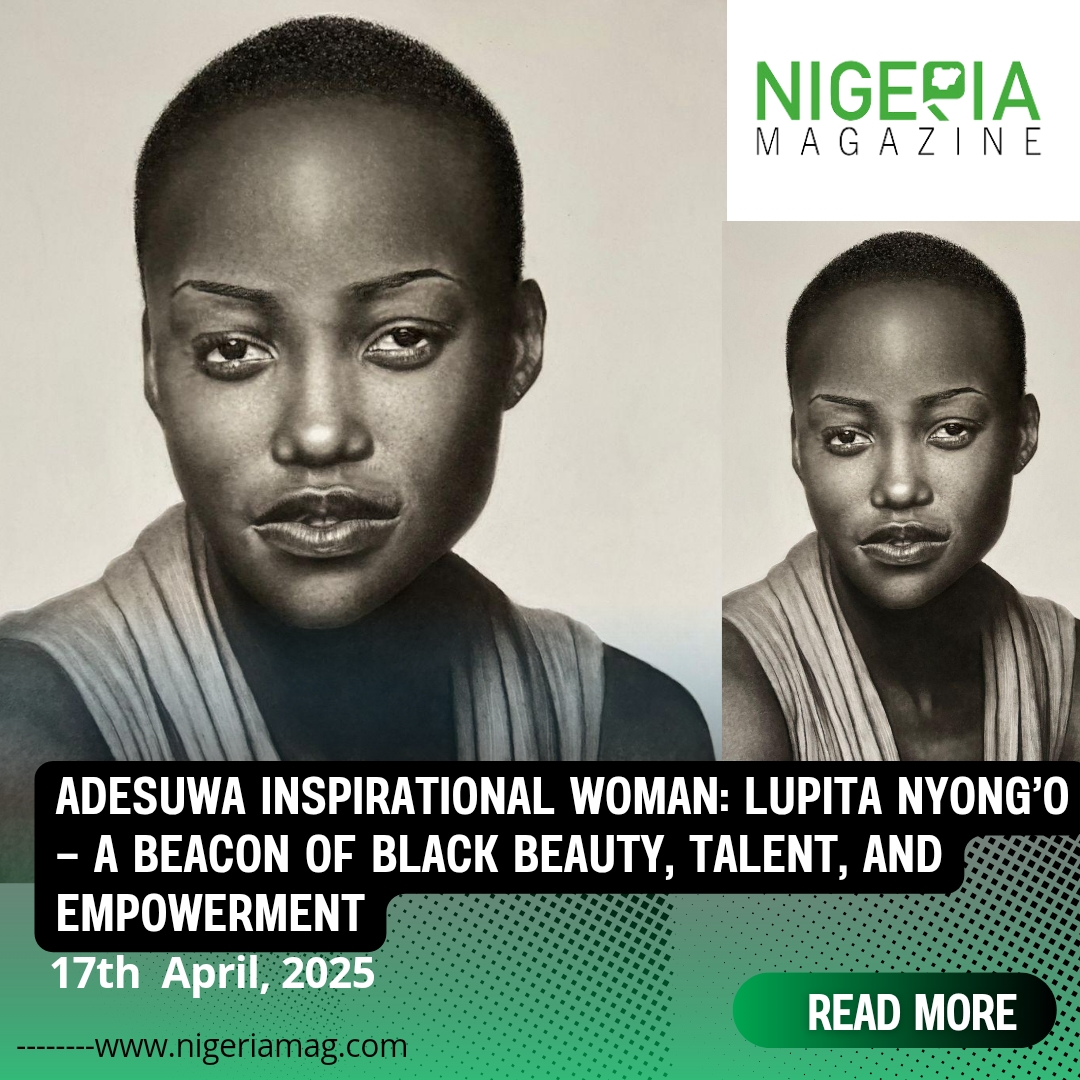
In a world where representation matters more than ever, Lupita Nyong’o has become a symbol of excellence, grace, and unapologetic authenticity. An actress, writer, producer, and global fashion icon, Nyong’o is much more than her accolades. She is a cultural force—a woman whose presence on screen and off has challenged long-held beauty standards, inspired millions, and given voice to underrepresented narratives.
It is no surprise that she is one of the remarkable women honoured in the Adesuwa Inspirational Women Spring Art Collection 2025, currently showing at Lambeth Archives, London. Painted with breathtaking detail by hyperrealism artist Melody Osagie, Lupita’s portrait stands as a tribute not only to her artistic achievements but also to her ongoing advocacy for diversity, identity, and self-love.
A Star is Born
Lupita Amondi Nyong’o was born on March 1, 1983, in Mexico City to Kenyan parents. Her father, Peter Anyang’ Nyong’o, was a prominent politician and academic, and her mother, Dorothy Nyong’o, a communications expert and advocate. The family returned to Kenya when Lupita was a child, where she grew up as part of a loving and intellectually rich environment that would shape her worldview and passion for storytelling.
Her global identity—Mexican-born, Kenyan-raised, American-educated—would later define her unique voice as an artist. She speaks Spanish, Luo, Swahili, and English fluently, a symbol of the cultural multiplicity that she celebrates in her life and work.
Acting Her Way Into History
After earning a bachelor’s degree in film and theater studies from Hampshire College and later an MFA in acting from the Yale School of Drama, Lupita was already poised for greatness. But it was her debut in Steve McQueen’s 12 Years a Slave (2013) that catapulted her into the global spotlight. Her portrayal of Patsey, a brutally abused enslaved woman, was both haunting and heart-wrenchingly human.
For her performance, she won the Academy Award for Best Supporting Actress, becoming the first Kenyan and first Mexican actress to win an Oscar—and only the sixth Black woman ever to do so.
Her win was monumental. But even more powerful was the speech she gave that night, closing with words that still echo:
“No matter where you’re from, your dreams are valid.”
That statement resonated deeply with audiences worldwide. It was not just an acceptance speech—it was a declaration of possibility for millions of girls who had never seen themselves reflected in the global film narrative.
Redefining Beauty on Her Own Terms
In a world dominated by Eurocentric beauty standards, Lupita Nyong’o’s rise was revolutionary. With her radiant dark skin, natural hair, and striking features, she shattered conventional definitions of beauty and inspired a generation of Black girls to see themselves as beautiful.
In 2014, she was named People magazine’s “Most Beautiful Woman,” a milestone moment that celebrated diversity in a new and powerful way. But Lupita didn’t stop at being a fashion darling and red-carpet icon. She used her platform to speak openly about colorism—the discrimination against those with darker skin tones within their own communities.
In a now-iconic speech at the Essence Black Women in Hollywood Luncheon, she shared how she once prayed for lighter skin and only began to love her appearance after seeing supermodel Alek Wek praised in the media. Her vulnerability sparked an honest, necessary conversation and helped dismantle harmful beauty ideals.
Champion of African Narratives
Lupita has never shied away from her African identity—in fact, she has embraced and elevated it at every turn. Her pride in her Kenyan heritage is visible in her fashion, her accent, and her choice of roles. She has brought African stories to Hollywood and Hollywood stories back to Africa, always conscious of the power of representation.
Her role as Nakia in Marvel’s Black Panther (2018) was not just a career highlight, but a cultural phenomenon. The film, set in the fictional African nation of Wakanda, broke records and stereotypes alike, becoming a celebration of Black excellence, leadership, and heritage. For Lupita, Black Panther was not just a film—it was an affirmation that African stories deserve the global stage.
Author, Advocate, Storyteller
In 2019, Lupita added “author” to her growing list of achievements with the release of Sulwe, a children’s book about a young girl who struggles with loving the color of her skin. The story, inspired by Lupita’s own childhood experiences with colorism, quickly became a New York Times bestseller.
Through Sulwe, Lupita created a resource that didn’t exist when she was growing up—a story that celebrates dark skin, self-love, and the beauty of being different. The book has been translated into multiple languages and is currently being adapted into an animated short film by Netflix, further extending its impact.
Her advocacy continues beyond the page. She has been a vocal supporter of women’s rights, education, refugee aid, and the #MeToo movement. As a UN Women ambassador, she has used her voice to bring awareness to sexual harassment and gender inequality, lending her influence to causes that aim to make the world more just and inclusive.
Immortalized in the Adesuwa Collection
Melody Osagie’s painting of Lupita Nyong’o in the Adesuwa Inspirational Women Spring Art Collection 2025 captures not only her physical beauty but her aura—a quiet strength that commands attention. The fine lines, lifelike textures, and intensity of her gaze reflect a woman who is confident in her identity, proud of her roots, and deeply aware of her influence.
Displayed alongside 22 other phenomenal women from around the world, the portrait is part of an artistic dialogue on empowerment, legacy, and resilience. It is not merely a tribute—it is a statement. A reminder that art, like Lupita herself, has the power to challenge norms, inspire change, and uplift generations.
Legacy in the Making
At just 42 years old, Lupita Nyong’o’s story is still being written. Yet her legacy is already secure. She has opened doors for Black actresses in Hollywood, redefined what it means to be a global African star, and become a role model for millions who see their own dreams reflected in her journey.
Lupita doesn’t just act—she activates. She doesn’t just represent—she reimagines. And in a world that is still learning to embrace the beauty of diversity, her presence is both a challenge and a celebration.
In the words of the Adesuwa Africa Charitable Foundation, whose exhibition brings these stories to light:
“To inspire is to awaken courage in others.”
Through her art, her voice, and her vision, Lupita Nyong’o continues to awaken courage in us all.

