


By Moses Chibuike Ezechukwu
Exploring how women shape development, opportunity, and progress across homes, communities, and nations
There are conversations that never really grow old, only deeper with time. One of them is the role of women in shaping society’s progress. Whether we describe them as engines driving growth or conduits through which growth flows, the truth remains that women occupy a central place in how families, economies, and communities evolve.
To reduce women to either category alone is to simplify a reality that is far more layered. Women are not just participants in development; they are often the starting point of it. In the quiet strength of households, in the boardrooms of corporations, in markets, classrooms, hospitals, farms, and even in informal spaces where survival is negotiated daily, women are constantly shaping outcomes that define collective progress.
The Engine Within the Home
The first space where women demonstrate their role in growth is the home. It is often said that the home is the first institution of learning, and in most societies, women are its primary managers. From early childhood development to emotional stability and moral grounding, women play a foundational role in shaping future citizens.
A child’s understanding of discipline, empathy, communication, and resilience is often first modeled by a mother or female caregiver. These early lessons do not remain at home; they travel into schools, workplaces, and eventually into leadership positions. In that sense, women act as the invisible engine of societal stability.
But this role is not always acknowledged economically, even though it is deeply valuable. The unpaid care work women provide is one of the most significant yet under-measured contributions to national development.
Women in the Economy: Beyond Support Roles
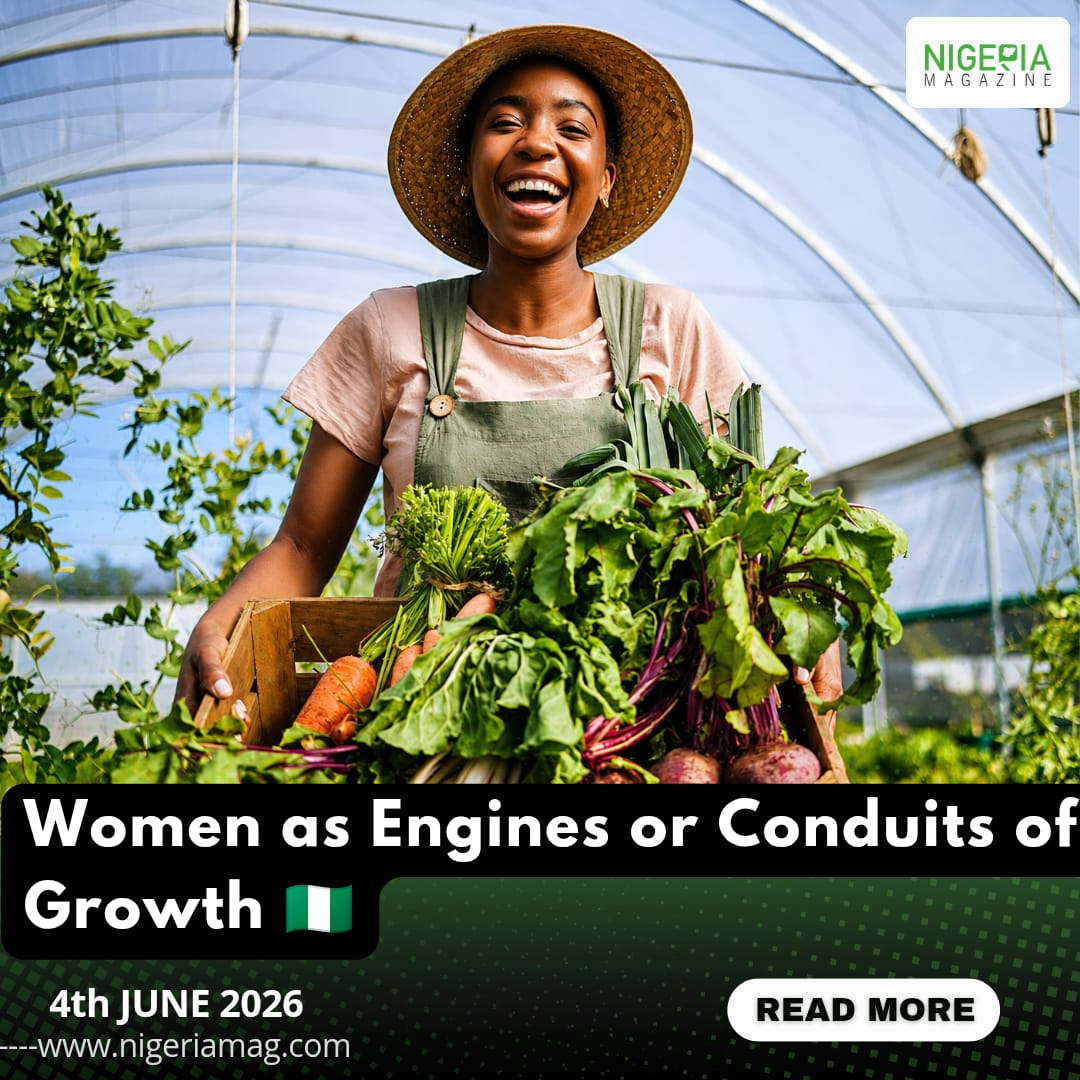
In the economic space, women are no longer just support systems; they are active drivers of innovation and productivity. Across Nigeria and many parts of Africa, women dominate informal trade, agriculture, and small-scale enterprise. These activities, though sometimes overlooked in formal statistics, are essential to local economies.
From market traders in Lagos to agripreneurs in rural communities, women ensure the circulation of goods, food security, and household income stability. Increasingly, they are also breaking into technology, finance, and leadership roles in both private and public sectors.
What is particularly striking is the resilience women bring into economic participation. Even in environments where access to capital, education, or policy support is limited, women continue to build enterprises, often reinvesting their earnings into family health and education. This reinvestment cycle strengthens long-term development outcomes in ways that are both direct and indirect.
Education as a Multiplier Effect
One of the most powerful ways women act as conduits of growth is through education. Educated women tend to educate others—especially their children and peers. The ripple effect is enormous.
When a girl is educated, she is more likely to delay early marriage, have better health outcomes, earn a higher income, and raise children who are also educated. This creates a generational chain of progress that extends far beyond the individual.
In communities where girls’ education is prioritized, poverty rates tend to decline over time. This is not coincidental. It reflects how knowledge, when placed in the hands of women, multiplies into broader social transformation.
Leadership and Decision-Making
Women are also increasingly present in leadership spaces, though not yet at equal representation globally. In governance, business, and civil society, their influence is reshaping priorities and policies.
Research consistently shows that when women are included in decision-making processes, outcomes tend to be more inclusive and socially balanced. Issues like healthcare, education, child welfare, and community development often receive greater attention.
However, leadership is not just about formal positions. Women lead informally every day—within families, religious communities, cooperatives, and grassroots movements. These forms of leadership may not always be documented, but their impact is deeply felt.
Cultural Expectations and the Weight of Roles
Despite progress, cultural expectations continue to shape how women’s contributions are perceived. In many societies, women are still expected to balance productivity with caregiving in ways that are rarely demanded of men.
This dual expectation often places a silent burden on women, where success is measured not only by professional achievement but also by domestic performance. Yet, rather than weakening their influence, many women navigate these pressures in ways that demonstrate remarkable adaptability.
It is important to recognize that the conversation is not about replacing one expectation with another, but about expanding opportunities so women can choose their paths without structural limitations.
Engines or Conduits? A False Separation
The framing of women as either engines or conduits may itself be limiting. An engine suggests active propulsion, while a conduit implies transmission. In reality, women embody both simultaneously.
They generate ideas, energy, and labor that drive growth forward, while also transmitting values, knowledge, and resources across generations. To separate these roles is to misunderstand the complexity of their contribution.
Perhaps a better way to see it is this: women are ecosystems of growth. They generate, sustain, and distribute development in ways that are interconnected and continuous.
Moving Toward Equity and Recognition
If societies are to fully benefit from the potential of women, then recognition must go beyond symbolism. It must be reflected in policy, access to education, healthcare, finance, and leadership opportunities.
Supporting women is not a charitable act; it is a developmental strategy. Economies grow faster and more sustainably when women are fully included. Communities become more stable. Families become more resilient.
The conversation, therefore, is not about whether women contribute to growth, but about how much more growth is possible when barriers are removed.
Women are not secondary actors in development. They are central to it. Whether in homes, markets, schools, or leadership spaces, their influence is woven into the fabric of society’s progress.
To describe them merely as engines or conduits is to attempt to contain something that is inherently expansive. Women are both—and more. They are the continuity of growth itself, shaping today while quietly building tomorrow.

