


By Ubong Usoro | Nigeria Magazine
Governance is measured by its impact on people’s lives. Beyond promises and policy announcements, effective leadership should translate into better roads, quality education, accessible healthcare, economic opportunities, security and improved living conditions.
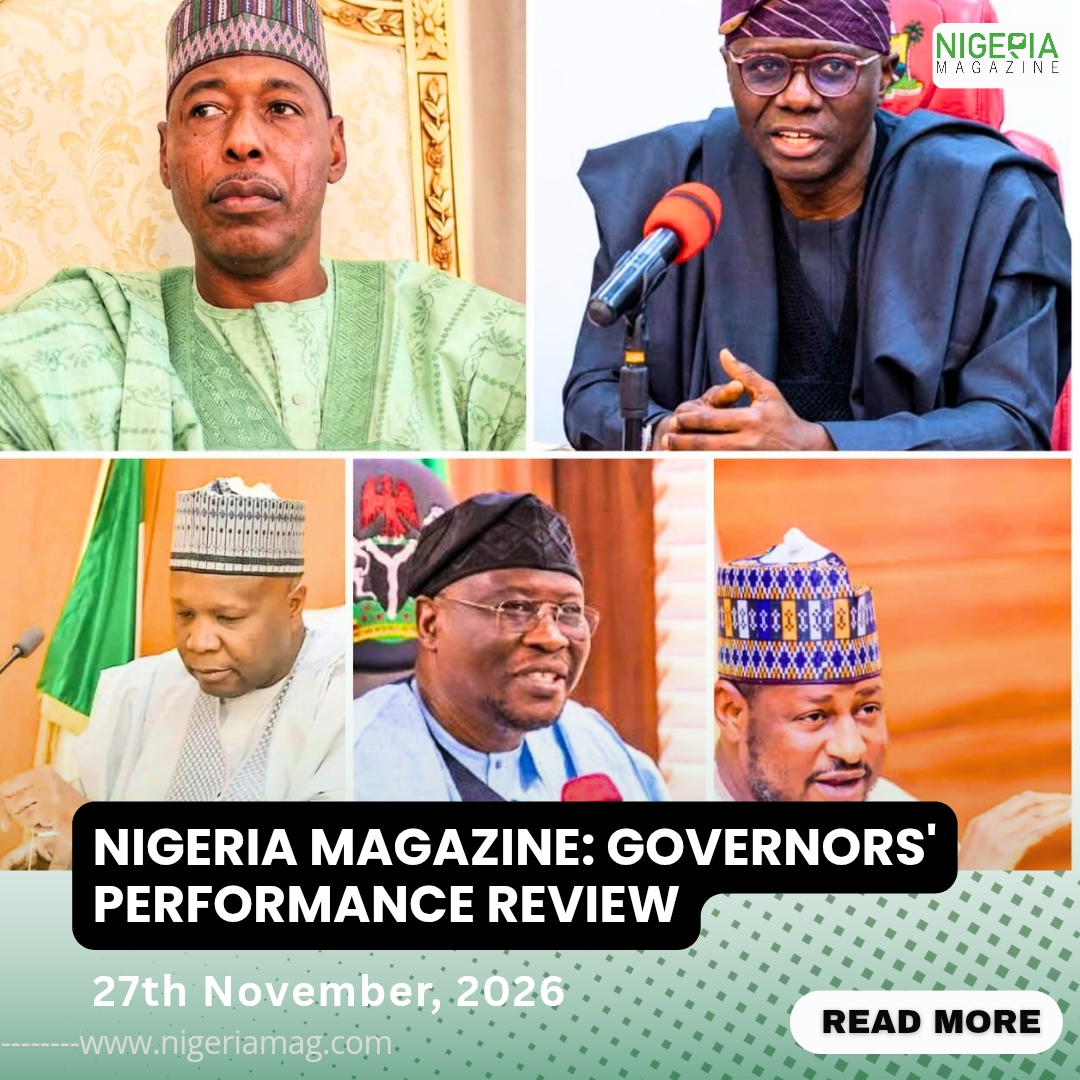
This review examines the performance of five governors: Babagana Umara Zulum of Borno State, Muhammadu Inuwa Yahaya of Gombe State, Malam Dikko Umaru Radda of Katsina State, Ahmadu Umaru Fintiri of Adamawa State and Babajide Sanwo-Olu of Lagos State, across key development sectors.
BABAGANA UMARA ZULUM – BORNO STATE
Governing Borno comes with the enormous challenge of rebuilding communities devastated by years of Boko Haram insurgency. Governor Babagana Zulum has made reconstruction, resettlement and restoration of public services central to his administration.
In education, the government reports constructing more than 104 schools and rehabilitating 2,931 classrooms. Other interventions include mega schools, 20 Higher Islamic Colleges, vocational institutions, scholarships and school feeding programmes supporting approximately 50,000 pupils annually.
In March 2026, about 3,000 trainees graduated from nine vocational institutions, receiving starter packs and entrepreneurship grants.
The administration also reports resettling approximately two million people and reconstructing more than 30,000 homes and public facilities.
Major infrastructure projects in Maiduguri include the West End Flyover, Sultan Mainalari, Bursari and Shehu Sanda Kura dual carriageways.
Healthcare investments include hospital rehabilitation, primary healthcare centres, the Borno State University Teaching Hospital and specialist facilities in Monguno.
However, insecurity, the number of children outside school and the economic reintegration of displaced residents remain major concerns. Zulum’s greatest test is ensuring that reconstruction translates into lasting peace and improved livelihoods.
MUHAMMADU INUWA YAHAYA – GOMBE STATE
Governor Inuwa Yahaya’s administration is guided by the Development Agenda for Gombe State (DEVAGOM), which focuses on infrastructure, education, healthcare and environmental sustainability.
One of its flagship projects is the Network 11-100 Road Initiative, designed to provide approximately 100 kilometres of roads in each of the state’s 11 local government areas.
In education, the government reports rehabilitating and constructing more than 2,000 classrooms across over 400 schools and integrating approximately 350,000 out-of-school children into formal education.
Healthcare interventions include the construction and renovation of 228 primary healthcare centres across 114 wards, upgrading of the Specialist Hospital in Gombe and expansion of the GoHealth insurance programme, which reportedly covers more than 400,000 beneficiaries.
Environmental sustainability is another priority through the Gombe Goes Green initiative, which addresses desertification, erosion and soil degradation. The state has also implemented erosion-control projects under the World Bank-supported ACReSAL programme.
While the administration has invested in infrastructure and human capital development, job creation, quality public services and equitable development across rural communities remain important measures of its performance.
MALAM DIKKO UMARU RADDA – KATSINA STATE
Governor Dikko Umaru Radda’s Building Your Future agenda places emphasis on education, healthcare, agriculture and security.
Education is among the administration’s biggest investments. Its three-year performance account published in May 2026 puts investment in the sector at over ₦120 billion. Reported achievements include 170 new junior secondary schools, rehabilitation of 300 schools, renovation of 150 primary schools and recruitment of 7,325 teachers.
The administration has also established three model smart schools in Radda, Jikamshi and Dumurkul, equipped with robotics and artificial intelligence laboratories.
In healthcare, the government reports upgrading 268 primary healthcare centres and establishing a 24-hour kidney dialysis centre at General Amadi Hospital, reportedly costing approximately ₦681 million.
Agriculture has also received attention, with the distribution of more than 400 tractors, 10 combine harvesters and 1,000 hand planters. The mechanisation programme represents an investment of approximately ₦21.8 billion.
However, persistent banditry and kidnapping remain major challenges. The security situation continues to affect farming, education and economic activities. Radda’s ability to restore safety to rural communities will be central to assessing his overall performance.
AHMADU UMARU FINTIRI – ADAMAWA STATE
Governor Ahmadu Umaru Fintiri’s Fresh Air Agenda has focused on infrastructure, education, healthcare and workers’ welfare.
One of his most visible projects is the Jimeta-Yola Unity Flyover, commissioned by former President Olusegun Obasanjo on May 29, 2024. The project comprises a flyover, underpass and connecting roundabout designed to ease traffic congestion.
Other road projects include the Maiha Township Road, Bachure Road and Mubi-Maiha Road, alongside developments in Numan, Michika, Hong and Yola South.
In education, the administration has established model schools across the state’s 21 local government areas, alongside investments in science and technical schools, teacher welfare and vocational training. The development of the Nigeria Law School Yola Campus is another notable achievement.
Healthcare investments include hospital upgrades and the handover of Cottage Hospital Hong and General Hospital Mubi to federal medical institutions in November 2024.
Fintiri also approved a ₦70,000 minimum wage in 2024 and introduced a 13th-month basic salary payment for civil servants in 2025.
The challenge ahead is sustaining these investments, improving rural access to public services and ensuring that infrastructure translates into broader economic opportunities.
BABAJIDE SANWO-OLU – LAGOS STATE
As Nigeria’s commercial centre, Lagos faces enormous pressure from population growth, traffic congestion, housing shortages, flooding and waste management.
Governor Babajide Sanwo-Olu’s administration has pursued the THEMES+ development agenda, with transportation, healthcare, education, technology and security among its priorities.
Transportation is one of the administration’s most visible areas of investment. The Lagos Blue Line commenced commercial operations in September 2023, while the first phase of the Red Line, connecting Agbado to Oyingbo, was commissioned in February 2024 and began passenger operations later that year.
Healthcare projects include the 80-bed Femi Gbajabiamila General Hospital, Lagos Medipark, improvements at Lagos State University Teaching Hospital and the development of specialist facilities such as Massey Children’s Hospital.
In education, the government has continued implementing the EKOEXCEL programme, alongside school rehabilitation, teacher development and digital learning initiatives.
Security interventions include support for security agencies, provision of equipment and vehicles, and investment in the Lagos State Security Trust Fund.
Despite these developments, traffic congestion, affordable housing, flooding and waste management remain significant challenges. The administration’s performance will depend on how effectively it addresses the demands of a rapidly growing megacity.
Zulum has focused on post-insurgency reconstruction, Inuwa Yahaya on infrastructure and environmental sustainability, Radda on education and agriculture, Fintiri on infrastructure and workers’ welfare, while Sanwo-Olu has prioritised transportation and urban development.
However, the real measure of governance goes beyond the number of projects commissioned or billions of naira reportedly invested.
Citizens want quality education, affordable healthcare, secure communities, employment opportunities, good roads and an environment that supports healthy living.
Ubong Usoro
Nigeria Magazine

