


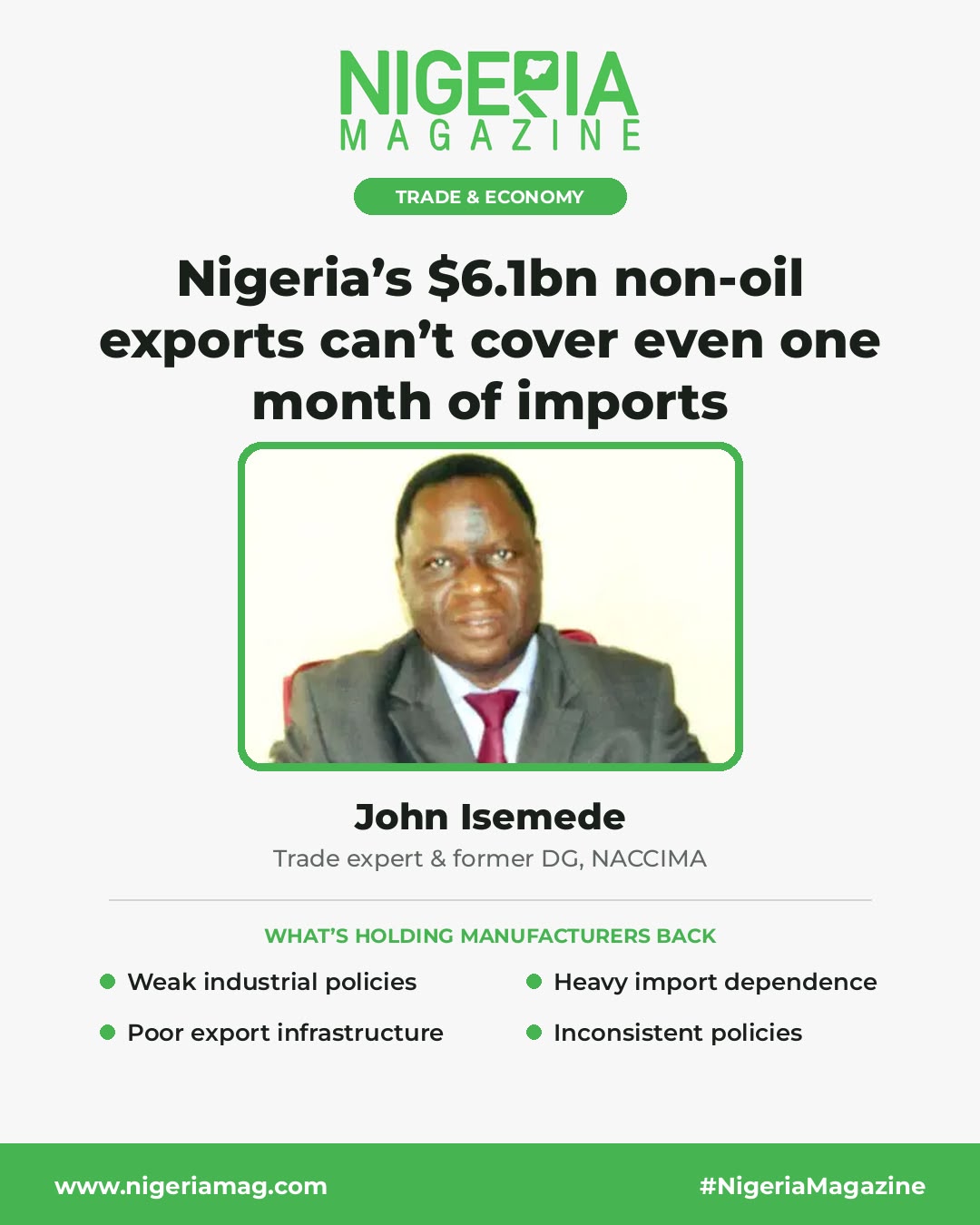
Nigeria’s manufacturers are not earning nearly what they should from international trade, and a leading trade expert says the causes are largely man-made. John Isemede, a former director general of the Nigerian Association of Chambers of Commerce, Industry, Mines and Agriculture (NACCIMA), points to weak industrial policies, heavy dependence on imports, poor export infrastructure and inconsistent government policies.
A trade imbalance with real consequences
Isemede said Nigeria’s persistent trade imbalance, with imports exceeding exports, has contributed to the country’s foreign exchange challenges and growing dependence on borrowing. He noted that annual non-oil export earnings of about $6.1 billion are not enough to cover even one month’s import bills, despite a population of over 240 million.
In his view, an import-dependent economy, no clear industrialisation roadmap and weak linkages among stakeholders continue to undermine local production and export competitiveness.
Policies that favour imports
Isemede criticised monetary and trade policies, arguing that they have failed to support local manufacturers. He lamented the lack of adequate incentives for domestic producers, noting that government policies appear to favour imports and established business interests.
He also pointed to the absence of a coordinated export value chain. He alleged that foreign operators dominate major export activities, while local manufacturers face barriers, including cartel-like practices.
Foreign exchange leakages
Isemede faulted the lack of effective monitoring of foreign exchange transactions, noting that substantial foreign currencies circulate outside the formal banking system. He added that Nigeria’s history of multiple exchange rates and restrictive foreign exchange and trade policies has pushed some exporters to route transactions through neighbouring countries, depriving Nigeria of potential foreign exchange repatriation.
Infrastructure and institutional gaps
The trade expert decried inadequate export infrastructure, particularly the absence of dedicated container terminals and border facilities to ease trade within the Economic Community of West African States (ECOWAS).
He also raised concerns about:
•	Policy instability and multiple taxation: along with the continued imposition of Nigerian Export Supervision Scheme (NESS) payments without matching improvements in export support systems.
•	The Export Expansion Grant (EEG): which he questioned, arguing that manufacturers need more practical incentives to compete internationally.
•	Outdated procedures: he described export procedures and documentation as largely unchanged for over four decades.
•	Weak human capacity: he said the absence of adequate training institutions and sustained capacity development has weakened exporters’ ability to meet international trade requirements.
A growing disconnect
According to Isemede, “The growing disconnect between government and organised private sector operators is another major obstacle. Businesses directly affected by trade agreements and policies are often excluded from critical decision-making processes.”
He also lamented the decline of trade promotion institutions, saying, “The decline of trade promotion institutions and support structures, including trade researchers, trade attaches in Nigerian embassies abroad and trade information officers, are essential for identifying opportunities and connecting local businesses to foreign markets.”
The way forward
Isemede believes Nigeria should learn from other economies. “Like China, Nigeria needs a deliberate strategy to develop foreign markets through its diplomatic missions and trade representatives.”
He called for a comprehensive economic roadmap that would address production constraints, strengthen export institutions, improve trade infrastructure and create a more supportive environment for local businesses.
Read more at www.nigeriamag.com
#NigeriaMagazine #NigeriaEconomy #NonOilExports #TradeNigeria #Manufacturing #MadeInNigeria #NACCIMA #ExportEconomy #ForeignExchange #ECOWAS #AfricaTrade #BusinessNigeria #NigerianManufacturers #EconomicPolicy

