


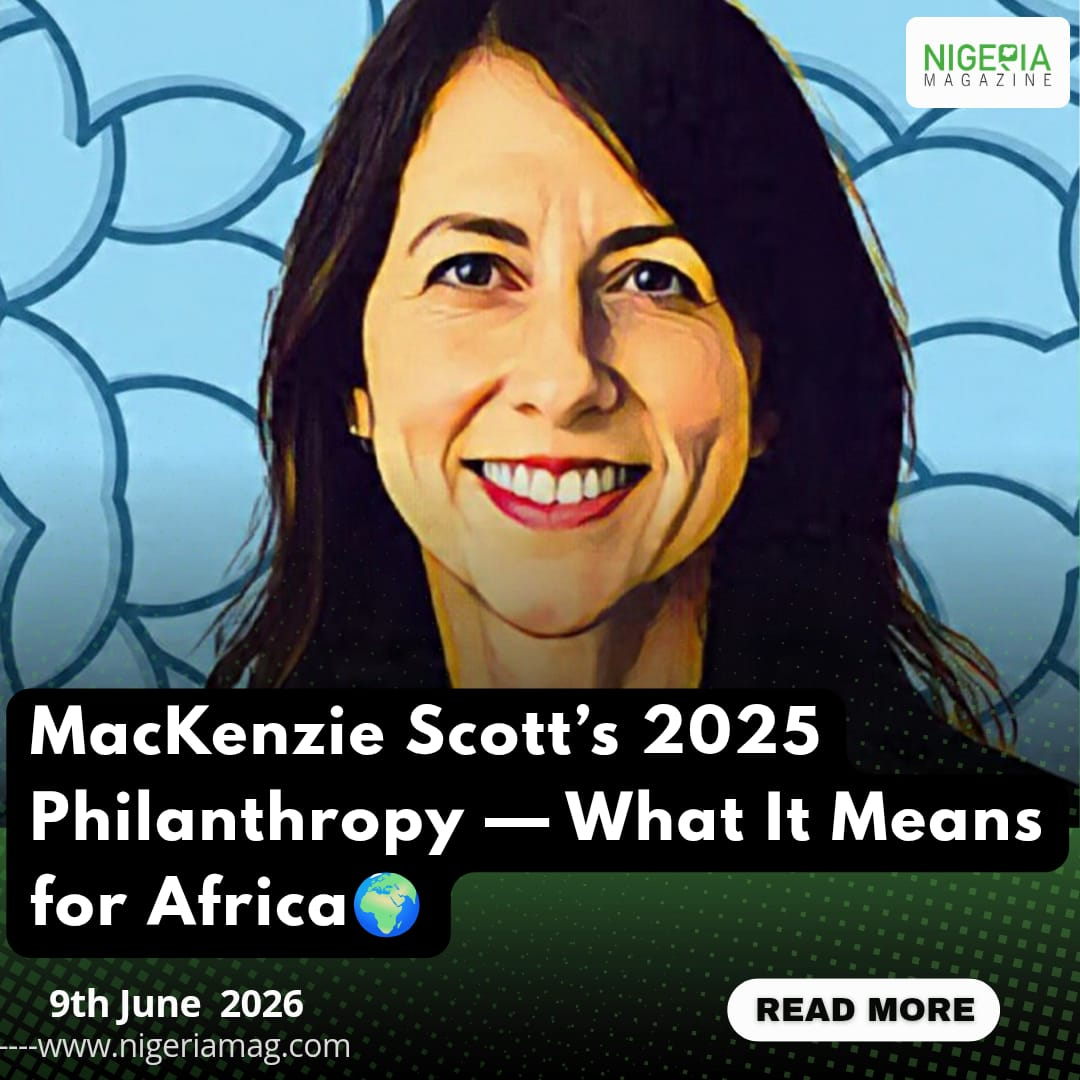
In 2025, MacKenzie Scott gave away $7.1 billion — her largest single year of giving since signing the Giving Pledge in 2019. Her vehicle, Yield Giving, has now distributed $26+ billion to 2,700+ nonprofits worldwide.
Africa’s Share: $1.5 Billion and Climbing
Scott’s total giving to African causes has now crossed $1.5 billion, up from $1.1B reported in July 2023. In 2025 alone, sub-Saharan Africa received the largest share of internationally focused grants, accounting for 25% of gifts directed outside the U.S.
Her Model: No Strings, High Trust
Scott’s method is unchanged: no applications, no reporting requirements, unrestricted gifts. Organizations are contacted without warning and given full autonomy over funds.
Where the Money Is Going in Africa:
- Girls’ Education + Economic Opportunity
CAMFED International received its 4th gift from Scott — $60 million in 2025, bringing total Scott funding to $105.5 million. CAMFED supports girls’ education in rural Africa and counts sustainable agriculture as one pillar of its work.
Educate! received a major investment toward its Vision 2025 plan to reach 400,000 new youth and 4x annual impact across Africa. With Scott’s gift, they’re nearly halfway to their $44M goal.
- Health Systems + Community Care
Amref Health Africa, based in Nairobi, received $50 million in 2021 and uses unrestricted funding to train health workers, strengthen clinics, and keep programs running when bilateral flows wobble.
- Climate, Agriculture & Restoration
Restore Local, One Acre Fund, myAgro, and Maliasili all received 2025 awards to scale climate restoration, smallholder agriculture, and conservation in sub-Saharan Africa.
Global Methane Hub got $60M to reduce methane emissions globally, with Africa as a key region.
Why This Matters:
Scott is betting on capacity over projects. Between 2019-2024, she deployed $385M across Sub-Saharan Africa in health systems, girls’ education, agriculture, research, and climate. Countries like Kenya, Ghana, Senegal, Rwanda, and Niger see the most activity — places where strong local institutions can absorb funds and work with governments.
Her 2025 essay urged donors to act in our “eleventh hour”. For Africa, that means funding groups already doing the work — and trusting them to do more.
What would change in development if more funders operated this way? What are the risks?

