


Exploring how sustainability, clean energy, innovation and responsible growth could redefine Nigeria’s economy while creating jobs, protecting communities and securing a better future for generations to come.
By Moses Chibuike Ezechukwu
The Economy We Inherited and the One We Need
For decades, economic growth has often been measured by how much a nation can produce, consume and export. The more industries expand and the more resources extracted, the stronger the economy appears on paper. Yet across the world, a difficult question is becoming impossible to ignore: what happens when growth comes at the expense of the environment that sustains life itself?
From devastating floods to rising temperatures, polluted waterways and worsening waste problems, the environmental cost of traditional development is becoming clearer. Nigeria is not exempt from these realities. Communities continue to battle erosion, deforestation, poor waste management and energy shortages, all while striving for economic prosperity.
This is where the idea of the green economy enters the conversation—not as an abstract environmental slogan, but as a practical economic model that aims to create wealth, generate jobs and improve living standards without destroying natural resources. It is an approach that asks a simple but powerful question: can economic growth and environmental responsibility exist side by side?
Increasingly, the answer appears to be yes.
What Exactly Is a Green Economy?
A green economy is an economic system designed to improve human well-being while reducing environmental risks. Rather than relying on wasteful production and heavy pollution, it prioritises renewable energy, resource efficiency, sustainable agriculture, cleaner transportation and responsible consumption.
Unlike the traditional “take, make and dispose” model, a green economy seeks to reduce waste and keep resources in use for as long as possible. This idea closely aligns with the circular economy, which emphasises recycling, reusing and redesigning products to minimise environmental damage. Nigeria’s growing interest in circular economic practices reflects the recognition that sustainability can also be economically beneficial.
A green economy is therefore not anti-development. If anything, it argues that long-term development becomes impossible when environmental systems collapse.
Why the Green Economy Matters to Nigeria
Nigeria stands at a unique crossroads. It is Africa’s most populous nation, home to a youthful population and one of the continent’s largest economies. At the same time, the country faces major energy deficits, unemployment challenges and increasing climate-related threats.
Rapid population growth means greater demand for electricity, transportation, housing and industrial production. Meeting those demands using outdated and highly polluting systems could deepen environmental problems while limiting future opportunities. Experts argue that Nigeria’s abundant renewable resources offer a pathway toward sustainable growth and improved energy access.
The conversation about the green economy is therefore not simply about saving trees or reducing emissions. It is about economic resilience. It is about ensuring that development today does not create impossible burdens for tomorrow.
Renewable Energy: Powering Growth Differently
Perhaps the most visible pillar of a green economy is renewable energy.
Nigeria receives significant sunlight throughout the year, giving it enormous solar potential. Wind, hydro and bioenergy also offer opportunities to diversify the country’s energy mix. Renewable energy is increasingly viewed not only as an environmental necessity but also as a tool for economic expansion, job creation and energy security.
This matters because electricity remains one of Nigeria’s biggest developmental challenges. Frequent power shortages continue to affect businesses, healthcare facilities, schools and households. Analysts have noted that decentralised solutions such as mini-grids and solar systems can complement existing infrastructure and expand electricity access, particularly in underserved communities.
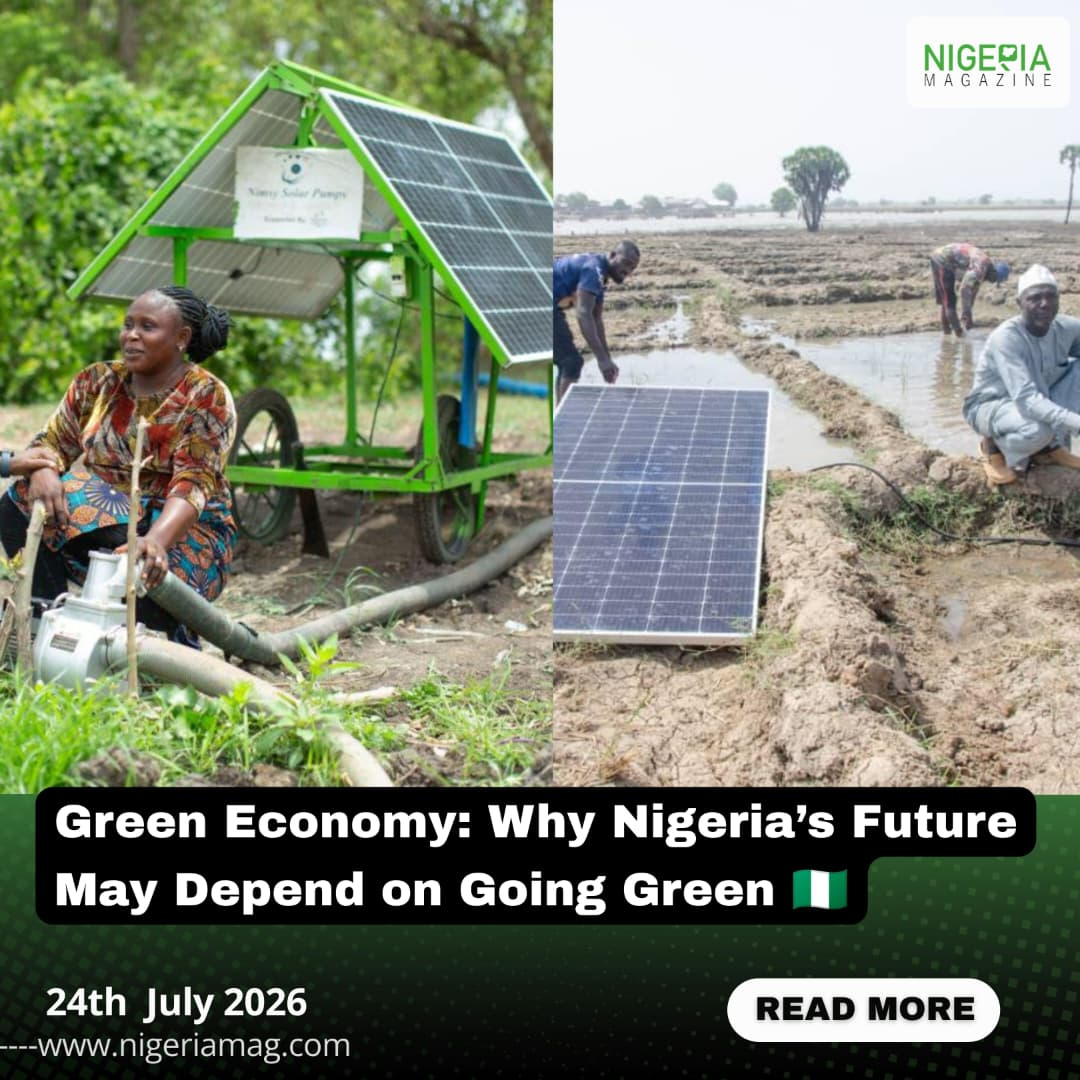
Across many parts of the country, small-scale solar installations are already creating opportunities for technicians, engineers, entrepreneurs and local businesses. Every new clean energy project has the potential to create not only electricity but also livelihoods.
Green Jobs and a New Generation of Opportunities
One of the strongest arguments for the green economy is employment.
Africa’s rapidly growing youth population requires millions of jobs in the coming years. Renewable energy, waste recycling, sustainable agriculture, electric mobility, green construction and environmental services are all sectors with significant employment potential. Reports indicate that the green economy could generate millions of jobs across Africa by 2030, with renewable energy expected to account for a large share of those opportunities.
For Nigeria, this presents an opportunity to equip young people with future-focused skills. Solar technicians, energy auditors, recycling specialists, climate researchers, electric vehicle engineers and sustainability consultants are professions that are becoming increasingly relevant.
The green economy is therefore not merely about environmental protection. It is also about preparing citizens for the industries of tomorrow.
Waste Is Not Always Waste
Nigeria’s waste management challenges are visible in many cities. Plastic pollution, open dumping and inefficient disposal systems have become familiar sights. Yet within a green economy, waste is often viewed as a resource waiting to be reused.
Agricultural waste can be converted into energy. Plastic can be recycled into new products. Organic waste can become compost or biofuel. Researchers have highlighted waste-to-energy systems as promising pathways for sustainability and resource efficiency within Nigeria.
This shift in mindset is transformative. Instead of seeing waste as the end of a product’s life, the green economy asks how materials can continue creating value.
For a country with a large population and an entrepreneurial culture, this represents both an environmental solution and an economic opportunity.
The Challenges Cannot Be Ignored
Despite its promise, transitioning to a green economy will not happen automatically.
Financing remains a major challenge. Green technologies often require substantial upfront investment. Policy inconsistency, infrastructure deficits and limited access to capital can also slow progress. Experts continue to stress the need for stronger financial mechanisms and supportive policies to accelerate the transition toward sustainable economic systems.
There is also the challenge of public awareness. Many people still see sustainability as a luxury rather than an economic necessity. Yet sustainability becomes far more compelling when discussed in terms of jobs, health, electricity, food security and economic resilience.
A Future Worth Building
History shows that every generation is shaped by the choices it makes during moments of transition. For Nigeria, the move toward a green economy could become one of those defining choices. Nigeria possesses abundant natural resources, a vibrant entrepreneurial spirit and a youthful population capable of driving innovation. Combined with strategic policies, investment and education, these strengths could position Nigeria as a leader in Africa’s sustainable future.
The green economy is not a perfect solution to every challenge. But it offers something increasingly valuable: a vision of progress that does not require sacrificing the environment for prosperity.
And perhaps that is the real promise of going green—not choosing between economic growth and environmental protection, but finally recognising that our future depends on both.

