


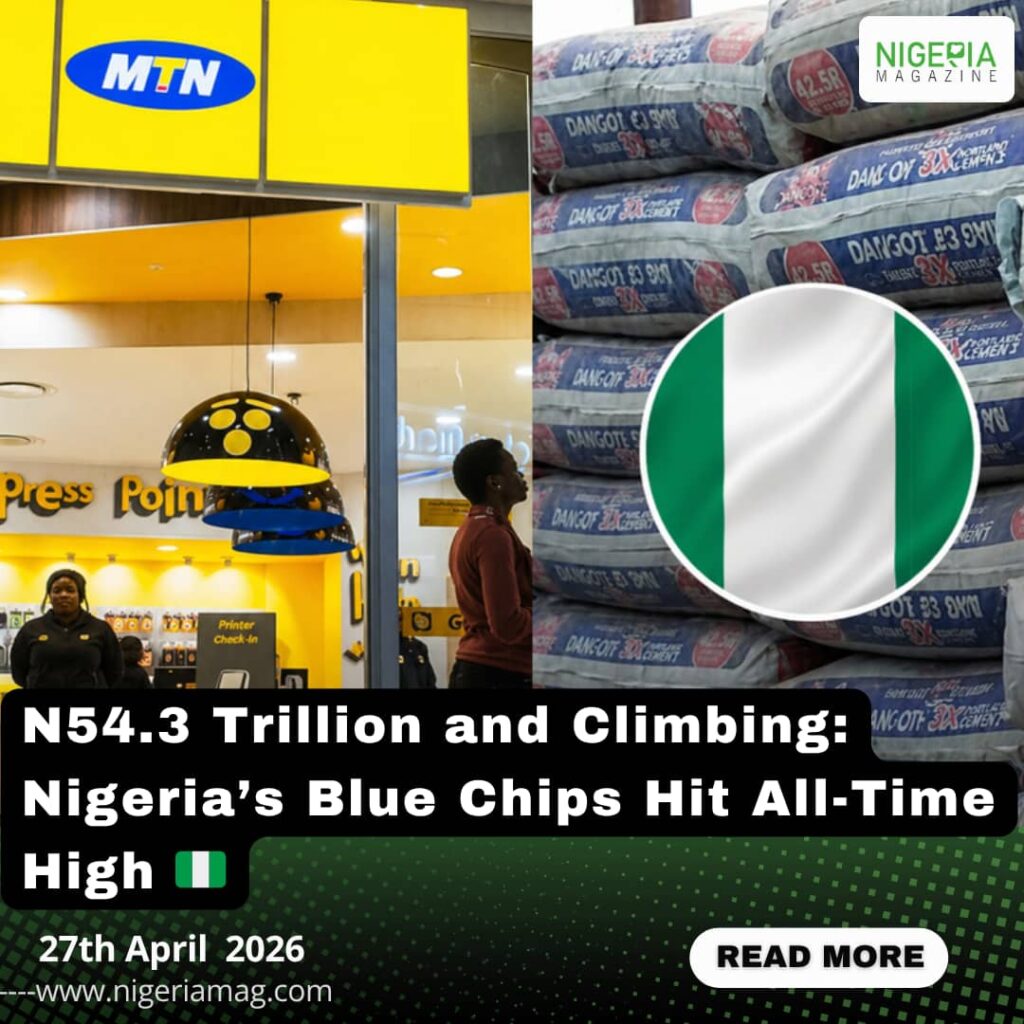
Nigeria’s capital market is sending a strong signal to global investors: confidence is back, and it is scaling fast. The valuation of premium board stocks on the Nigerian Exchange (NGX) has surged to an all-time high of ₦54.3 trillion, driven largely by blue-chip heavyweights across telecoms, banking, and energy.
At the center of this rally are industry leaders like MTN Nigeria, now the most valuable listed company, and Zenith Bank, which has crossed the historic ₦5 trillion market capitalization threshold; underscoring renewed investor trust in Nigeria’s financial system . This upward momentum reflects a combination of macroeconomic reforms, improved foreign exchange liquidity, and stronger corporate earnings performance.
The Drivers Behind the Rally
Nigeria’s equity surge is not happening in isolation. It is backed by structural shifts in policy and capital flows. Recent FX reforms have improved liquidity and reduced uncertainty for foreign investors, while monetary tightening has helped stabilize the naira. Together, these factors are repositioning Nigeria as a more predictable and investable market within emerging economies.
Blue-chip stocks; particularly in banking, telecoms, and energy; have become the anchor of this rally. These companies benefit from scale, strong balance sheets, and their strategic importance in Nigeria’s economic architecture. Notably, the concentration of market value among top companies highlights how institutional capital is flowing toward stability and proven performance.
Beyond Stocks: Energy Transition and Industrial Expansion
What makes this rally more compelling is the broader economic transformation happening alongside it; especially in energy, manufacturing, and infrastructure.
Nigeria is rapidly positioning itself as a renewable energy hub in West Africa. In 2025 alone, the country attracted approximately $425 million in investments to establish eight solar manufacturing plants, aimed at boosting local production and reducing dependence on imports. This shift is already increasing domestic solar capacity and driving exports to neighboring markets.
At the same time, solar manufacturing capacity has expanded significantly, with local assembly and production gaining traction under “Nigeria First” policies. The country is scaling toward a pipeline of about 3.7 gigawatts of solar projects, signaling a major push toward cleaner and more reliable energy.
Electrification efforts are also accelerating. Through initiatives like the Nigeria Electrification Project, the government is targeting underserved and rural communities, aiming to improve energy access and unlock productivity across sectors . A $750 million electrification programme is expected to catalyze over $1 billion in additional private sector investment, further deepening infrastructure development .
Manufacturing Momentum and Industrial Scale
Industrial growth is gaining pace, particularly with large-scale projects tied to energy and petrochemicals. Developments such as the expansion of petrochemical production at the Dangote refinery complex are expected to reduce import dependence while boosting local manufacturing capacity in plastics, detergents, and industrial inputs.
Simultaneously, major gas infrastructure like the Ajaokuta-Kaduna-Kano pipeline is set to power industrial corridors across northern Nigeria, supporting fertilizer production, manufacturing clusters, and power generation.
These developments point to a deeper structural shift: Nigeria is not just experiencing a stock market rally; it is building the industrial and energy backbone to sustain long-term economic growth.
The Bigger Picture
The ₦54.3 trillion milestone is more than a market statistic; it is a reflection of renewed confidence in Nigeria’s economic direction. As capital markets strengthen, and as investments flow into renewable energy, electrification, and manufacturing, the country is laying the foundation for a more diversified and resilient economy.
For investors, this signals opportunity. For policymakers, it reinforces the importance of sustaining reforms. And for Nigeria, it marks a pivotal moment where financial market performance and real-sector growth are finally moving in sync.
