


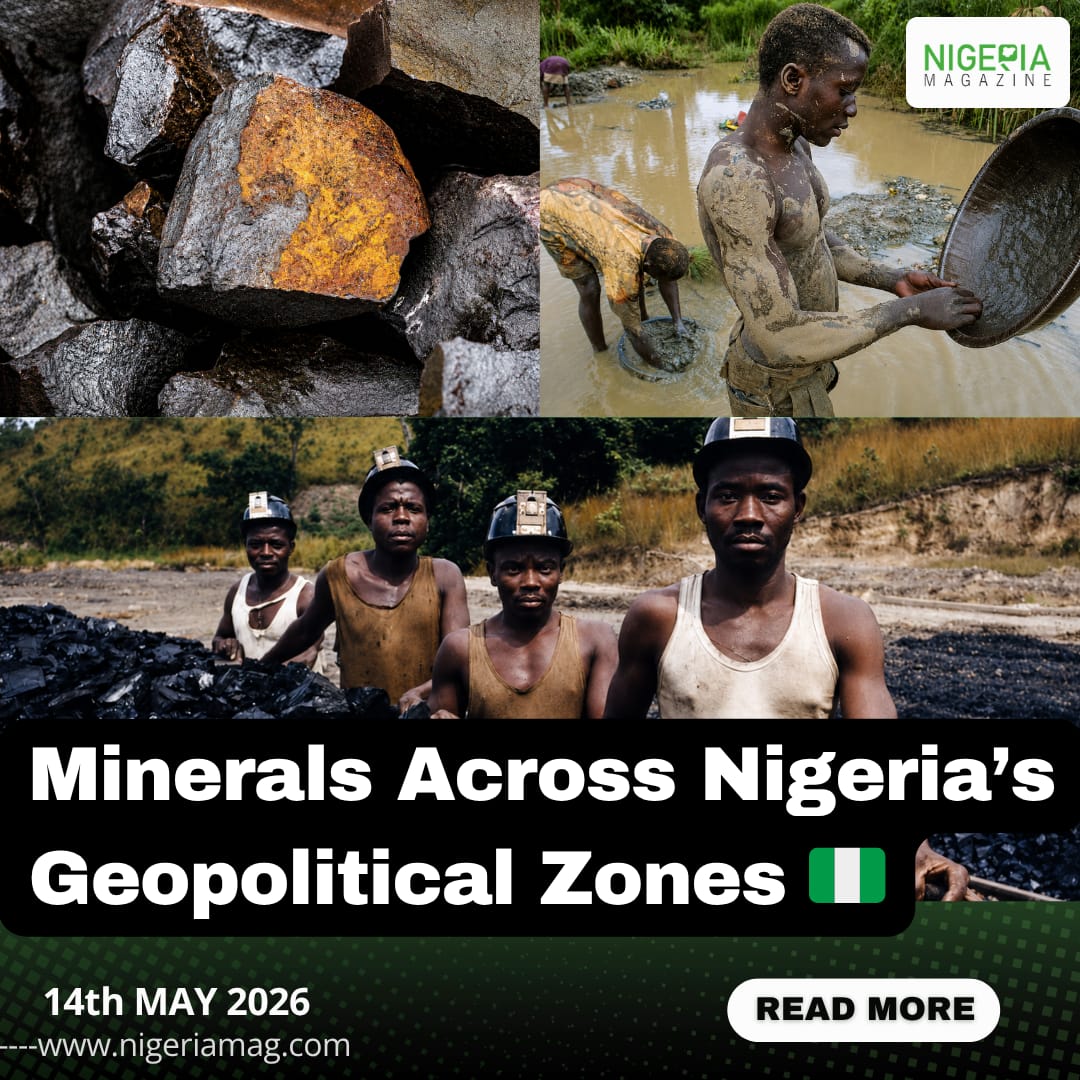
Nigeria is richly endowed with a wide range of solid minerals distributed across its six geopolitical zones. These resources, though still underexploited compared to crude oil, present significant opportunities for economic diversification, industrial development, and job creation. Understanding how these minerals are distributed across regions helps to highlight the country’s natural endowment and investment potential.
(1) North Central Zone: Nigeria’s Solid Mineral Powerhouse
The North Central region, often regarded as the “mineral heartland” of Nigeria, includes states such as:
Plateau
Nasarawa
Kogi
Benue
Niger
Kwara
Federal Capital Territory (Abuja)
This zone is particularly rich in:
Tin and columbite (Plateau State, historically Jos Plateau mining areas)
Iron ore (Kogi State – Itakpe iron ore deposits are among the most important in West Africa)
Gold (Niger and Kwara States, with artisanal mining activities)
Limestone and marble (Nasarawa and Kogi)
Baryte and coal (Nasarawa and Benue)
The North Central zone stands out because it hosts minerals essential for steel production and industrial manufacturing. If properly developed, it could serve as Nigeria’s industrial backbone.
(2) North East Zone: Emerging but Vastly Untapped Resources
The North East region includes:
Adamawa
Bauchi
Borno
Gombe
Taraba
Yobe
Despite security challenges in some parts, the region is highly mineralised.
Key minerals include:
Gypsum (Borno, Yobe, and Gombe – used in cement production)
Limestone (Bauchi and Gombe, supporting cement industries)
Uranium traces (Borno and Adamawa)
Kaolin and bentonite clay (Bauchi and Gombe)
Gold and gemstones (Taraba and Adamawa)
Rock salt deposits (notably in parts of the Lake Chad Basin area)
The North East holds strong potential for cement manufacturing and construction materials, which could drive reconstruction and infrastructure growth in the region.
(3) North West Zone: Agricultural Land Meets Industrial Minerals
The North West consists of:
Kano
Kaduna
Katsina
Kebbi
Jigawa
Sokoto
Zamfara
Major mineral deposits include:
Gold (Zamfara is particularly known for gold deposits, though mining has been historically artisanal and controversial)
Lead and zinc (Kaduna and Zamfara)
Limestone (Kano, Sokoto, and Kebbi)
Kaolin and gypsum (Sokoto and Jigawa)
Iron ore and manganese (Kaduna)
Silica sand (widely available across the region)
The zone’s mineral base supports construction, ceramics, and metallurgy industries. However, challenges such as illegal mining and environmental concerns have limited full-scale exploitation.
(4) South East Zone: Small but Strategic Mineral Deposits
The South East region comprises:
Abia
Anambra
Ebonyi
Enugu
Imo
While it is smaller in mineral diversity compared to northern regions, it has highly strategic resources.
Key minerals include:
Coal (Enugu – historically the backbone of Nigeria’s coal mining industry)
Lead and zinc (Ebonyi State, especially in Abakaliki axis)
Limestone (Abia and Ebonyi)
Natural gas and oil shale potentials (Anambra Basin)
Kaolin and clay deposits (Abia and Imo)
Enugu’s coal deposits were once central to Nigeria’s energy supply, and there is renewed interest in reviving coal for industrial energy use, though environmental considerations remain a concern.
(5) South South Zone: Nigeria’s Oil and Gas Hub with Solid Minerals
The South South region includes
Akwa Ibom
Bayelsa
Cross River
Delta
Edo
Rivers
It is best known for hydrocarbons, but also contains significant solid minerals.
These include:
Crude oil and natural gas (dominant resource across the region, especially Delta, Rivers, and Bayelsa)
Limestone (Edo and Cross River)
Clay and kaolin (Akwa Ibom and Rivers)
Silica sand (Cross River and Delta)
Lignite deposits (Delta State)
While oil dominates the region’s economy, solid minerals offer diversification opportunities, particularly in cement production and petrochemical industries.
(6) South West Zone: Industrial Minerals and Construction Materials
The South West comprises:
Lagos
Ogun
Oyo
Osun
Ondo
Ekiti
This zone is one of the most industrialised in Nigeria and benefits from abundant construction-related minerals:
Bitumen (tar sands) (Ondo State – one of the largest deposits in Africa)
Limestone (Ogun and Oyo – supporting cement industries)
Granite and feldspar (Oyo, Ogun, and Osun)
Clay and kaolin (Ekiti and Ondo)
Bituminous sandstone (Ondo)
Gold traces (Osun State – Ilesa axis)
Ondo State’s bitumen deposits alone are considered a potential game-changer for Nigeria’s road construction industry if fully developed.
Cross-Cutting Challenges Across All Zones
Despite Nigeria’s vast mineral wealth, several challenges affect optimal exploitation:
Illegal mining and artisanal operations
Environmental degradation
Inadequate geological data
Poor infrastructure in mining areas
Limited local processing capacity
Over-dependence on crude oil revenues
These issues have slowed the transformation of the solid minerals sector into a major revenue contributor.
Opportunities for Economic Transformation
If properly harnessed, Nigeria’s solid minerals can:
Drive industrialisation through local raw material supply
Create millions of jobs in mining and processing
Reduce dependence on oil revenue
Boost export earnings
Strengthen regional economic development
Each geopolitical zone holds unique mineral advantages that, if integrated into a national industrial strategy, could reposition Nigeria as a leading mining economy in Africa.
The distribution of minerals across Nigeria clearly shows that every geopolitical zone has something valuable to offer. From the tin fields of the North Central to the bitumen-rich soils of the South West and the oil-and-gas dominance of the South South, Nigeria’s mineral geography is both diverse and strategic.
What remains critical is not just discovery, but effective governance, investment in technology, and sustainable extraction practices that ensure long-term national benefit.

