


By Esosa Aihie | Nigeria Magazine
For most of its history, the House of Lords was a chamber of hereditary privilege. Black Britons were not part of that story until 26 March 1969, when the Trinidad-born cricketer and campaigner Learie Constantine became the first Black member. Lord Pitt of Hampstead followed in 1975. Today, a growing, if still small, group of Black men and women sit in the upper chamber of the UK Parliament, and their journeys carry real lessons for young people in Nigeria, across Africa and throughout the diaspora.
The trailblazers
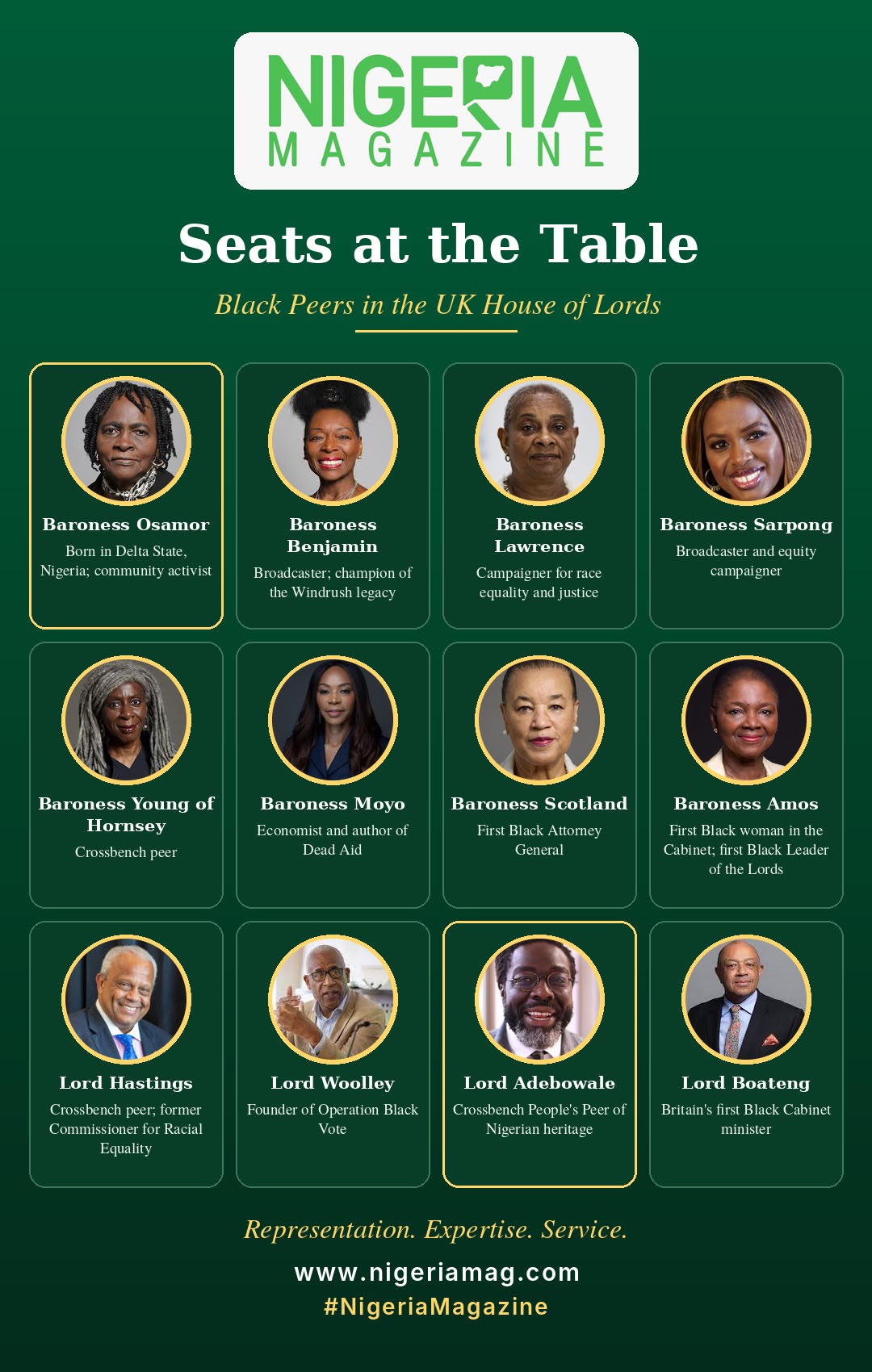
Baroness Amos was appointed a life peer in 1997, becoming the first Black woman in the Lords. In 2003 she became International Development Secretary, the first Black woman in the Cabinet, and later Leader of the House of Lords, the first Black person to hold that post. She went on to a distinguished career at the United Nations and, later, as Master of University College, Oxford.
Lord Boateng, of Ghanaian heritage, became Britain’s first Black Cabinet minister as Chief Secretary to the Treasury, before serving as High Commissioner to South Africa. In the Lords he has pressed for mandatory ethnic pay gap reporting and spoken on racial disparities in health.
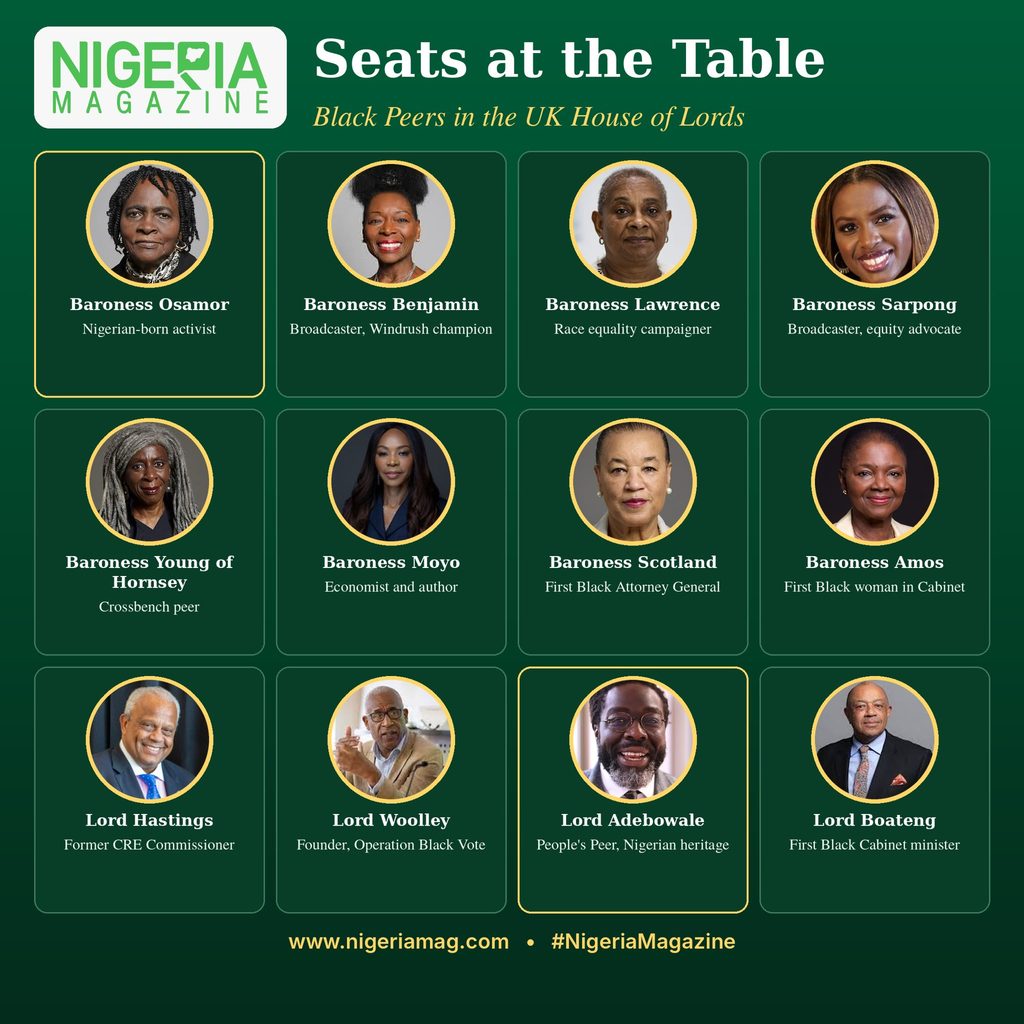
Baroness Scotland of Asthal was the first Black person and the first woman to serve as Attorney General, appointed in 2007.
The voices shaping debate today
Lord Adebowale, a crossbencher of Nigerian heritage, is one of the original “People’s Peers” and a leading voice on health, social care, homelessness and mental health. His career shows that expertise built in communities can carry real weight at the national level.
Baroness Osamor, born in Delta State, Nigeria, moved to Britain in 1963 and settled in Tottenham, where she became a community activist and civil rights campaigner. A founding member of the Broadwater Farm Defence Campaign and part of Labour’s Black Sections movement, she became a Labour life peer in November 2018. Her title, Baroness Osamor of Tottenham and of Asaba in the Republic of Nigeria, carries her Nigerian roots into the chamber itself.
Lord Hastings of Scarisbrick, Michael Hastings, has sat as a crossbench peer since 2005. A former teacher, he served as a Commissioner for Racial Equality for nine years, then led public affairs and corporate responsibility at the BBC and, from 2006 to 2019, served as KPMG International’s Global Head of Citizenship. He is Chancellor of Regent’s University London, Chair of the SOAS board of trustees, a Vice President of UNICEF and co-founder of the prisoner support network MyBrothersKeeper.
Baroness Moyo of Knightsbridge, the Zambian-born economist and author of Dead Aid, made her maiden speech in 2023 during the Spring Budget debate, bringing her global expertise on developing economies to Westminster.
Baroness Benjamin and Baroness Young of Hornsey continue to champion children’s online safety, the Windrush legacy and equality. Baroness Lawrence carries forward the legacy of her son Stephen Lawrence’s case, reshaping the conversation on race and justice, while Lord Woolley, founder of Operation Black Vote, has spent a lifetime pushing for Black political participation.
The most recent name to enter the conversation is June Sarpong, the broadcaster and equity campaigner of Ghanaian heritage, who was named in a recent peerage list as Baroness Sarpong of Walthamstow. Her path from television to Parliament is a reminder that influence can be built in many fields.
What their presence means
- Representation makes ambition imaginable. A child who sees a Black woman lead the Lords or a Black economist address the chamber learns that these spaces are not closed to them. The advice “you can be anything” lands very differently when there is a face to attach to it.
- Diverse voices change what gets asked. Pay gap reporting, health inequalities, online safety, racial justice and global development are all issues that these peers have brought to the floor. When people with lived experience are in the room, the questions in the room change.
- Different routes to the top. Politics, broadcasting, economics, the third sector, law, diplomacy: the peers named here took different roads. Young Nigerians who are not sure politics is “for them” can see that public service welcomes many kinds of talent.
- The diaspora connection. For a Nigerian teenager in Lagos or a British-Nigerian student in Peckham, peers like Lord Adebowale and Baroness Osamor, who was born in Delta State, show that heritage and national belonging can sit together. Their success reflects the contributions of Africa and the Caribbean to British life, and it strengthens the ties between those communities.
The work that remains
The picture is not one of complete progress. One press report put Black peers at only 12 of some 794 sitting members, and campaigners have criticised omissions from peerage lists. The Lords is also changing as hereditary peers leave and new life peers arrive, so there is an opening to widen the chamber. Representation should not mean a few exceptional individuals carrying the whole burden of an entire community.
A message to young readers
The peers profiled here did not wait for permission. They built expertise, stayed rooted in their communities and said yes when the door opened. For the next generation, the lesson is plain: prepare, persist, and take your seat. Then hold the door open for someone behind you.
What Black leaders inspire you?
Share your thoughts with Nigeria Magazine.

