


Nigeria Magazine, Defence Strategy Desk
While Russia spends its defence billions on legacy hardware, a Ukrainian startup just proved that a warehouse, some scrap metal and sharp engineering can hit just as hard.
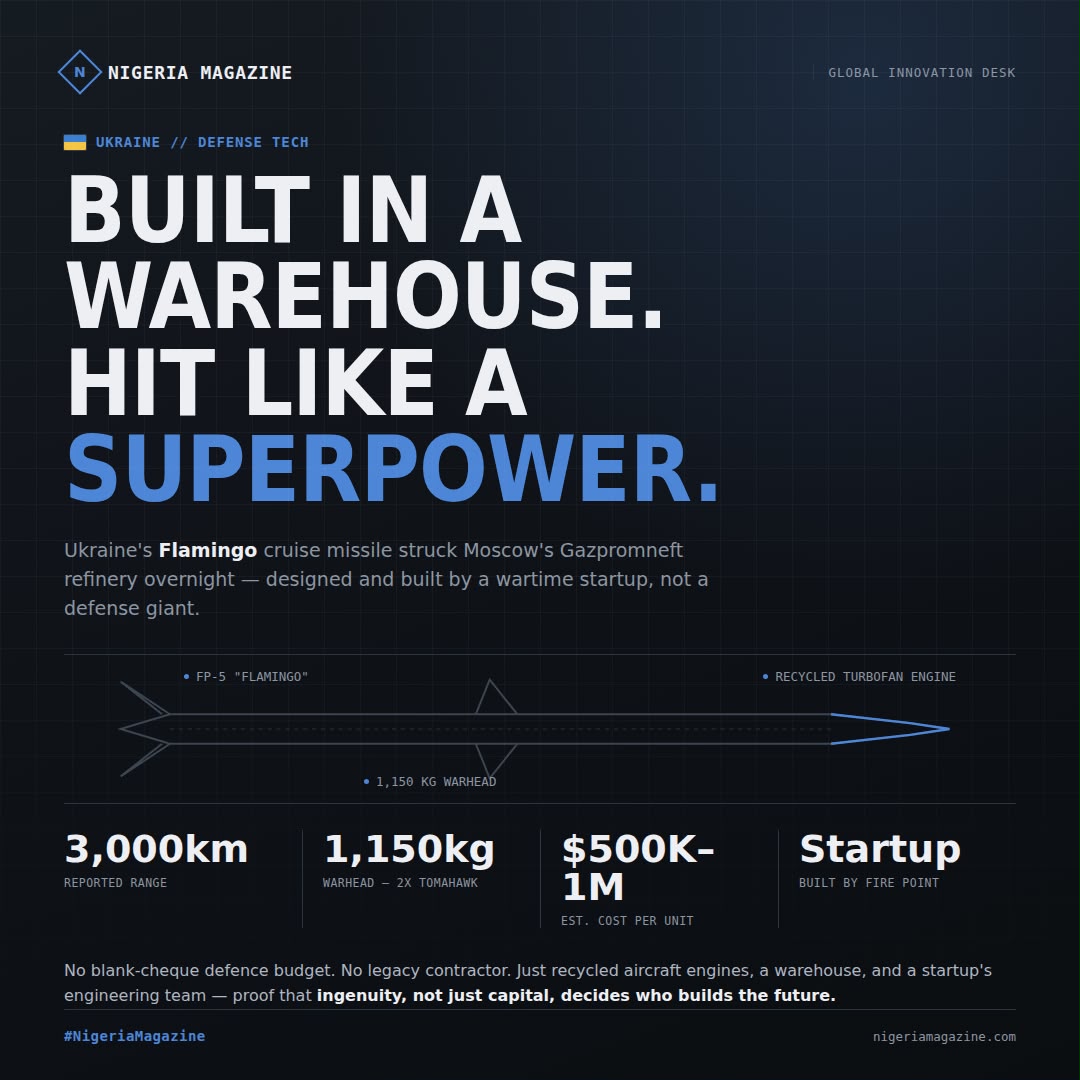
In an overnight strike, Ukraine’s domestically built Flamingo cruise missile — officially the FP-5 — slammed into Moscow’s Gazpromneft oil refinery, one of Russia’s largest fuel-processing sites. It was part of a broader barrage described by Moscow’s own mayor as the largest assault on the capital since the war began.
What makes the Flamingo remarkable isn’t just that it flew roughly 3,000 kilometres to reach its target. It’s what’s inside it. The missile carries a warhead of up to 1,150 kilograms — more than double the payload of an American Tomahawk cruise missile, long considered the gold standard of precision strike weapons.
And the price tag is where the story gets even more interesting. Reports put the Flamingo’s cost at roughly $500,000 to $1 million per unit — a fraction of what comparable Western munitions cost. The missile is built by Fire Point, a Ukrainian defence startup, using recycled Soviet-era turbofan engines pulled from aging aircraft, paired with a carbon-fibre fuselage that reportedly takes just hours to manufacture.
No decades-long procurement cycle. No sprawling defence-industrial complex. Just a wartime economy solving a wartime problem with whatever it could get its hands on — and building something that, on paper, out-punches machines developed by the world’s best-funded militaries.
It’s a case study in constraint-driven innovation. When you can’t out-spend your opponent, you out-think them. Fire Point didn’t have the luxury of a Pentagon-sized budget, so it built around what was available: old engines, cheaper materials, and a relentless focus on function over polish.
There’s a broader lesson here — for defence, for tech, for any industry watching from the sidelines. Budget has always been treated as the ultimate advantage. Ukraine is quietly making the case that resourcefulness, urgency and a willingness to improvise might matter just as much.
A new world order isn’t just being fought on the battlefield. It’s being built in warehouses.

