


Nigeria Magazine | Travel & Economy | By Esosa Aihie
Friday, 6 November 2026, Lower Manhattan, New York City
They say money never sleeps in New York. On Friday 6 November, it did not even stop for the rain.
I arrived in Lower Manhattan under a heavy grey sky, umbrella in one hand and a shopping bag in the other. The cobblestones were slick, the scaffolding dripped, and the pavements were a moving forest of umbrellas. Yet the energy of the place was unmistakable. This is the few square blocks where the American economy, and a good part of the global one, takes its daily pulse. I came to see it for myself, and to ask what it means for a reader in Lagos, Abuja or Port Harcourt.
Wall Street: A Name That Became a Verb
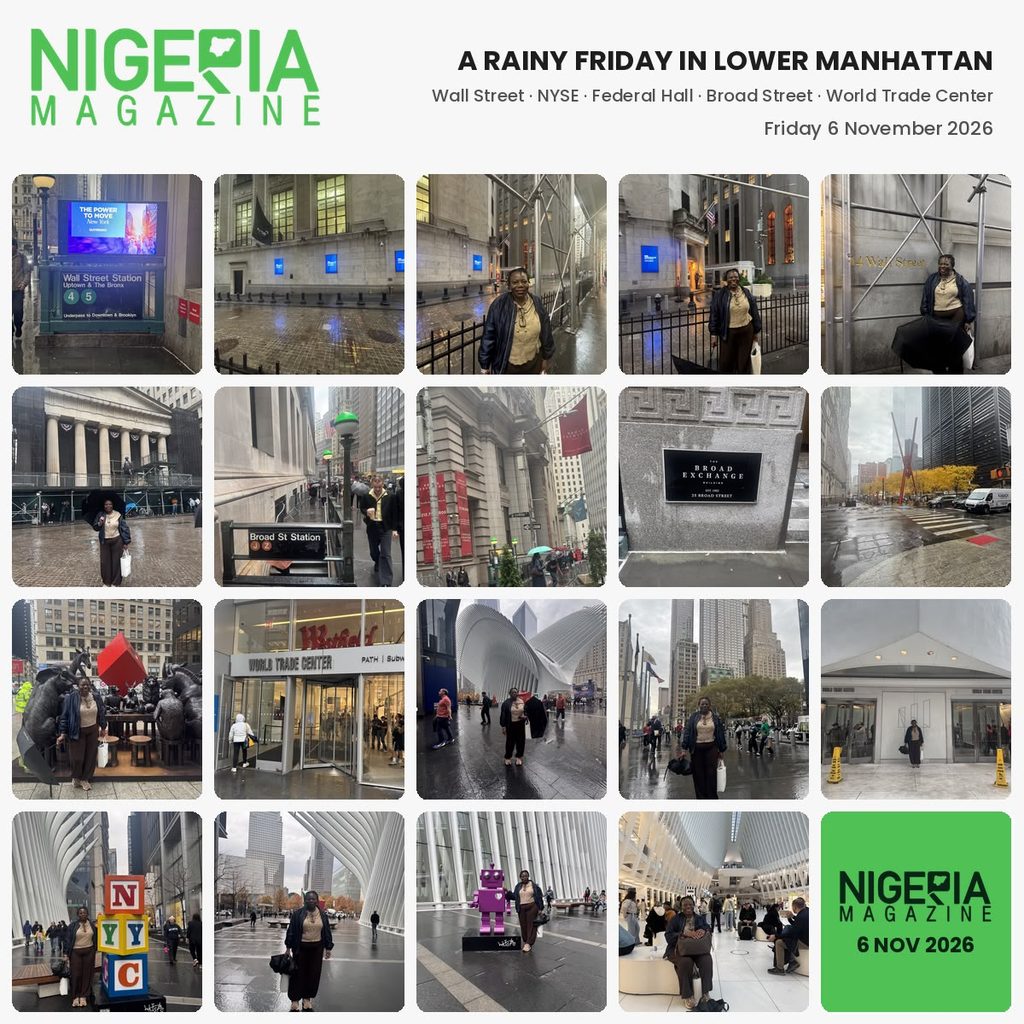
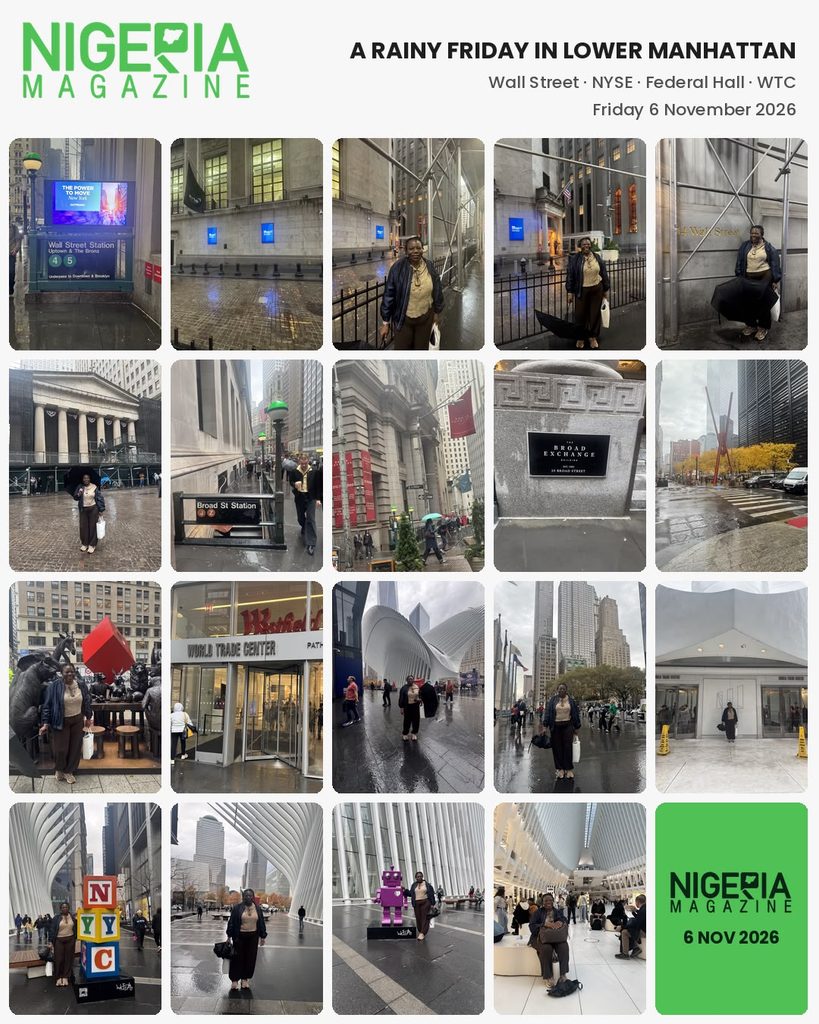
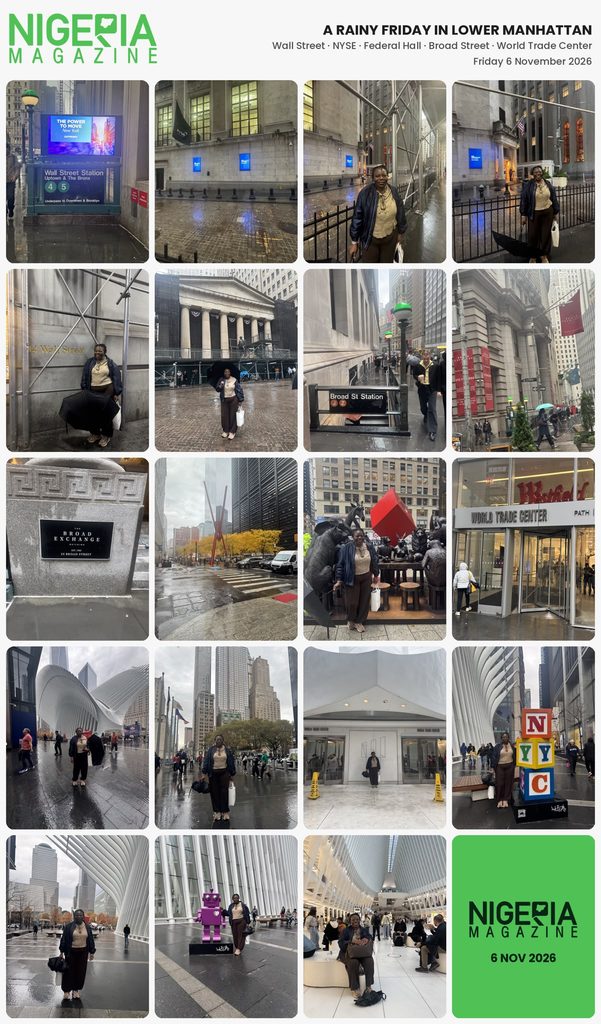
My first stop was the Wall Street subway station, its green lamp posts and old-fashioned signage unchanged by time, with a bright digital advertisement above it reading The Power to Move New York. It felt like a fitting slogan. Down these steps, thousands of workers, traders, tourists and dreamers travel every day.
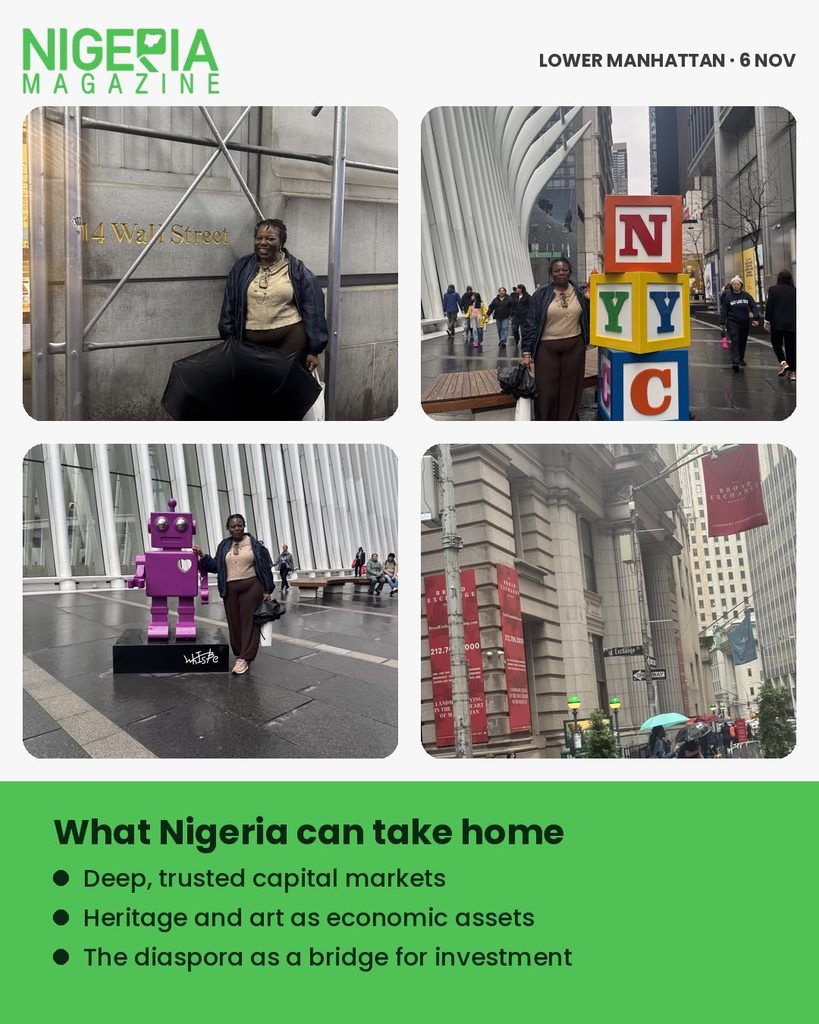
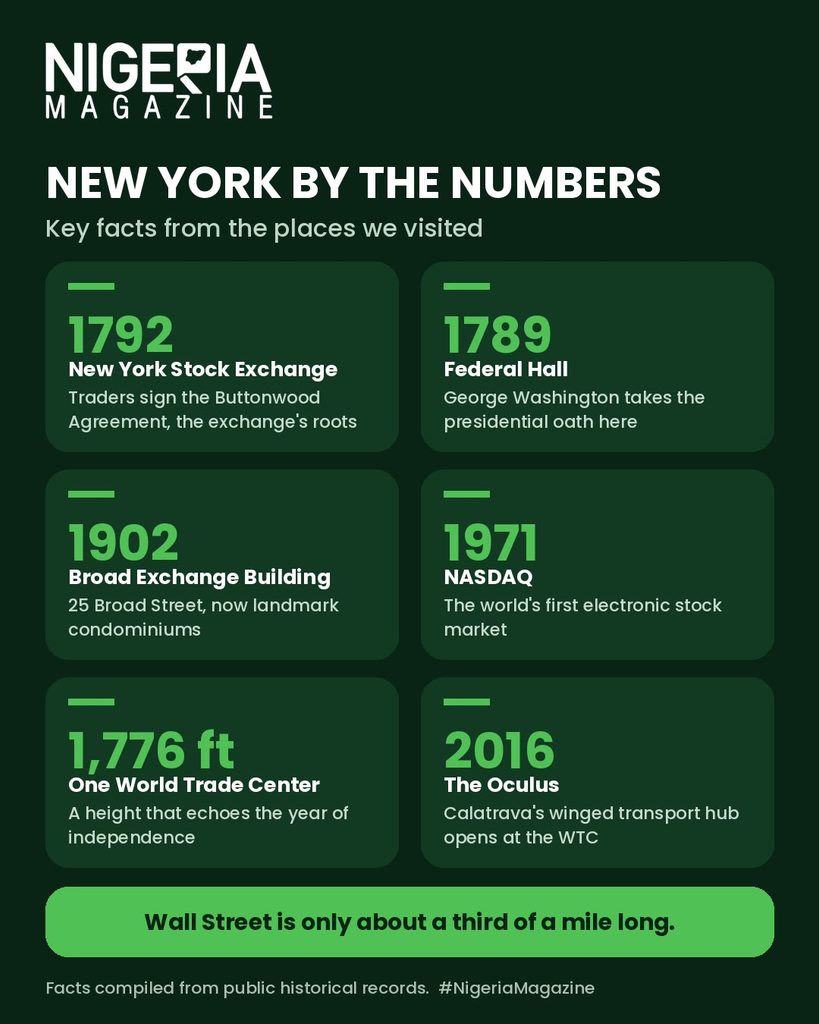
The street itself takes its name from a defensive wall built by Dutch settlers in the seventeenth century. Today it is only about a third of a mile long, yet “Wall Street” has become shorthand for the entire American financial system. I stood beside the gold-lettered number on the granite facade of 14 Wall Street, wrapped in scaffolding, and posed for a photo that I will treasure. A street that small, carrying that much weight in the world, is a lesson in itself.
The New York Stock Exchange: Capitalism’s Cathedral
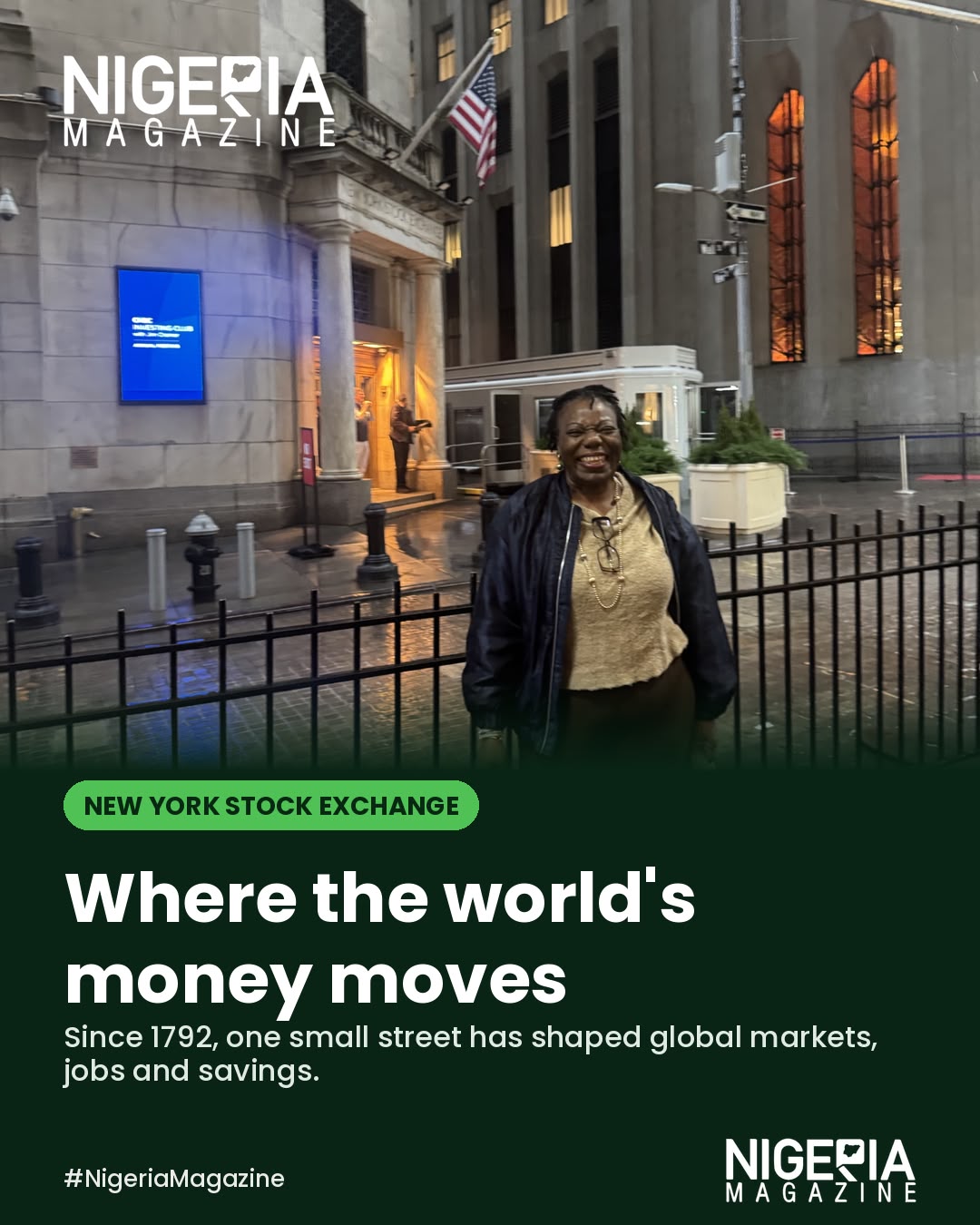
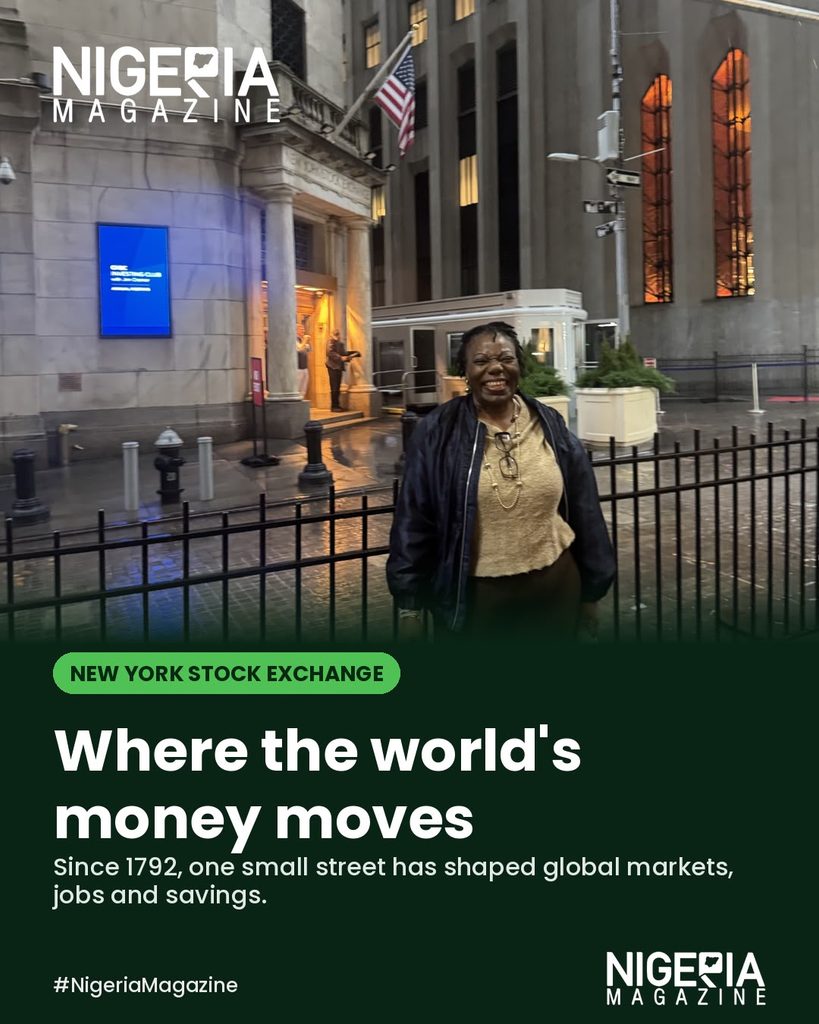
The New York Stock Exchange, with its classical columns and flag-draped front, is the beating heart of the district. Its roots go back to 1792, when a group of brokers agreed under a buttonwood tree to trade securities together. More than two centuries later it remains one of the largest exchanges on earth by the value of the companies listed on it.
On the day of my visit, large screens along its marble walls displayed a CNBC Investing Club annual meeting message, a reminder that finance here is not just business, it is also media, education and entertainment. Security barriers and black bollards line the street, a sober reminder that this address is also a symbol that must be protected. Through the rain I watched staff stepping in and out of the lit entrance beneath the famous pediment, and I could not help smiling at how ordinary it all looked for a place where decisions move billions.
Federal Hall: Where Politics Met Money
Just across the street stands Federal Hall, its Greek-style columns draped with patriotic bunting, and the bronze statue of George Washington standing before it. This is the site where Washington took the oath as the first President of the United States in 1789. Even with scaffolding hugging parts of the building during restoration, the message was clear: in America, government and markets were born as neighbours, and they have been negotiating with each other ever since.
Broad Street and the Broad Exchange Building
A short walk brought me to Broad Street, where the Broad Street subway station, serving the J and Z lines, sits beside the Exchange. Nearby is the Broad Exchange Building at 25 Broad Street, established in 1902. Its ornate stonework and Greek-key patterns show how seriously the early financiers took their image. Once a hub for brokers and traders, it now advertises landmark condominiums, an example of how Lower Manhattan has evolved from a purely commercial district into a place where people also live, eat and raise families.
Small details tell the story of a living neighbourhood: a pizza sign advertising two cheese slices, bars and restaurants tucked into historic buildings, and workers in coats hurrying for lunch. A financial district is not only about banks. It is also about the street vendors, cooks, cleaners, security officers and transport workers who keep the system running.
Zuccotti Park and the Art of the City
In Zuccotti Park, the autumn trees glowed gold against dark glass towers, with a bold red steel sculpture rising above them. Nearby stood Isamu Noguchi’s famous Red Cube, balanced on its corner outside a glass office building, and a remarkable bronze installation of animals seated around a banquet table. I joined them for a photograph, a grinning visitor among lions, zebras and elephants.
This is a quiet but important point. New York uses art and public space to soften the hard edges of finance. Culture and commerce here are partners, not rivals, and tourists come as much for the sculpture and architecture as for the stock tickers.
The World Trade Center and the Oculus
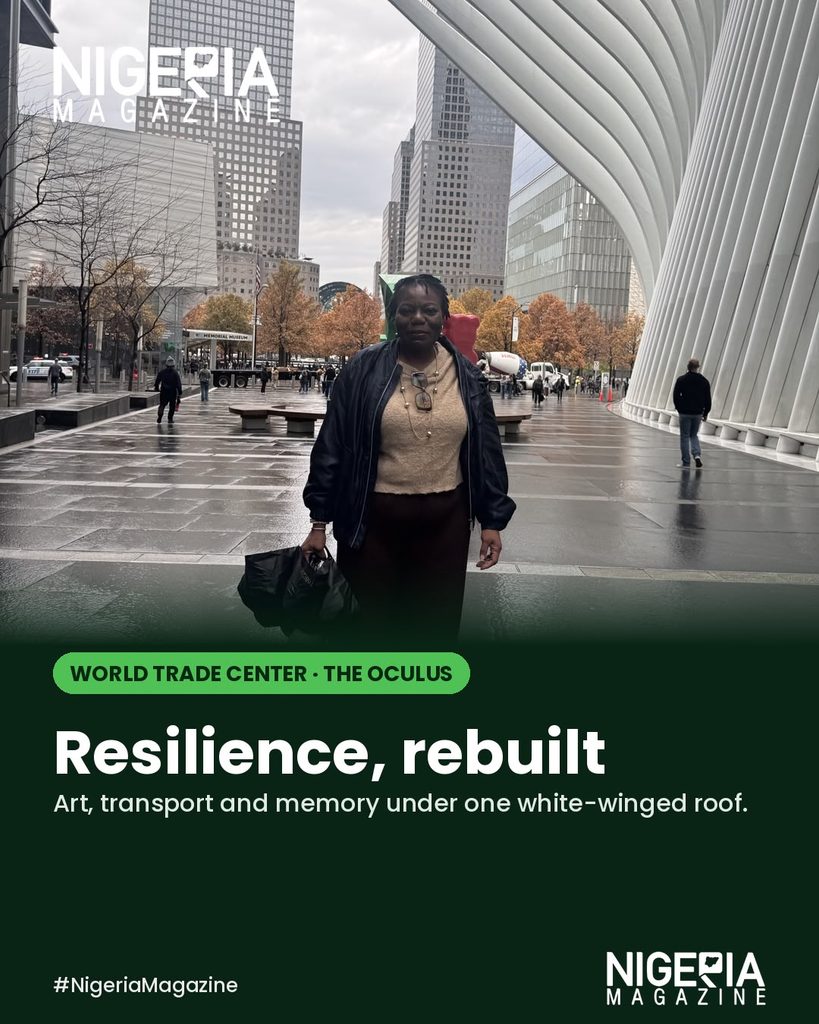
My day ended where New York’s resilience is most visible: the World Trade Center. The white ribs of the Oculus, designed by Santiago Calatrava, rise like the wings of a bird about to take flight. Inside, the vast hall is filled with commuters, shoppers and visitors, linking the PATH trains, the subway and the Westfield shopping centre. Outside, the 9/11 Memorial Museum sign and One World Trade Center, standing at a symbolic 1,776 feet, remind every visitor of the cost of the attacks of 2001 and of the city’s determination to rebuild.
Here too I found playful street art, including a giant colourful NYC alphabet block sculpture and a purple robot with a heart, both signed by the artist Whisbe. After a morning of heavy history, the laughter of children posing beside them was a welcome surprise. I rested on one of the Oculus’s curved white benches, a bag of memories at my feet, and watched the world go by.
NASDAQ and the Electronic Age
No story of Manhattan’s markets is complete without NASDAQ. Founded in 1971 as the world’s first electronic stock market, it is headquartered in Times Square and is the home of many of the technology companies that define our daily lives. Where the NYSE represents tradition and the trading floor, NASDAQ represents screens and speed. Together they show how American finance blends old and new, and how innovation is rewarded with capital.
What This Means for the Economy
For the city. Finance, insurance and real estate generate a significant share of New York City’s jobs and tax revenue. That money pays for subways, schools, parks and the sort of public art I enjoyed on my walk.
For the state and the country. New York State depends heavily on Wall Street’s health, and the United States depends on it for raising capital. Pension funds, start-ups, factories and homebuyers all rely on markets that function well. When Wall Street sneezes, Main Street often catches a cold.
For the world. The US dollar, American bond markets and the major exchanges anchor global trade. Prices of oil, cocoa, currencies and technology shares are all influenced by decisions in these few blocks. That is why it is fair to say that America’s economic pulse is, in many ways, the world’s pulse.
Tourism and Culture: Money Meets Memory
Even on a wet Friday, the streets were full of visitors photographing the Exchange, Federal Hall and the Oculus. Tens of millions of people visit New York every year, and Lower Manhattan is among their favourite stops. Hotels, restaurants, guides, shops and transport all benefit. The lesson is that heritage, history and a strong brand can become an economic engine in their own right.
Lessons for Nigeria
As a Nigerian standing on those wet cobblestones, I could not help drawing comparisons.
- Deep capital markets create opportunity. The Nigerian Exchange in Lagos is our own gateway for businesses to raise money. Strengthening investor confidence, transparency and the range of companies listed can help it play a greater role in our growth.
- Preserve and present our heritage. America turns even a statue, a building plaque and an old subway sign into an attraction. Nigeria has remarkable history, from ancient Benin and Nok to the Lagos waterfront, and it deserves the same care and storytelling.
- Invest in public spaces and transport. The Oculus is a transport hub that also became a tourist destination. Good infrastructure serves residents and visitors alike.
- The diaspora is part of the story. Many Nigerians work, trade and invest in places like this, and the money they send home supports families and businesses across our country. Connecting that talent and capital to opportunities at home remains one of our best chances.
Final Thoughts
America earns the description of a big country not simply because of its size, but because of the confidence with which it joins ambition, rules, art and history in the same few city blocks. On a rainy Friday, with water running along the gutters and umbrellas knocking together, Wall Street felt less like a fortress of money and more like a place of people: workers, tourists, vendors, artists and dreamers, all drawn to the same promise.
I left Lower Manhattan wet, tired and inspired. The world’s economic pulse is not found only in numbers on a screen. It is also in the footsteps of ordinary people moving through the rain, believing tomorrow will be better than today.
Have you visited Wall Street or the World Trade Center? Share your experience and photos with Nigeria Magazine in the comments.
#NigeriaMagazine #WallStreet #NewYorkCity #NYC #NYSE #NewYorkStockExchange #WorldTradeCenter #Oculus #LowerManhattan #FinancialDistrict #TravelBlog #NigerianTravellers #NaijaAbroad #NigeriansInAmerica #DiasporaStories #EconomyAndCulture #RainyDayInNYC #ExploreNYC #TravelWriter #AfricaToTheWorld

