


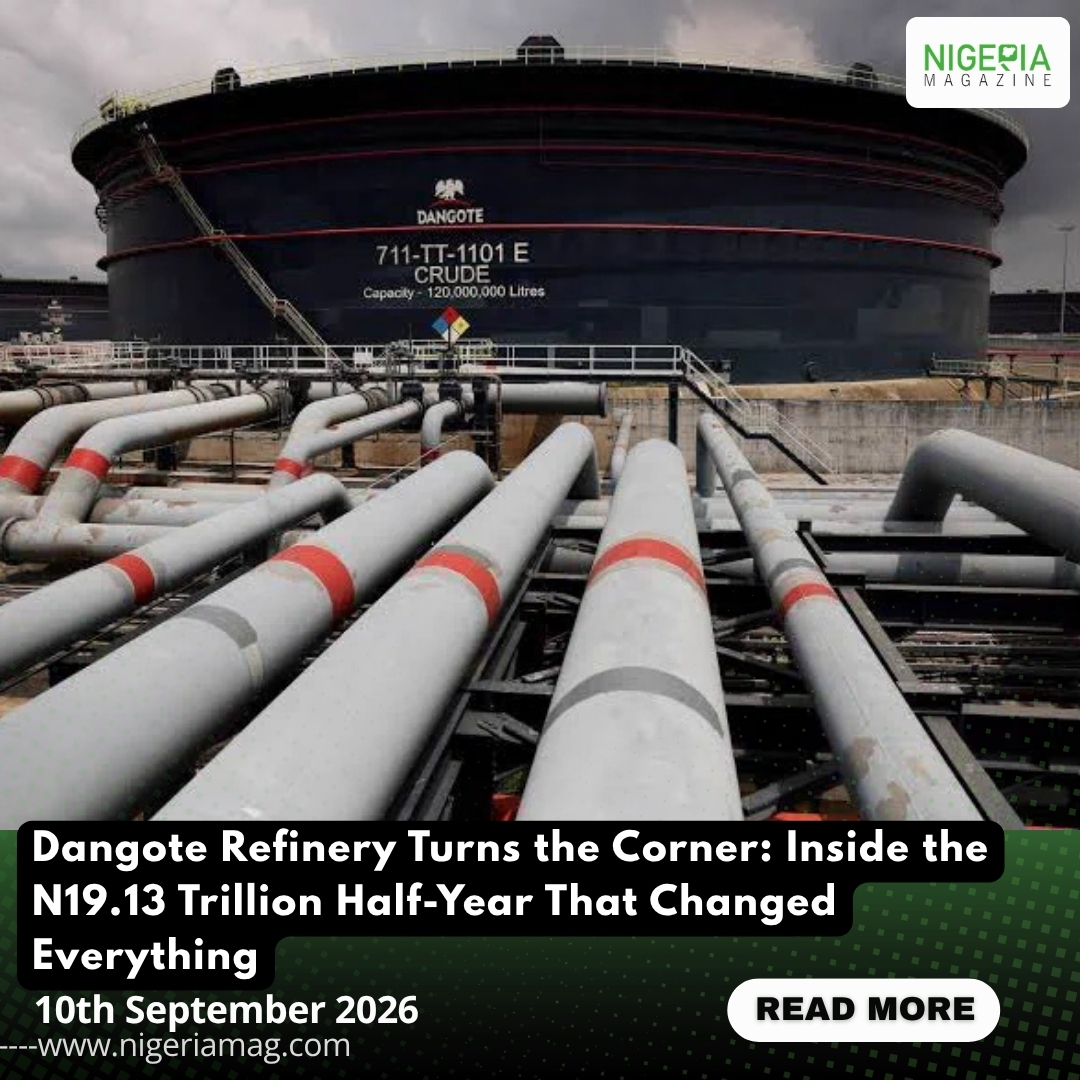
For two years, the story around Dangote Petroleum Refinery was one of patience. Nigerians watched a $20 billion mega-project rise on the outskirts of Lagos, celebrated as a symbol of industrial ambition, but the financials told a quieter tale; one of heavy losses as the facility worked through the growing pains that come with commissioning the largest single-train refinery in the world.
That story has now flipped.
In the first half of 2026, Dangote Refinery reported N19.13 trillion (about $13.91 billion) in revenue; more than double what it made over the same period in 2025. More strikingly, the company posted a profit after tax of $1.82 billion, a dramatic reversal from the losses that had piled up since operations began in 2024. Put together, those two years of losses totaled nearly $2 billion. Six months into 2026, the refinery had already erased that narrative and moved firmly into profitability.
What Actually Changed
The turnaround wasn’t the result of some single dramatic event; it came down to the unglamorous but essential work of getting a massive industrial facility to run at the scale it was built for.
Throughput is the simplest explanation. The refinery reached its original nameplate capacity of 650,000 barrels per day in February 2026, and by June, performance testing pushed output as high as 700,000 barrels per day. That matters more than it might sound: a refinery of this size carries enormous fixed costs; regardless of whether it processes 300,000 or 700,000 barrels a day, the bills for maintaining and running the plant stay largely the same. Higher volumes let the refinery spread those fixed costs across far more output, which is exactly the kind of operating leverage that turns a loss-making facility into a highly profitable one almost overnight.
The second piece of the puzzle came from the market itself. Refining margins; the difference between what a refinery pays for crude oil and what it earns from selling the finished products; improved significantly through the period, aided in part by global supply disruptions tied to ongoing geopolitical tensions. Better margins on top of higher volumes created a compounding effect on profitability.
Setting the Stage for Africa’s Biggest IPO
The timing of these results is not a coincidence. They come straight from the prospectus prepared for Dangote Refinery’s Initial Public Offering; an offer being positioned as a “people’s IPO,” designed to let everyday Nigerians, diaspora investors, and other Africans buy into a piece of the continent’s most significant industrial asset.
The offer opens on September 14 and runs through October 13, with shares priced at N525 each. For a project that has, until now, existed mostly as a symbol of national ambition, this is the first real opportunity for ordinary Nigerians to become actual owners of it.
Why This Moment Matters
There’s a broader lesson buried in the refinery’s numbers, one that goes beyond a single company’s balance sheet. Big infrastructure; the kind that changes a country’s economic trajectory; rarely pays off on a predictable schedule. It often requires years of losses, patience, and public skepticism before the underlying value becomes visible. Dangote Refinery’s first two years looked, to many observers, like proof that the project had been overhyped. Its first half of 2026 suggests the opposite: that the hard part was never whether the refinery could work, but how long it would take to reach the scale where it could prove it.
For Nigeria, that has implications well beyond one refinery. It’s a reminder that some of the country’s most consequential investments will test the patience of the public long before they reward it; and that judging a mega-project too early can mean missing the moment when it finally turns.
Whether the IPO delivers the kind of long-term value its backers are promising remains to be seen. But for now, the numbers have done what months of press coverage couldn’t: they’ve made Dangote Refinery’s turnaround undeniable.

