


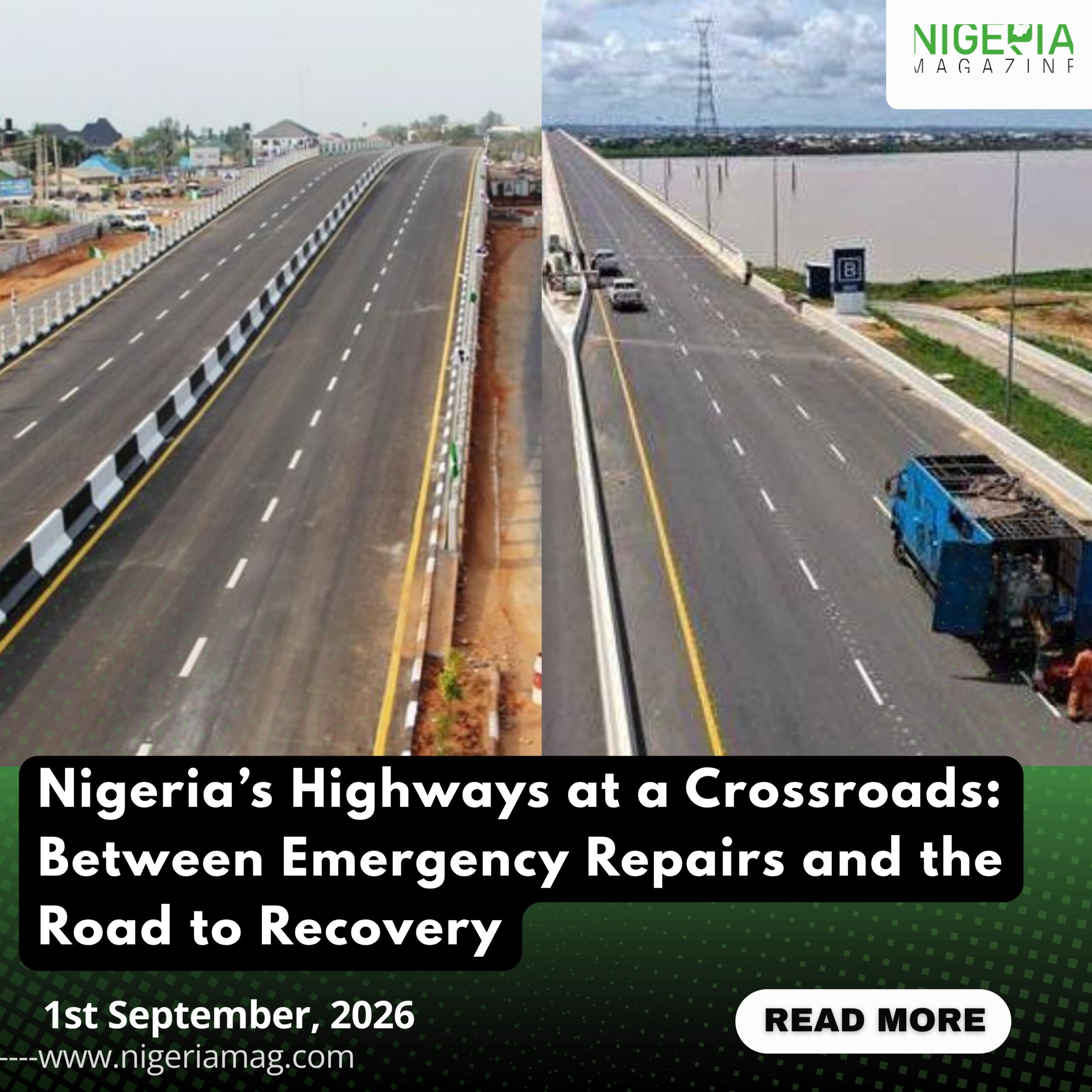
Nigeria’s Highways at a Crossroads: Between Emergency Repairs and the Road to Recovery
by Moses Chibuike Ezechukwu
An examination of Nigeria’s struggling highway network, the human and economic cost of bad roads, and what the latest intervention on the Benin–Asaba Highway says about the country’s wider road infrastructure challenge.
Nigeria’s highways are more than stretches of asphalt connecting one city to another. They are the arteries through which food, fuel, people, raw materials and finished goods move across the country. When those arteries become blocked, damaged or unsafe, the consequences are felt far beyond the road itself.
For millions of Nigerians who depend on road transportation every day, the condition of the nation’s highways has become a matter of survival. A journey that should take a few hours can sometimes turn into an exhausting, costly and uncertain experience. Transport fares rise, goods arrive late, vehicles suffer damage and, in the worst cases, lives are put at risk.The current situation on parts of the Benin–Asaba Highway in Delta State provides another reminder of the wider challenge facing Nigeria’s road infrastructure.
On August 28, 2026, Minister of Works, Engr. David Umahi, directed the China Civil Engineering Construction Corporation (CCECC) to repair damaged sections of the Benin–Asaba Highway within 14 days. The directive followed an inspection of the Asaba axis of the Second Niger Bridge access road, where particular concerns were raised about sections around Ubulu-Okiti and Onicha-Ugbo.
The minister also ordered the rehabilitation of service lanes where asphalt had been removed and called for urgent intervention on sections between Chainage 103 and 105 and between Chainage 106 and 107. Together, the affected portions cover roughly four kilometres of dual carriageway.At first glance, a 14-day deadline may sound like a straightforward construction instruction. But the situation exposes something much bigger: the difficulty of maintaining major highways while construction, concession arrangements, funding issues and the daily movement of thousands of Nigerians all compete for attention.
The Benin–Asaba Highway: A Critical Economic CorridorThe Benin–Asaba route is not an ordinary road. It forms part of an important transportation corridor connecting the South-South with other parts of southern Nigeria and beyond.
Every day, commercial vehicles, private cars, buses, tankers and heavy trucks use this corridor. Businesses located along the route depend on it, while farmers and traders rely on it to move agricultural products to markets.When such a road deteriorates, the economic impact can quickly spread.
Recent reports have highlighted the hardship experienced by motorists on the corridor, including severe traffic congestion and unusually long travel times. For commercial drivers, time lost in traffic translates directly into fuel expenses, vehicle maintenance costs and lost income. For passengers, prolonged journeys can mean missed appointments, disrupted businesses and additional transportation costs.
This is why highway maintenance should not be treated merely as a construction issue. It is an economic issue.
Emergency Repairs Are Necessary — But They Cannot Become the SystemThe directive to repair the affected sections within 14 days is important. Nigerians using the road cannot be expected to wait indefinitely while discussions over contracts and funding continue.
However, emergency repairs should ideally be exactly what the name suggests: emergencies.
Nigeria’s recurring road problem is that intervention often becomes reactive. A section deteriorates, motorists complain, accidents increase, traffic becomes unbearable, government officials inspect the road, and then emergency repairs are ordered.
By that point, what could have been a relatively modest maintenance exercise may have become a major rehabilitation project.
The Federal Government itself has acknowledged the need for stronger supervision of road projects. In August 2026, Umahi urged Federal Controllers of Works across the country to intensify supervision, improve engagement with stakeholders and ensure that problems affecting projects are addressed promptly.
That approach is crucial.A good highway system is not simply one where new roads are constructed. It is one where existing roads are constantly monitored and maintained before failure becomes catastrophic.
The Second Niger Bridge Connection
The condition of the Benin–Asaba corridor is particularly significant because of its relationship with the Second Niger Bridge.
The Federal Government has reaffirmed its commitment to the ₦148 billion access-road project being executed by CCECC. According to the minister, 4.47 kilometres of dual carriageway had been completed, representing 26.7 per cent of the project.The logic behind the project is clear. A major bridge cannot fulfil its purpose if the roads leading to it are inadequate.
This is an important lesson for infrastructure planning in Nigeria: infrastructure should be viewed as a connected network rather than isolated projects.
A beautiful bridge surrounded by damaged approach roads cannot deliver its full economic value. Similarly, a newly constructed highway loses much of its usefulness if maintenance is neglected.
The Second Niger Bridge is also strategically important because of the age and vulnerability of the First Niger Bridge, which has served the country for more than six decades.The Wider Highway ProblemThe problems seen on the Benin–Asaba Highway are not unique.
Across Nigeria, motorists encounter potholes, failed shoulders, flooding, inadequate drainage, unfinished sections, poorly managed diversions and construction zones that sometimes create additional hardship.
Some of these problems are caused by age and heavy traffic. Others are linked to drainage failures, poor maintenance, delayed construction, funding constraints or inadequate supervision.The scale of the challenge is enormous. In June 2026, the Works Minister warned contractors over delays on Federal Government road projects, while noting that funding constraints had forced a reduction in the scope of one section of the Abuja–Lokoja Dual Carriageway from 49.28 kilometres to 28 kilometres so that available resources could focus on critical portions.
This illustrates one of the uncomfortable realities of infrastructure development: announcing projects is easier than funding, supervising and maintaining them over many years.
What Nigeria Needs Beyond New AsphaltNigeria needs a stronger maintenance culture.
The country should move towards systematic highway inspections, timely repairs, effective drainage management and transparent performance monitoring of contractors and concessionaires.
Road users should also have accessible channels for reporting dangerous sections, while government agencies should be able to respond before a damaged road becomes a national embarrassment.
There must also be greater accountability. Contractors should be held to the standards and timelines contained in their agreements, while concession arrangements should not become barriers to protecting the public when a road deteriorates.
At the same time, government must ensure that contractors are paid promptly where contractual obligations have been fulfilled. Infrastructure delivery becomes difficult when contractors face uncertainty over funding.
A Road to RecoveryThe 14-day directive to CCECC is therefore more than a deadline for repairing several kilometres of highway. It is a test of whether emergency government action can translate into visible relief for ordinary Nigerians.
For the truck driver trying to deliver goods, the commuter travelling between cities, the trader moving products to market and the family travelling home, the measure of a successful road project is simple: Can they travel safely, affordably and within a reasonable time?
Nigeria has the population, economic activity and strategic location to benefit enormously from an efficient road network. But roads must be treated as national economic infrastructure, not simply as construction projects.
The Benin–Asaba Highway demonstrates both the urgency and the opportunity. If emergency repairs are followed by proper maintenance, stronger supervision and sustained investment, the corridor can once again support the movement of people and commerce with fewer disruptions.
Nigeria does not merely need more roads.Nigeria needs roads that work — and roads that continue to work after the ribbon-cutting ceremony.
#NigeriaMagazine #Nigeria #NigeriaRoads #Highways #BeninAsabaHighway #SecondNigerBridge #RoadInfrastructure #InfrastructureDevelopment #DavidUmahi #CCECC #DeltaState #Transportation #EconomicDevelopment #RoadSafety #NigerianHighways #PublicInfrastructure #RoadMaintenance #NigeriaNews #NewMedia #MosesChibuikeEzechukwu

