


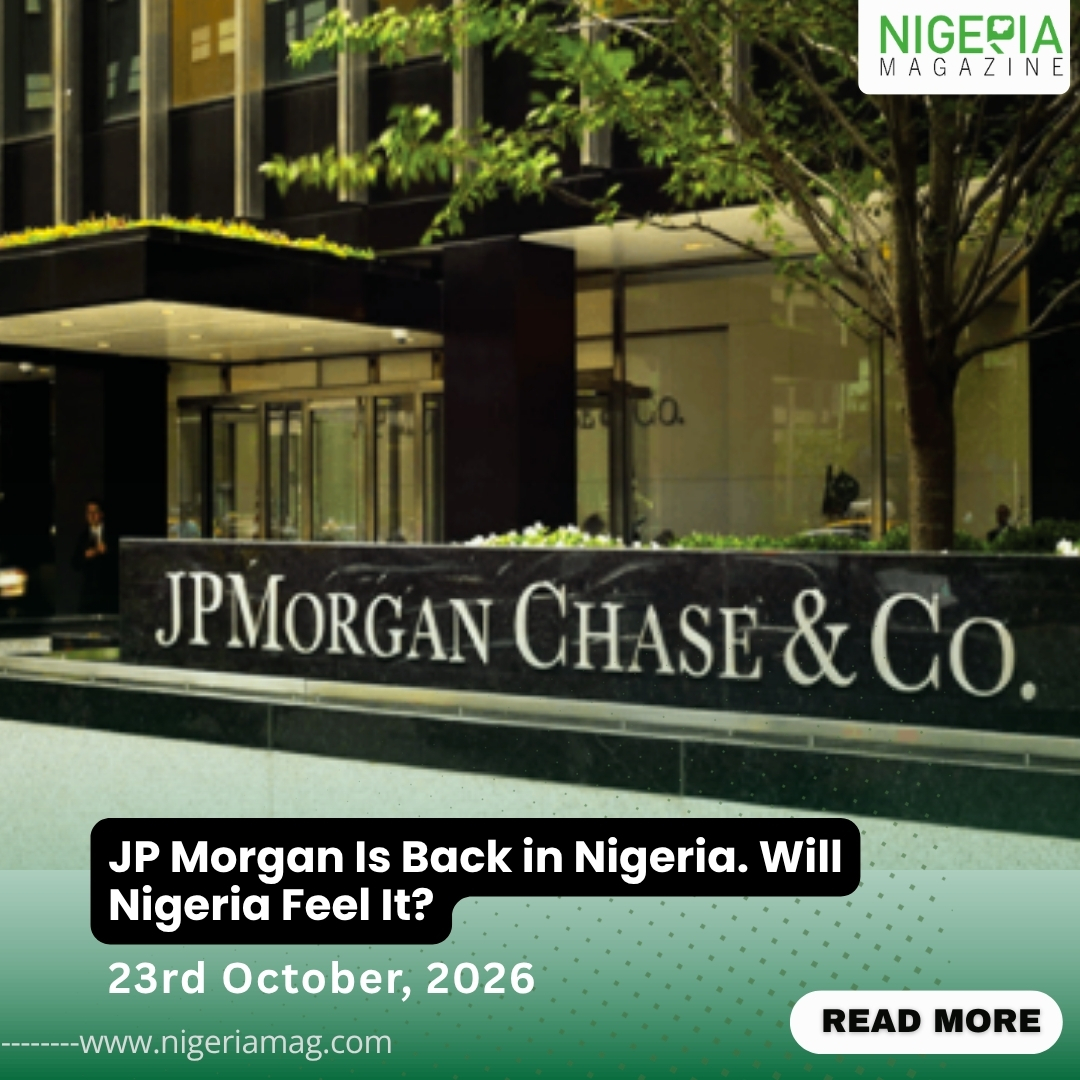
JP Morgan Is Back in Nigeria. Will Nigeria Feel It?
By Kede Aihie
When JP Morgan removed Nigeria from its flagship emerging-market bond index in 2015, it was a verdict on more than foreign exchange. It said Nigeria’s financial plumbing could not be trusted.
A decade later, the verdict has flipped. JP Morgan has lodged about $38 million with the Central Bank of Nigeria ( the N50 billion minimum capital required for a national merchant bank) and awaits final approval to begin operations by end-2026. It is no longer speculative.
The symbolism is powerful. So is the limitation.
JP Morgan itself is a product of the great merchant bank consolidations that shaped modern finance. Chase Manhattan bought Robert Fleming & Co, the Scottish house founded in 1873 that financed America’s railroads, for $7.7 billion in 2000. Its peers — Barings, which collapsed in 1995 after losing £827 million in Singapore and was sold for £1; SG Warburg, Morgan Grenfell, Hope & Co., Dresdner — vanished into what is now UBS, Deutsche Bank, ING and Commerzbank.
For forty years JP Morgan kept only a representative office in Lagos. It could advise, but not take deposits or lend. A merchant bank licence changes that. It is lean: N50 billion versus N500 billion for an international commercial bank, but it authorises dollar lending to large corporates, project finance and advisory.
The timing is not accidental. On April 1, 2026, the CBN closed its recapitalisation with 33 banks cleared and N4.65 trillion raised. Reserves are at an 18-year high of $55 billion. In November 2025, Nigeria’s $2.35 billion Eurobond ,JP Morgan was a joint bookrunner( drew over $13 billion in orders). In September, Nigeria returned to FTSE Russell’s Frontier Market classification. Governor Olayemi Cardoso announced the plan in Singapore with NGX and FMDQ, signaling to global allocators that opaque exchange rates are over.
But Nigeria’s structural defects remain.
There are about five merchant banks left after recapitalisation. Their impact on productive business has been muted. They do not lend to SMEs. They do not build factories. They finance the top. JP Morgan will not either.
The beneficiaries will be three: the federal government, which gets a global distributor for Eurobonds; blue-chips like Dangote, BUA, MTN and Airtel, which will access long-term dollars at 7-8% instead of 9-12%; and the top four or five local banks that can co-syndicate.
Every other bank will feel margin compression. Local banks charge a premium because dollar funding is scarce, often 6-8% via their own Eurobonds. JP Morgan funds at SOFR plus about 100 basis points from New York. It can undercut and compress underwriting fees from 2.5% to under 1%. The most profitable slice ( corporate dollar lending ) will thin.
If that is all, the entry will not move the needle.
For a merchant bank to shape an economy, Nigeria needs what recapitalisation did not deliver: honest asset quality with full IFRS 9 disclosure of post-devaluation non-performing loans; a real hedging market with forwards and options beyond the new electronic matching system; a functional credit and collateral registry and fast-track courts, recovery today takes three to five years; enforcement of governance on single-obligor limits and insider lending after Heritage Bank’s failure; and final open banking rules so banks can compete with OPay and Moniepoint on data.
History warns: Fleming, Warburg and Barings did not disappear because they were unprofitable. They disappeared because the market outgrew the structures around them.
JP Morgan is returning to a Nigeria that wants to be taken seriously by global capital. Being taken seriously will require more than a $38 million deposit.

