


Walk through any major Nigerian city at 7 a.m. and you’ll see the economy waking up before the banks open their doors. Roadside mechanics roll out their tools. Okada riders line up at junctions. Market women arrange tomatoes and peppers into perfect little pyramids. Tailors, hairdressers, phone repairers, and food vendors set up shop on the same corners they’ve claimed for years.
None of this shows up neatly in GDP reports, tax filings, or labour ministry statistics — yet it is the engine room of African livelihoods.
The Numbers Behind the Hustle
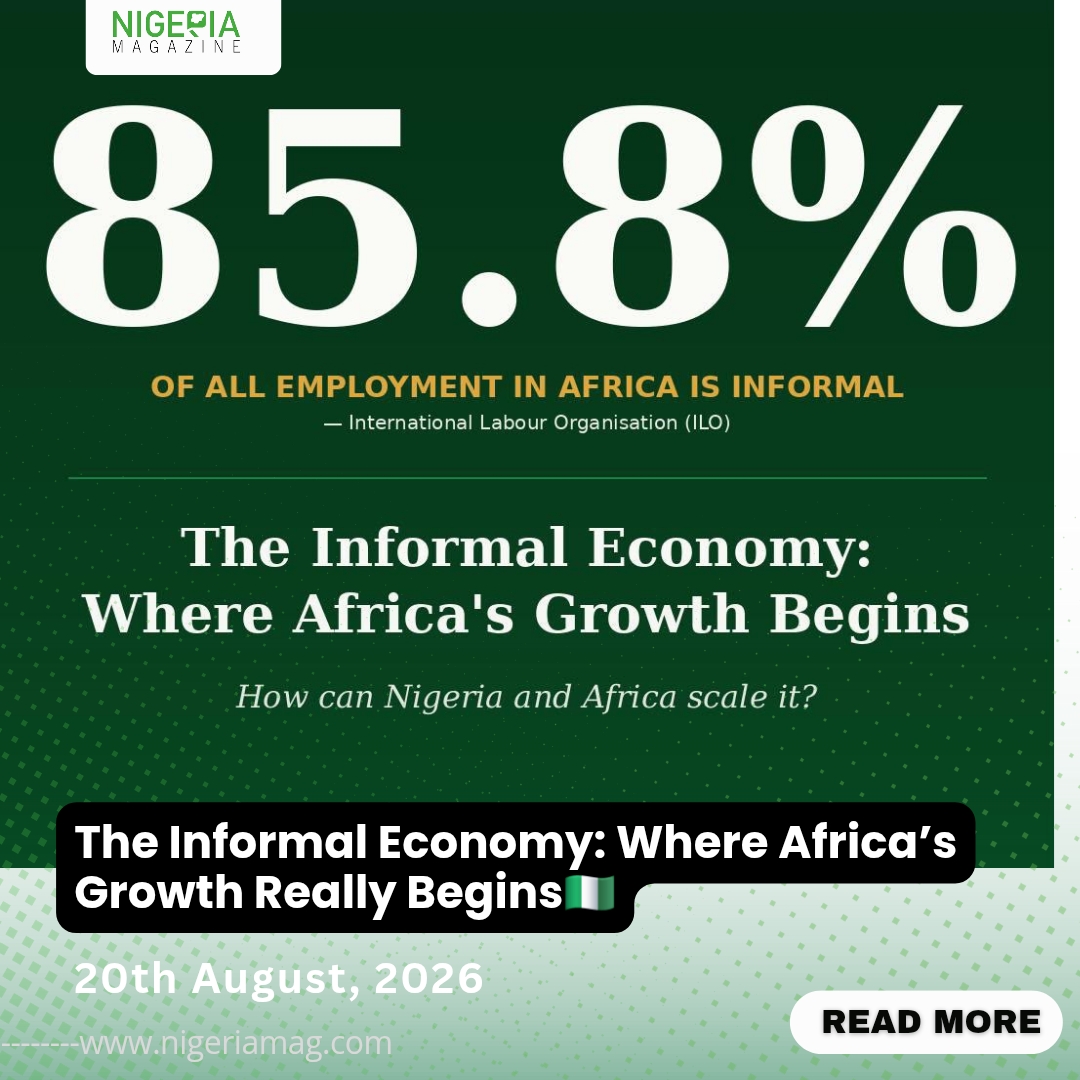
According to the International Labour Organisation, 85.8% of all employment in Africa is informal — the highest share of any region in the world, well above Asia and the Pacific (68.2%) and the Arab States (68.6%). Among African youth aged 15–24, an estimated 95% work informally. In Nigeria, the picture is no different: the informal sector employs the overwhelming majority of the workforce and is widely estimated to account for more than half of the country’s total economic output.
This isn’t a side economy. It is the economy for most Nigerians — the primary source of income, food security, and opportunity for millions who may never hold a formal payslip.
Why the Informal Economy Matters So Much
The informal sector fills gaps the formal economy hasn’t reached:
▶️It absorbs labour formal job creation can’t keep pace with. Nigeria adds millions of young people to its workforce each year, far more than formal employers can hire.
▶️It requires almost no capital or paperwork to enter. A woman selling akara by the roadside or a young man fixing generators needs skill and hustle, not a business registration certificate.
▶️It’s deeply entrepreneurial. Side hustles, multiple income streams, and informal apprenticeships (the “master-craftsman” system) quietly train the next generation of Nigerian talent.
▶️It moves money fast, locally, and often invisibly — cash exchanged hand-to-hand, keeping neighbourhoods and local markets alive even when the formal economy slows down.
The Cost of Staying Informal
But informality has a price. Workers in this space typically lack social protection, health insurance, pensions, and legal recourse when things go wrong. Income is unpredictable. Businesses can’t easily access credit because they have no formal records, no collateral, and often no bank relationship at all. Many informal workers fall into the category the ILO calls the “working poor” — employed, yet still living below the poverty line.
Scaling the informal economy, then, isn’t about forcing it into a formal box overnight. It’s about building bridges that let informal enterprises grow without losing what makes them work.
How Nigeria and Africa Can Scale It
1️⃣Make formalisation worth it, not just mandatory.
Simplify business registration, cut multiple taxation, and pair formal status with real benefits — access to loans, government contracts, and protection — so informality stops being the safer choice.
2️⃣Extend financial inclusion, not just financial access.
Mobile money, agent banking, and fintech-driven micro-lending (already thriving across Nigeria) can bring credit history and savings tools to traders and artisans who banks have historically ignored.
3️⃣Build infrastructure where informal trade actually happens.
Markets, roads, power, and digital connectivity in informal trading hubs multiply productivity far more than top-down policy alone.
4️⃣Recognise and formalise apprenticeship systems.
Nigeria’s traditional apprenticeship model already trains a huge share of the informal workforce. Certifying and supporting it could professionalise skills without dismantling a system that already works.
5️⃣Extend social protection to informal workers.
Portable health insurance and pension schemes not tied to a single employer would let informal workers build security without needing a formal job first.
The Bigger Picture
Africa’s informal economy isn’t a problem to be eliminated — it’s the continent’s largest, most resilient jobs engine, built by ordinary people solving their own unemployment one stall, one skill, one hustle at a time. The real opportunity for Nigeria and the continent isn’t shrinking the informal economy; it’s scaling the systems around it — capital, protection, infrastructure, and recognition — so that growth already happening on the streets can compound.
#NigeriaMagazine #InformalEconomy #NigeriaEconomy #AfricaGrowth #SMEsNigeria #FinancialInclusion #NigerianHustle #AfricaRising #EconomicDevelopment #YouthEmployment #NigerianBusiness #ILO #GrassrootsEconomy #JobCreationAfrica #NigeriaEntrepreneurs

