


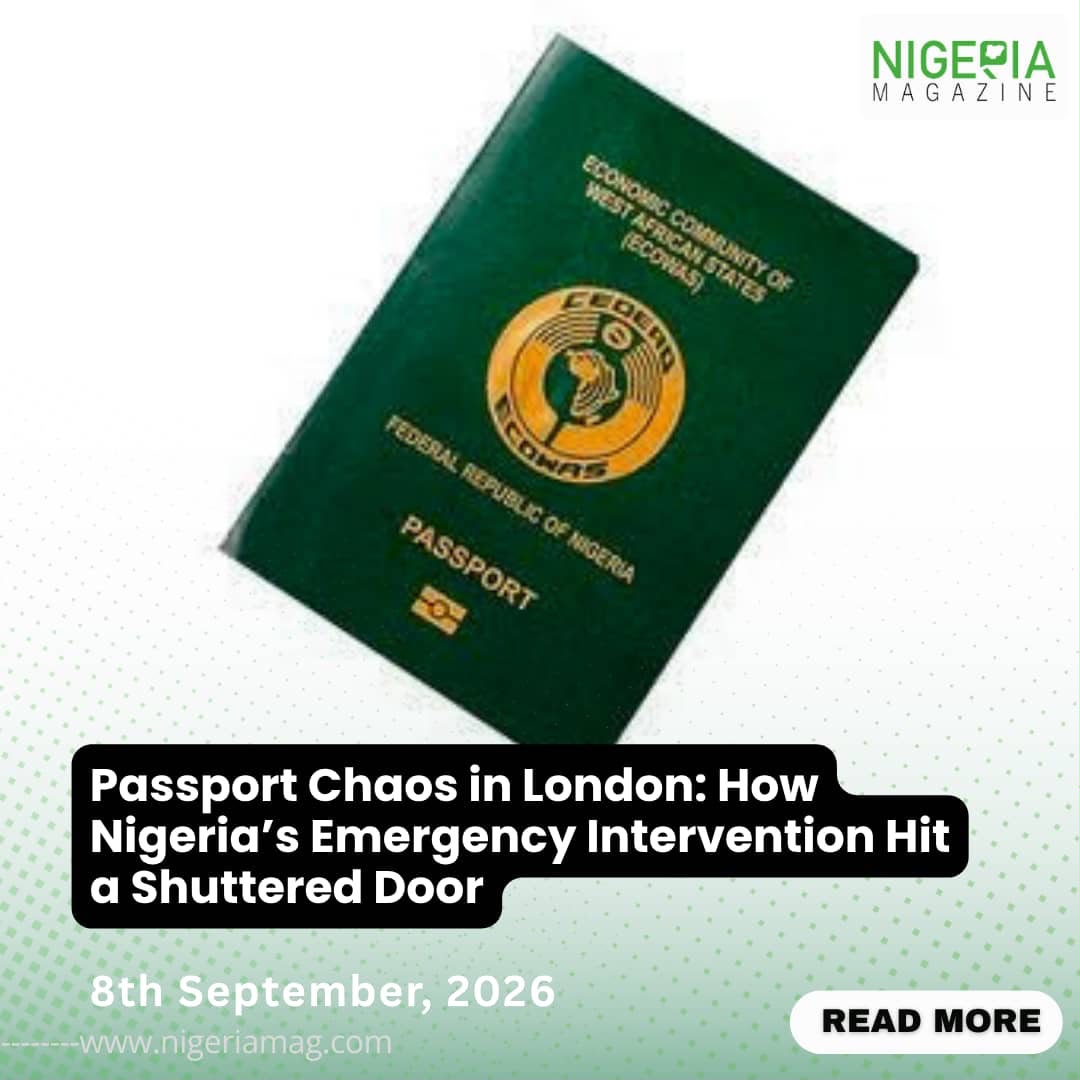
An official Nigerian passport intervention exercise in London has been thrown into controversy after applicants reportedly arrived at the designated venue only to find the doors shut.
The incident has raised uncomfortable questions about planning, payment, security and coordination — and once again placed Nigeria’s public-service delivery under the spotlight.
For Nigerians living in the United Kingdom who had hoped that the Nigeria Immigration Service’s latest passport intervention would provide relief, the experience in London appears to have delivered something else: confusion, frustration and questions.
An intervention designed to solve a problem
The Nigeria Immigration Service (NIS) had announced a special passport intervention exercise aimed at addressing passport-related challenges faced by Nigerians in the United Kingdom.
London was one of four cities selected for the exercise, alongside Manchester, Aberdeen and Cardiff.
The Nigeria High Commission in London officially listed Layali Lounge, Trent Park, Bramley Road, London, as the venue for the London exercise, scheduled to run from September 7 to 21, 2026.
Applicants were also given instructions on the documents they needed to bring and the applicable fees for passport services.
On paper, it appeared to be a straightforward government intervention designed to take passport services closer to Nigerians in the diaspora.
Then things reportedly went wrong.
The door that changed the story
In a social media post that has drawn attention, Nigerian commentator Olamide Obe alleged that Layali Lounge had been selected by the Nigeria Immigration Service as the venue for the exercise but that the owners or management of the facility had not been paid.
He also alleged that no security had been provided for the exercise.
According to Obe, the situation allegedly escalated to the point where the person managing the lounge asked people to leave and shut the premises.
If accurate, the incident would represent more than an embarrassing logistical mishap.
It would raise serious questions about how a government agency could publicly designate a private venue for a major citizen-facing exercise without first ensuring that the basic arrangements for hosting the programme were firmly in place.
There is, however, an important caveat.
The allegations concerning non-payment and the absence of security had not, at the time of writing, been independently established by the Nigeria High Commission, the NIS or the management of Layali Lounge.
They therefore remain allegations requiring clarification.
What is established is that Layali Lounge was officially identified as the London venue for the passport intervention. That makes the reported disruption difficult to dismiss as simply an ordinary misunderstanding.
Nigerians were told to show up
The government intervention was intended to solve a problem, not create another one.
Applicants were instructed to prepare their passport application documents, payment receipts and appointment information before attending the intervention centres.
The published fee structure listed £70 for standard passport applications and £150 for lost, misplaced or damaged passports.
This was therefore not an informal outreach programme where people could simply drop in.
Applicants were responding to an officially announced government service.
For some Nigerians, attending the exercise may have involved taking time off work, arranging transportation and travelling considerable distances.
The expectation was straightforward: arrive at the designated venue and access the promised service.
That expectation is precisely why the reported shutdown deserves answers.
The questions authorities need to answer
Several questions now demand clarification.
How was Layali Lounge selected as the venue?
Was a formal agreement reached with the management?
If an agreement existed, had all financial obligations been settled before applicants were directed to the location?
Who was responsible for security?
Were venue-management officials adequately briefed about the nature, timing and expected volume of the exercise?
And perhaps the most basic question of all:
Why were members of the Nigerian community allowed to travel to an officially designated venue if the arrangements were not ready?
These are not merely administrative questions.
They go to the heart of public confidence.
When an “intervention” becomes another problem
The passport intervention programme itself addresses a genuine need.
Passport delays and difficulties accessing consular services have long been sources of frustration for Nigerians in the diaspora. An exercise that takes services directly to communities can therefore be welcomed as a practical response.
But an intervention is only as effective as its execution.
Government programmes involving hundreds of citizens require more than announcements and the deployment of personnel. They require confirmed venues, logistics, security, communication, crowd management and contingency planning.
A failure in any one of these areas can quickly turn a well-intentioned programme into a public-relations disaster.
And when the programme involves Nigerians abroad, the embarrassment can be magnified.
A familiar Nigerian problem — now on foreign soil
There is an uncomfortable irony in the reported incident.
Nigeria has spent years talking about improving public institutions, strengthening service delivery and changing the way government interacts with citizens.
Yet incidents involving poor coordination, unclear responsibilities and last-minute arrangements continue to fuel the perception that government business is sometimes conducted with too much improvisation.
That perception becomes particularly damaging when it follows Nigerians outside the country.
A government agency operating in London is working in an environment where expectations around contracts, venues, security and public events are well established.
There should be little room for a “we will sort it out when we get there” approach.
What the authorities need to explain
The social media allegations should not be allowed to become the final account of what happened.
The appropriate response is transparency.
The NIS and the Nigeria High Commission should clarify the circumstances surrounding the reported incident.
Was Layali Lounge properly contracted?
Were the required payments made?
Was security arranged?
Did the venue management withdraw permission to host the exercise?
If so, why?
And what alternative arrangements were made for applicants who had already arrived?
These questions matter because Nigerians deserve to know whether the incident was the result of a simple misunderstanding, a breakdown in communication, a contractual dispute or a more serious failure in planning.
Silence will only leave room for speculation.
The bigger issue: Citizens deserve better
There is nothing inherently wrong with taking government services closer to citizens.
In fact, the NIS passport intervention programme could become a model for improving consular services if it is properly planned and executed.
But access is not enough. The service must also work.
For Nigerians abroad, a passport is not a luxury. It is a critical identity and travel document.
When citizens respond to an official government announcement, they should be able to trust that the government has done its own homework.
The location should be ready.
The officials should be ready.
The security should be ready.
The information should be clear.
And, above all, citizens should not be left standing outside a locked door wondering what went wrong.
From embarrassment to accountability
The Layali Lounge episode, if the allegations are eventually confirmed, should not simply be treated as another embarrassing story about Nigeria.
It should trigger an internal review of how overseas intervention programmes are planned and executed.
Someone should be able to answer who selected the venue, who negotiated the arrangement, who approved the logistics and who was responsible for ensuring that everything was ready before applicants were invited.
That is how institutions learn.
That is how public resources are protected.
And that is how citizens regain confidence.
For now, one thing is clear: the passport intervention in London was supposed to bring government closer to Nigerians.
Instead, reports of a shuttered venue have raised questions about whether the government got the basics right.
Those questions deserve answers.

