


By Moses Chibuike Ezechukwu
For years, Nigeria has struggled to establish a reliable way of knowing who its citizens are. The country is now closer than ever to building a nationwide digital identity system, but the real challenge may no longer be registration alone. It is accuracy, trust, privacy and whether the system can actually work for the people it is designed to serve.
Nigeria has spent years trying to solve what sounds like a simple problem: knowing who lives in the country and being able to verify their identity.
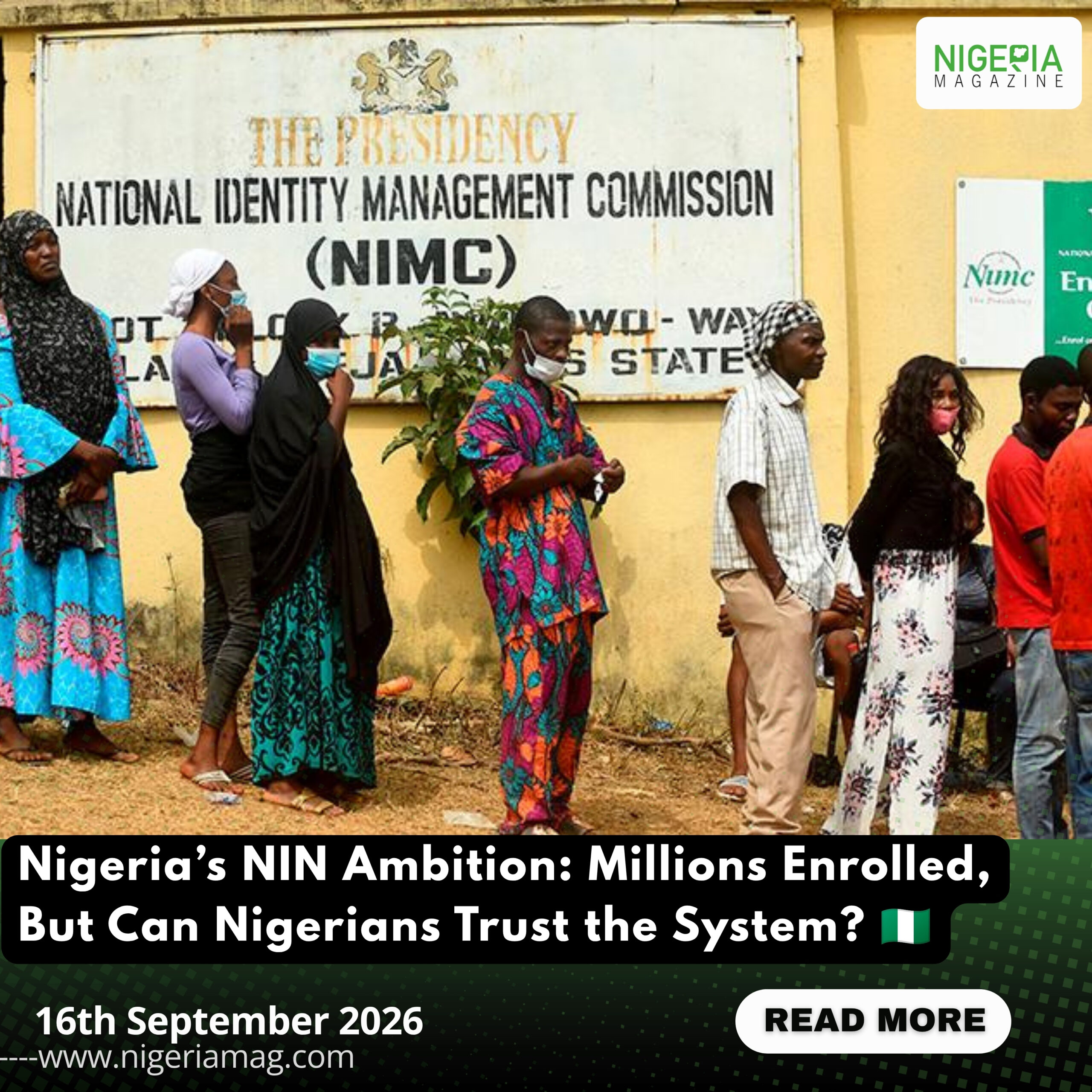
The National Identification Number, popularly known as NIN, has become central to that effort. It is increasingly connected to banking, telecommunications, government services and other parts of everyday life.
On the surface, the numbers suggest remarkable progress. As of June 30, 2026, the National Identity Management Commission (NIMC) had issued NINs to about 117.5 million people from more than 134.5 million enrolments.
But behind that impressive figure lies a much bigger question: How reliable is the identity system Nigeria is building?
The Numbers Look Impressive, But the Target Is Still Far Away
According to the latest World Bank implementation report for Nigeria’s Digital Identification for Development project, 117,493,554 people had been issued NINs by June 30, 2026.
That is a major increase from the project’s 2019 baseline of about 36.9 million people.
However, Nigeria has set an ambitious target of reaching 180 million people with NINs by December 2026. That means it still needs more than 62.5 million additional NINs.
At the current enrolment rate of roughly 1.5 million to 1.8 million people every month, Nigeria would not be moving fast enough to reach that target. The World Bank estimates that monthly enrolment would need to rise to approximately 7.4 million to close the gap within six months.
That is not a small adjustment.
It would require Nigeria to dramatically expand its registration capacity while ensuring that speed does not come at the expense of accuracy.
And that is where the conversation becomes more complicated.
Registration Is Not the Same as Identification
One of the easiest mistakes to make when discussing NIN is to treat enrolment figures as proof that Nigeria has already solved its identity problem.
It has not.
There is a difference between collecting people’s information and having a dependable identity infrastructure capable of verifying that information whenever it is needed.
A person may successfully enrol for a NIN, but that does not automatically mean every piece of information connected to that identity is accurate, up to date or properly integrated with other government systems.
This distinction matters.
If an identity database contains duplicate records, incorrect information, outdated records or poor links between different databases, simply increasing the number of registered people will not solve the underlying problem.
Nigeria therefore has to be careful not to turn the 180 million target into a numbers game.
The goal should not simply be to say, “We registered another million Nigerians this month.”
The bigger question should be: Can this identity be trusted?
The Accuracy Problem Cannot Be Ignored
Nigeria is a country of more than 200 million people with a huge informal economy, millions of young people and significant movement between rural and urban areas.
People change addresses. They change names. They marry. Children grow into adults. People die. Some Nigerians live abroad for years before returning home.
An effective national identity system must be capable of dealing with these changes.
That requires more than registration centres and biometric capture. It requires strong databases, reliable verification, secure authentication and regular updating.
The World Bank report itself indicates that Nigeria’s new National Identity Management System, NIMS 2.0, is still being developed. The system is intended to strengthen the country’s identity infrastructure and provide stronger safeguards around personal data.
This is important because Nigeria is moving toward a society where identity verification increasingly determines access to services.
The stronger the role of NIN becomes, the more damaging an inaccurate identity record can be.
Trust Is Just as Important as Technology
There is another issue that deserves much more attention: public trust.
People are more willing to surrender personal information when they believe the information will be protected and used responsibly.
NIN registration involves sensitive personal information. That makes data protection more than a technical issue. It becomes a question of public confidence.
Nigerians need to know who has access to their information, how it is protected, what happens when something goes wrong and how they can correct inaccurate information.
If people believe that their personal information can easily fall into the wrong hands, confidence in the entire system can suffer.
This is particularly important as identity verification becomes increasingly connected to financial services, telecommunications and digital platforms.
A national identity database can be incredibly useful.
But the same database can become incredibly dangerous if poorly protected.
The Digital Economy Needs a Reliable Identity System
Despite the concerns, Nigeria should not lose sight of why this project matters.
A functional national identity system could transform the country’s digital economy.
Banks could verify customers more efficiently. Government agencies could reduce duplication in social programmes. Businesses could improve customer verification. Citizens could potentially access public services more easily.
It could also help the government plan better.
When a country does not have dependable information about its population, planning becomes much harder.
How many people need healthcare?
How many children need schools?
Where are vulnerable households located?
How many people are eligible for social intervention?
Reliable identity data can help answer questions like these.
But again, the value depends on accuracy.
Bad data can produce bad decisions.
Nigeria Must Avoid the Pressure of “Big Numbers”
The temptation to celebrate milestones is understandable.
Going from roughly 36.9 million NINs in 2019 to more than 117 million in 2026 is significant progress. The World Bank also reports that hundreds of enrolment partners have been licensed, thousands of personnel trained and Nigerian government offices abroad equipped to support enrolment.
But Nigeria should resist the temptation to measure success solely by the number of NINs issued.
A better measurement would include questions such as:
Are duplicate identities being detected?
Can Nigerians easily correct mistakes?
Is authentication working reliably?
Are citizens’ personal records protected?
Are rural communities being properly covered?
Can government agencies securely use the identity system?
And most importantly, do Nigerians trust the system?
These are the questions that will determine whether the project succeeds beyond the statistics.
What Nigeria Should Focus On Next
The next stage should be about quality as much as quantity.
First, registration needs to become easier and more accessible, especially for people in rural communities and Nigerians living abroad.
Second, the government needs stronger mechanisms for correcting inaccurate information. A national identity system cannot be considered reliable if citizens struggle to fix mistakes in their own records.
Third, data protection must remain a priority. Nigerians should not have to choose between accessing essential services and worrying about the safety of their personal information.
Finally, different government databases need to communicate securely with one another without creating unnecessary duplication or exposing citizens to additional risks.
The World Bank’s report indicates that Nigeria is already working toward these broader improvements, including the development of NIMS 2.0 and the integration of authentication into the national identity infrastructure.
The Real Test Begins After Registration
Nigeria’s NIN journey is no longer simply about getting people registered.
The country has already registered more than 117 million people. The next challenge is turning those registrations into a trusted, accurate and useful national identity system.
That will take more than ambitious targets.
It will require functioning technology, competent institutions, strong privacy protections and, perhaps most importantly, public confidence.
Nigeria has spent years trying to answer the question of who its people are.
Now it must answer another question:
Can Nigerians trust the system that claims to know who they are?
If the answer eventually becomes yes, the NIN could become much more than another government identification number. It could become one of the foundations of Nigeria’s digital economy.
But if speed is prioritised over accuracy and numbers over trust, the country could end up with a database that is large on paper but weak where it matters most.
The opportunity is enormous.
So is the responsibility.

