


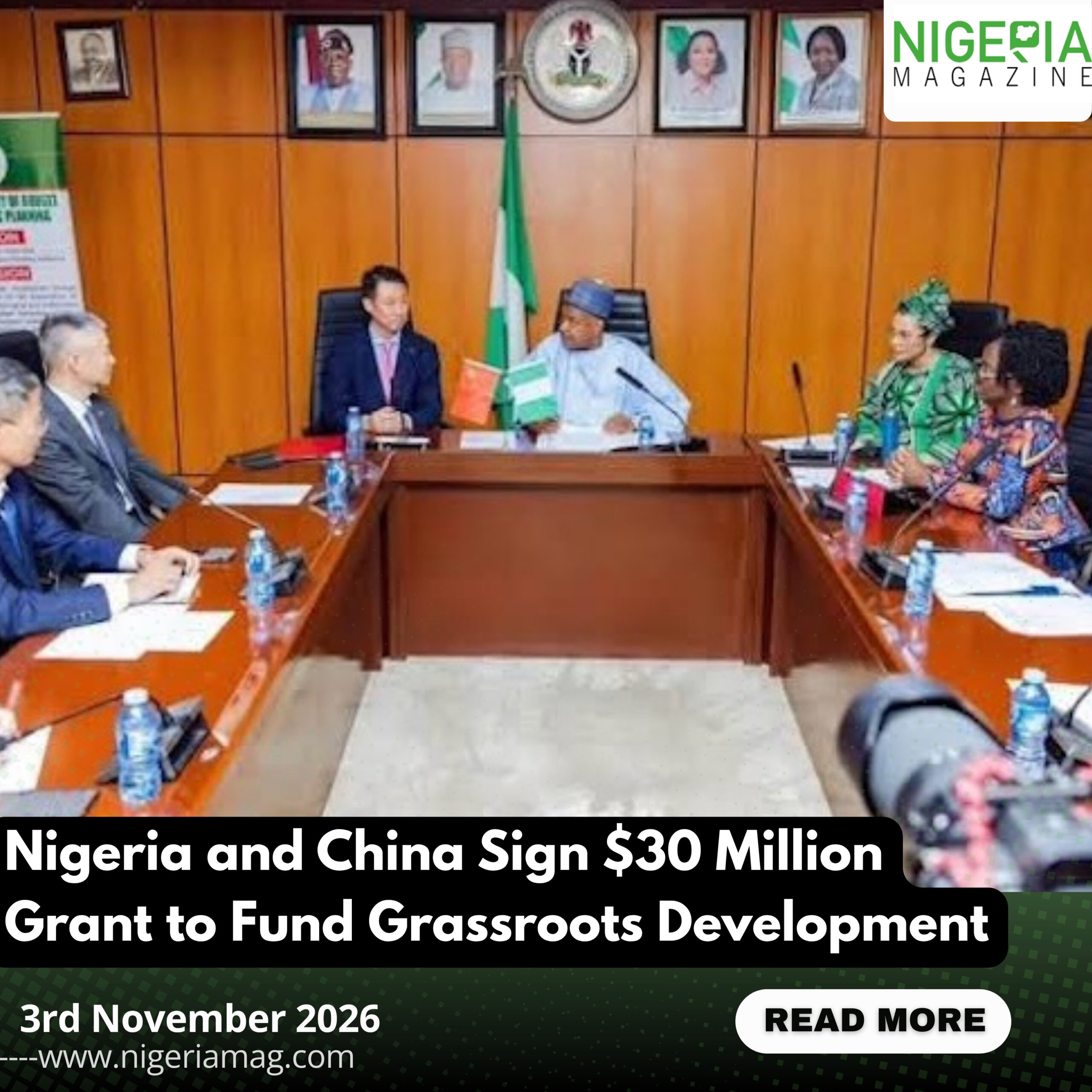
Nigeria has secured a new grant from China aimed at the communities where poverty is felt most. The Federal Government has signed a grant agreement worth about $30 million, or RMB 200 million, to finance community-based development projects across the country, with the stated goals of reducing poverty, improving livelihoods and widening economic opportunity at the grassroots.
The agreement was signed on Thursday, 29 October 2026, at the Federal Ministry of Budget and Economic Planning in Abuja. Minister of Budget and Economic Planning, Senator Abubakar Bagudu, and Chinese Ambassador to Nigeria, Yu Dunhai, were present. Bagudu described the deal as evidence of strong bilateral relations and shared development objectives. The ambassador said it was a step towards delivering commitments made by both countries’ leaders and the outcomes of the fourth China-Nigeria Cooperation Forum in Beijing.
The funding falls under China’s “small but beautiful” initiative, which favours affordable, community-driven projects that deliver practical results and direct benefits to residents. Reports say it will also support Nigeria’s plan to reach all 8,809 wards. The grant follows an earlier $1 million Chinese contribution this year to strengthen Nigeria’s technological and knowledge development capacity.
The deal is a grant, which means it does not add to Nigeria’s debt. That matters in a country where financing from China has often been discussed in terms of loans and repayment. The RMB 200 million figure was first announced in August, when some outlets converted it to roughly $28 million. Signing-day reports put it at about $30 million, or around ₦41 billion to ₦43 billion, depending on the exchange rate used.
The specific projects have not been finalised. State governments have proposed projects, which are being reviewed by the Budget Ministry and the Nigeria-China strategic partnership office. As one report noted, the grant’s impact will depend on the quality of project selection, implementation and accountability. For communities hoping for boreholes, electricity and other basic infrastructure, those details will decide whether the agreement shows up in daily life.
The grant arrives as both countries explore an economic development partnership agreement ahead of the expiry of China’s zero-tariff policy on 1 May 2028. China has also said trade with Nigeria reached $18 billion in the first half of 2026, with Nigerian exports rising by 80%.
A signed agreement is only the beginning. The test will be which communities are chosen, how quickly projects are delivered, and how openly the results are reported.

