


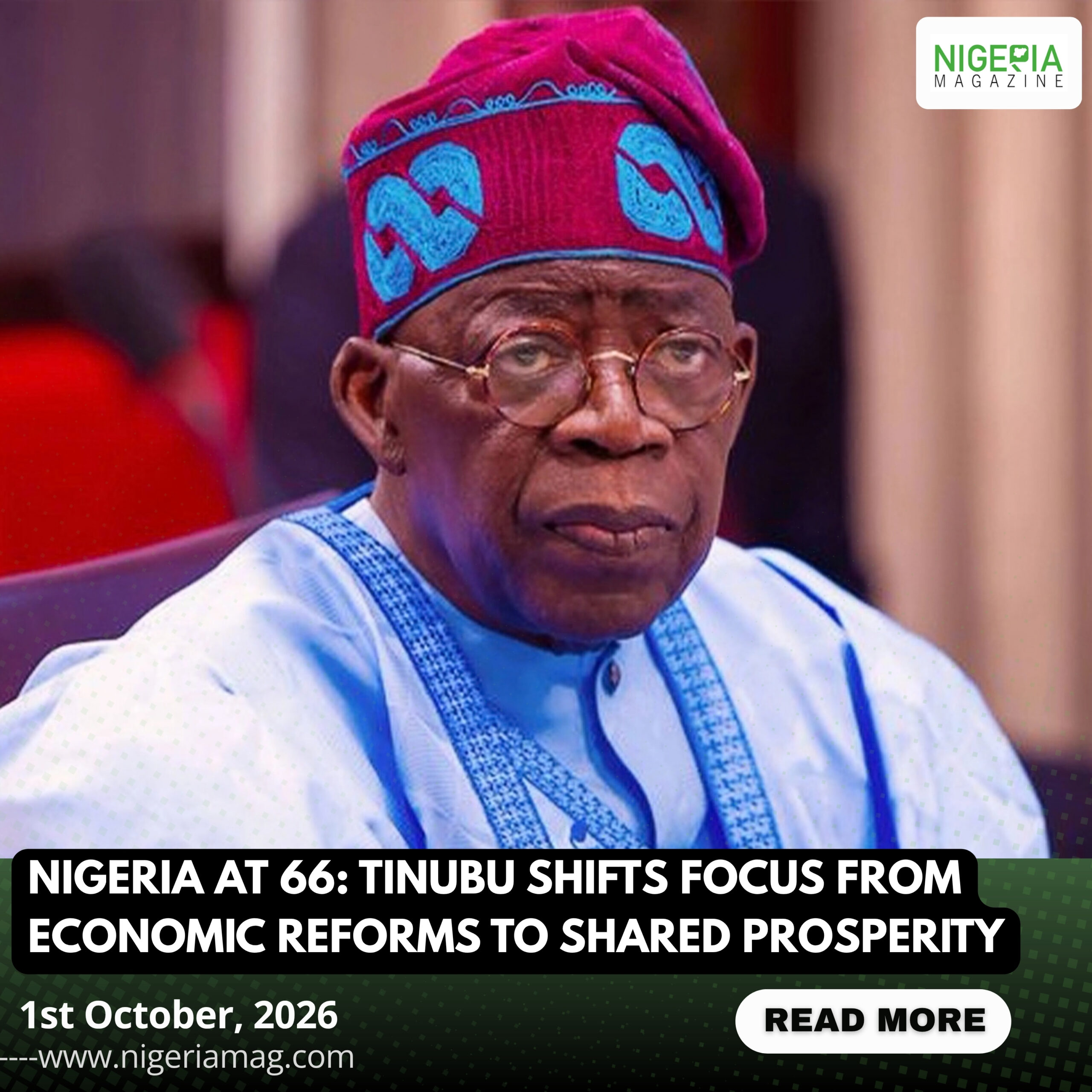
As Nigeria marks 66 years of independence, President Bola Ahmed Tinubu says his administration is moving from economic reforms to a new phase focused on shared prosperity, economic growth, job creation and improved living conditions for Nigerians.
Sixty-six years after Nigeria gained independence from British colonial rule, President Bola Ahmed Tinubu has declared that the country is entering a new phase of economic development, with a renewed focus on shared prosperity and improving the welfare of its citizens.
In his 66th Independence Day address to the nation on October 1, 2026, the President highlighted what he described as progress in economic growth, foreign reserves, foreign exchange stability and non-oil exports. He also outlined plans to reduce the cost of living, expand social support programmes, create jobs and strengthen national security.
Tinubu said the initial period of emergency economic reforms had been completed, adding that the administration was now shifting its attention towards ensuring that the gains of reform translate into widespread prosperity.
The declaration comes at a significant moment in Nigeria’s history, as the country reflects on its journey from colonial rule to self-government and the challenges that continue to shape its development.
NIGERIA’S JOURNEY TO INDEPENDENCE
On October 1, 1960, Nigeria became an independent nation after decades of British colonial administration. The historic transition marked the beginning of a new chapter in the country’s political and economic life.
Sir Abubakar Tafawa Balewa became Nigeria’s first Prime Minister, while Dr. Nnamdi Azikiwe later became the country’s first indigenous Governor-General and, following the declaration of a republic in 1963, its first President.
Nigeria’s independence struggle was shaped by several nationalist leaders and movements. Figures such as Herbert Macaulay, Nnamdi Azikiwe, Obafemi Awolowo, Ahmadu Bello, Margaret Ekpo and Anthony Enahoro played important roles in the political mobilisation and agitation for self-government.
Their efforts helped establish the foundations of a sovereign state whose aspirations included unity, freedom, democratic governance and national development.
However, the years following independence brought significant challenges, including political instability, a civil war between 1967 and 1970, military rule, economic difficulties and recurring questions about national cohesion.
Since the return to democratic governance in 1999, successive administrations have pursued different policies aimed at addressing these challenges and improving the country’s economic and social conditions.
At 66, Nigeria remains a country with considerable human and natural resources, but the task of translating these advantages into improved living standards continues.
FROM ECONOMIC REFORMS TO PROSPERITY
In his Independence Day address, President Tinubu said the administration had completed the foundational phase of its economic reforms and was now concentrating on expanding prosperity.
The President pointed to economic growth of more than four per cent, improved foreign reserves, a decline in inflation from its peak and greater stability in the foreign exchange market as indicators of progress.
He also highlighted non-oil export earnings, which he said exceeded six billion dollars in 2025, describing the performance as evidence of growing economic activity beyond the oil sector.
The administration’s economic reforms, including the removal of fuel subsidies and changes to the foreign exchange system, have been central to its economic policy. While the government has maintained that these measures are necessary for long-term stability, their effects on household purchasing power, transportation and business costs remain major concerns for many Nigerians.
The President acknowledged the importance of addressing the cost of living, identifying it as a top priority in the next phase of the administration’s economic agenda.
FOOD PRODUCTION AND THE COST OF LIVING
A major part of the President’s strategy centres on reducing the cost of producing and transporting goods, particularly food.
Tinubu highlighted mechanised irrigation, dry-season farming and improved access to agricultural inputs as measures intended to strengthen food production and improve agricultural productivity.
He also pointed to investments in roads, railways, ports and electricity infrastructure as important to reducing transportation and production costs.
The focus on agriculture comes amid persistent concerns about food affordability and the purchasing power of Nigerian households.
Expanding agricultural production, improving storage and transportation networks, and making essential farm inputs more accessible are among the issues that will shape the effectiveness of the government’s plans.
For millions of Nigerians, the practical test of economic recovery will be reflected in the affordability of food, transportation, housing and other basic necessities.
YOUTH, JOB CREATION AND INDUSTRIAL GROWTH
Nigeria’s youthful population also featured prominently in the President’s address.
Tinubu described young Nigerians as a major resource for national productivity and said his administration would place jobs, enterprise and industrial development at the centre of national policy.
The proposed approach includes supporting gas-powered industries, reviving factories, expanding digital connectivity and investing in skills development.
The focus reflects the need to create employment opportunities for a growing population, particularly young people entering the labour market.
However, the success of these objectives will depend on the ability to attract investment, improve infrastructure, expand access to finance and create an environment in which businesses can grow and sustain employment.
The President’s emphasis on industrial growth also highlights the importance of reducing dependence on raw commodity exports and strengthening local production.
SOCIAL SUPPORT AND ACCESS TO CREDIT
In addressing the welfare of vulnerable households, Tinubu said the government was updating the National Social Register to improve the identification and targeting of direct assistance to the poorest Nigerians.
He also highlighted the importance of timely payment of salaries and pensions as part of the administration’s social protection efforts.
The President further referenced the Nigerian Consumer Credit Corporation, CREDICORP, which provides access to consumer financing for eligible working Nigerians.
Through the initiative, citizens can access financing for assets such as vehicles, solar energy systems and digital devices without having to accumulate the full purchase amount over several years.
Education was another key component of the address. Tinubu highlighted the Nigerian Education Loan Fund, NELFUND, as a mechanism for helping students from low-income families pursue higher education without facing immediate financial barriers.
The programmes form part of the administration’s broader social and economic agenda. Their impact will depend on accessibility, effective implementation, transparency and the ability to reach the people they are designed to support.
SECURITY AND PROTECTION OF NATIONAL RESOURCES
On security, the President cited reductions in oil theft as a significant achievement, while commending the Armed Forces and other security agencies for their efforts to protect the country.
Oil theft has long affected Nigeria’s petroleum industry, reducing government revenue and contributing to environmental degradation, particularly in the Niger Delta.
Tinubu said his administration remained committed to protecting national resources and strengthening security across the country.
Despite the government’s stated progress, insecurity continues to be a major national concern, with challenges including terrorism, banditry, kidnapping and communal violence in different parts of the federation.
The effectiveness of security measures will remain an important factor in determining the country’s capacity to attract investment, sustain economic activity and protect communities.
THE CHALLENGE OF TURNING PROMISES INTO PROGRESS
As Nigeria celebrates its 66th Independence Day, President Tinubu’s address presents a transition from economic stabilisation to a broader ambition of shared prosperity.
The message places emphasis on economic growth, food production, infrastructure, youth employment, social protection and security.
Yet, beyond the economic indicators highlighted by the President, the central question for many Nigerians is how these policies will translate into measurable improvements in everyday life.
The country’s independence journey has been marked by significant achievements as well as persistent challenges. From the early aspirations of the nationalist movement to decades of political and economic transformation, the pursuit of a united and prosperous Nigeria remains an unfinished national project.
At 66, the country’s next chapter will depend not only on policy announcements and economic performance figures, but also on effective implementation, accountable governance and the extent to which development reaches ordinary citizens.
For Nigeria, the promise of independence continues to be measured by the opportunities available to its people and the quality of life they experience.
Ubong Usoro for Nigeria Magazine

