


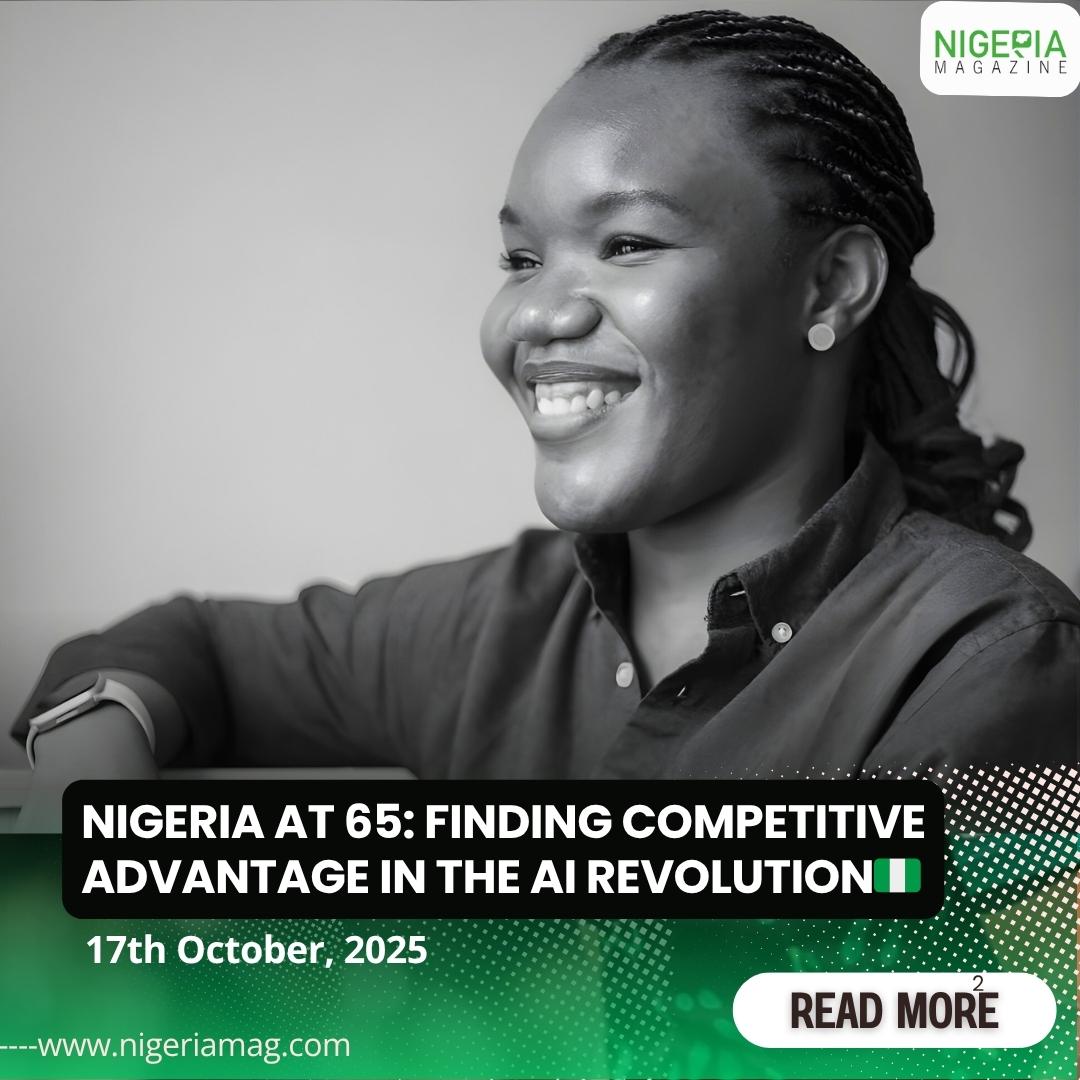
By Stephanie I Ohumu
At 65, Nigeria stands at an inflection point. The AI revolution is already determining which nations will thrive in the computational economy and which cultures will remain visible in the digital century ahead. For Nigeria, with its intermittent power supply, bandwidth constraints, and limited capital for massive compute investments, the question isn’t whether to participate in AI but where and how to position itself to actually win.
The conventional framing presents a false choice: either compete head-to-head with Silicon Valley and Beijing on frontier models (impossible given infrastructure realities), or resign to being merely a market for foreign AI systems. But there’s a third path, one that transforms Nigeria’s apparent disadvantages into strategic assets.
The Counterintuitive Advantage
Nigeria cannot and will not train models larger than GPT-5 or compete on compute with tech
superpowers. That race is lost before it begins. But consider what Nigeria has that no one else
possesses: over 517 indigenous languages, unique cultural frameworks, and a creative economy that has already proven its global value. Afrobeats dominates international charts. Nollywood is the world’s second-largest film industry by volume. Nigerian fashion, literature, and art command global attention.
This isn’t romantic nationalism. It’s strategic reality. The AI systems being built today are
overwhelmingly trained on English, Chinese, and a handful of European languages. When these systems encounter Nigerian realities, they fail in ways both subtle and catastrophic. They can’t understand code-switching (the natural mixing of languages in Nigerian communication). They misinterpret cultural contexts. They lack the data to serve Nigeria’s actual needs in agriculture, healthcare, governance, and education. This gap is Nigeria’s competitive moat.
The precedent for this strategy exists. South Korea in the 1960s was poorer than Nigeria is today, a war-devastated nation with few natural resources and authoritarian governance. The conventional wisdom was that South Korea should focus on low-cost manufacturing and accept its position in the global periphery. Instead, South Korea made a multi-generational bet: invest heavily in technical education and industrial policy (Samsung, LG, Hyundai), while simultaneously treating cultural production as strategic infrastructure. The government
supported film, music, and television not as frivolous luxury but as economic and soft-power assets.
The results are instructive. Technical capacity enabled cultural exports: Samsung’s technological prowess created devices that became vessels for Korean content. K-pop didn’t spread via radio; it spread via smartphones, YouTube, and streaming platforms that Korean tech helped build. Cultural exports reinforced technical adoption: as K-dramas gained global audiences, Korean became cool. Young people worldwide began learning Korean, creating economic incentives to preserve and promote the language. Korean language ability is now valuable in global markets. Translation services, localization, and cultural consultation for Korean content are thriving industries. The cycle became self-reinforcing: tech development funded cultural exports, which created linguistic prestige, which increased tech adoption, which enabled more development.
Crucially, South Korea didn’t wait until it was wealthy to invest in cultural infrastructure. It treated culture and technology as complementary from the beginning, understanding that in the long run, Samsung and BTS reinforce each other. Nigeria has the raw materials for this strategy: proven creative industries, linguistic diversity, cultural influence, and a diaspora that bridges local and global ecosystems. What’s needed is strategic positioning in the AI value chain that leverages these advantages while working within current infrastructure constraints.
Intelligence Over Compute
Given Nigeria’s realities, success means claiming intelligence-intensive rather than compute-intensive positions in the AI value chain. Data annotation and curation represent immediate revenue opportunities. African countries like Kenya and Nigeria are already providing these services to OpenAI, Google, and Microsoft. This works because it requires only basic internet connectivity, leverages English proficiency, and creates immediate employment. But Nigeria’s unique angle lies in specializing in culturally-aware annotation: labeling data that
requires understanding of African contexts, languages, and cultural nuances that Western annotators miss. When a model needs to distinguish between Yoruba proverbs and insults, or understand the context of Nigerian political discourse, Nigerian annotators are irreplaceable.
The critical caveat here cannot be ignored. Data workers in Kenya currently earn less than $2
per hour labeling graphic content, often with psychological trauma and no support systems. A
Nigerian-led approach must prioritize fair wages and worker rights, or it simply replicates
colonial extraction patterns with a digital interface. The goal is to build value, not become a sweatshop for AI companies.
Indigenous language datasets represent a competitive monopoly. No one else has native access to Nigeria’s 517 languages. Global tech companies desperately need this data as they build multilingual systems, but they can’t create it themselves. Nigeria’s recently launched N-ATLAS (multilingual, multimodal large language model) demonstrates technical capability. But N-ATLAS currently supports only Yoruba, Hausa, Igbo, and Nigerian-accented English. While these languages serve tens of millions, this approach leaves significant value on the table. The commercial model is straightforward: package language datasets as products for international tech companies. A comprehensive Yoruba corpus commands different pricing than an English dataset because it’s rare and required. This isn’t charity; it’s monopoly pricing on unique assets.
Fine-tuning and localization services offer a value-add layer that doesn’t require training models from scratch. Rather than the compute-intensive work of building foundation models, Nigeria can take existing systems like GPT, Claude, or Llama and fine-tune them for Nigerian contexts. This leverages local cultural knowledge while requiring modest computational resources. Specialised models for key sectors (agriculture, healthcare, education, governance), cultural adaptation layers that make global AI systems contextually appropriate, and industry-specific fine-tuning that encodes Nigerian professional expertise all represent sustainable business opportunities with lower technical barriers than model development.
Application development offers the highest near-term impact. Direct solutions to local problems using AI create immediate economic and social value. Education AI tutors in local languages can address Nigeria’s education crisis. Agriculture voice-based advisory systems serve farmers who may be illiterate in English. Healthcare diagnostic support can be trained on local disease patterns. Financial inclusion through voice-banking and credit assessment in local languages opens markets currently underserved. Governance automated translation services across Nigeria’s linguistic diversity improve accessibility and efficiency.
Model evaluation and red-teaming represent an emerging high-value opportunity that few recognise. Testing AI systems for cultural appropriateness, bias, and safety in African contexts is completely underserved. This createshigh-value jobs requiring cultural expertise rather than massive compute. Establishing testing frameworks and certifying AI systems as “Africa-ready” positions Nigeria as the gatekeeper for a growing market. As global companies seek African expansion, this certification becomes mandatory rather than optional.
Culture as Infrastructure
Nigeria’s National AI Strategy, launched in 2025, includes N-ATLAS as its flagship multilingual initiative, supported by a ₦2.8 billion Google grant and Microsoft’s commitment to train one million Nigerians in AI skills by 2026. This positions Nigeria as a regional AI leader. But here’s where strategy meets identity: the real victory won’t be training the largest model or having the most GPUs. The victory will be ensuring that in 2050, when a child asks an AI system about the Benin Kingdom, it responds fluently in Edo. When a researcher studies traditional African governance systems, the AI can parse Tiv political concepts. When healthcare AI operates in Nigeria, it understands not just English medical terms but traditional healing frameworks.
This isn’t merely romantic. It’s strategic. The dominance of English-centric AI systems creates a vicious cycle: languages that AI cannot understand become marginalized in the digital economy, pushing younger generations to abandon their mother tongues for economic survival. Nigeria has already lost 29 languages to extinction, with another 29 currently endangered. N-ATLAS supporting Yoruba, Hausa, and Igbo is pragmatic. These languages serve tens of millions and command immediate commercial value. But this “Big Three” approach leaves significant cultural and economic value behind.
Consider Edo, the language of the civilization that produced the Benin Moats (the world’s largest earthwork, dwarfing the Great Wall of China) and the Benin Bronzes (whose artistic sophistication stunned European museums). Or Tiv, with unique musical traditions and complex kinship systems. These languages encode worldviews, philosophical frameworks, and knowledge systems that took millennia to develop. When we account for the 29 Nigerian
languages already extinct and another 29 endangered, we’re not just losing vocabulary. We’re losing irreplaceable human inheritance. And critically, we’re leaving economic value unclaimed. High-value cultural heritage requires linguistic access. Tourism, cultural exports, academic research, and creative industries all depend on linguistic preservation.
The Brutal Economics
Here’s where intellectual honesty demands confronting reality: the commercial case for building language models for smaller Nigerian languages is weak to non-existent in puremarket terms. An Edo corpus serving 1-2 million speakers, most of whom already speak English or Pidgin, in a country where average annual income is under $2,000, is not commercially compelling. A tech company evaluating ROI would rather invest in improving their English models (serving billions) or even focus on Yoruba, Hausa, or Igbo (serving tens of millions) before touching Edo. The opportunity cost is damning. Every hour of skilled technical labor spent building an Edo language model could be spent on work that pays 10x more and serves 100x more people.
The infrastructure deficit is real. Building language corpora requires stable internet, power for computation, and sustained funding for initially non-profitable cultural work. Nigeria’s unreliable power grid makes even laptop-based work challenging. The economic pressure is immense. When a talented Nigerian computational linguist can earn multiples moredoing generic annotation for OpenAI than building an Edo corpus, the market actively works against preservation. The scale problemis severe. Even with 2 million words, an Edo corpus will be tiny compared to the billions of words needed for modern language models.
Before defending this work, let’s demolish the weak arguments often made. “It’s commercially viable!” No, it’s not. Not at current scale, not with current technology costs, not for decades. Stop pretending otherwise. “The diaspora will fund it!” Maybe for passion projects, but diaspora capital flows toward immediate family needs, real estate, and businesses with actual returns. How many Edo diaspora engineers will sustainably fund corpus building when their relatives back home need school fees? “Government will prioritize it!” Critics already argue Nigeria must address electricity, food security, and poverty before broader tech ambitions. Asking a government to fund endangered language preservation when children are malnourished is politically difficult at best. “Tourism and cultural heritage!” This works for French or Italian protecting language prestige. For Edo? The Benin Bronzes might be famous, but tourists aren’t learning Edo to visit Nigeria.
These arguments fail because they try to justify cultural work on purely economic grounds. That’s the wrong frame.
The honest arguments are harder but more defensible. Languages encode knowledge that has genuine economic value: traditional ecological knowledge about local plants, climate patterns, and soil management; indigenous medical knowledge about local diseases and treatments; agricultural practices adapted to specific regional conditions over centuries; conflict resolution and governance frameworks tested over generations. But the hard question remains: can’t you document that knowledge in English and preserve it that way?
The counterargument holds that language shapes thought. Certain concepts don’t translate cleanly. Tiv political concepts have no English equivalents. Edo philosophical frameworks don’t map onto Western categories.The pragmatics of how things are said, the cultural context, matters for actual application. Still, this argument feels stronger to linguists than to policymakers allocating budgets. It’s intellectually honest but not politically sufficient.
Methods developed for low-resource language modeling create techniques that transfer toother applications: few-shot learning approaches, transfer learning from high-resource to low-resource languages, efficient fine-tuning methods. Computational linguistics research on endangered languages has produced innovations that help other domains. This is real, but it requires framing the work as research, not product development. Different funding sources (academic grants, research institutions) rather than commercial viability.
The closing window argument is darker but compelling. Right now, there are still native speakers, linguistic knowledge, and oral traditions accessible. In 30 years, there might not be. The window for preservation is closing. Once the last fluent speakers die, you can’t build a corpus. You can’t recover the knowledge. It’s gone permanently. This is less “why do the work” and more “why do it now, “because delay means impossibility. But this is still arguing from
preservation imperative, not economic logic.
The identity and dignity question cuts deepest. Does a nation have an obligation to preserve its cultural heritage even when it’s not economically optimal? France spends enormous resources
protecting French language primacy not because it’s profitable, but because linguistic identity is considered a public good worth subsidizing. Indigenous language revitalization in New Zealand, Canada, and Wales represent conscious choices to value cultural survival over pure economic efficiency. But here’s the uncomfortable part: those are wealthy countries. Nigeria isn’t. When you’re choosing between language preservation and malaria programs, infrastructure development, or education funding, the moral calculus gets brutal.
The counter-argument holds that Nigeria at 65 isn’t choosing between Edo corpus funding or malaria programs. That’s a false binary. National budgets are complex. The question is whether there’s room for any investment in cultural infrastructure alongside immediate material needs.
Making the Economics Work
If we’re being honest, endangered language preservation can’t be purely market-driven or purely government-funded in Nigeria’s context. But it can be economically viable if understood correctly, not as a separate cost center, but as a strategic component of Nigeria’s overall AI positioning.
The self-subsidizing strategy works like this. Commercial work subsidizes cultural work. The
same infrastructure, expertise, and institutions doing profitable English, Yoruba, and Hausa annotation and localization can subsidize Edo and Tiv corpus building. A Nigerian AI company doing $5 million in commercial localization work can allocate 10-15% of resources to endangered language preservation without threatening its commercial viability. Cultural work enhances commercial positioning. Having comprehensive Nigerian language capabilities, including smaller languages, strengthens Nigeria’s position as the authoritative provider of African linguistic services. It’s brand differentiation. “We do all Nigerian languages, not just the big three” commands premium pricing.
The South Korea pattern repeats itself here. As Nigerian cultural exports (Afrobeats, Nollywood)
continue global expansion, linguistic access becomes valuable. An Edo language corpus seems commercially marginal today. But if amajor Nollywood production features Edo culture, suddenly there’s commercial demand for Edo subtitling, localization, and AI services. The corpus built today enables the commerce of tomorrow. Research and academic work provides cover. Much of the technical development can happen as academic research (funded by universities and research grants), with commercial entities building on top of that foundation.
This isn’t just theory. Projects implementing exactly this strategy are already underway. The Edo Corpus, which I coordinate, is taking all ofthese arguments and learnings and making the first comprehensive corpus of the Edo language. The project employs innovative go-to-marketstrategies that directly test the South Korea cultural-technical linkage hypothesis. Rather than relying solely on traditional grant funding or hoping for government support, the Edo Corpus is
leveraging Nollywood as a funding vehicle through a short film project. The film serves multiple functions simultaneously: it creates authentic Edo language content for the corpus, it generates commercial interest through entertainment value, it demonstrates market demand for Edo cultural content, and it provides a revenue model that makes the preservation work sustainable.
This is the hybrid model in practice. The short film isn’t charity or academic exercise. It’s a commercial product that happens to generate the linguistic data needed for corpus building. It’s content that can be monetized through streaming platforms while simultaneously serving as training data for language models. It’s cultural preservation that pays for itself by creating entertainment value. The film production involves language speakers, creates employment, and produces an artifact that has both immediate commercial value and long-term cultural significance.
The sustainable model involves multiple actors, each working from their comparative advantage. Academics handle corpus building as research, funded by universities and linguistic preservation grants. Commercial entities do profitable work (annotation, localization) that
subsidizes adjacent cultural work. The diaspora contributes through passion projects and volunteer efforts, following a Wikipedia model of distributed contribution. Government acts as coordinator and standards-setter, not primary funder. Communities provide volunteer contributions from language speakers. Graduate students conduct thesis work on low-resource natural language processing, providing cheap labor that’s time-limited but valuable.
The technical reality is more feasible than it seems. The scale problem is real but not insurmountable. Transfer learning and multilingual models mean you don’t need billions of words for every language. You start with a multilingual foundation model, fine-tune it on a modest corpus (even 2 million words helps), and leverage cross-lingual transfer from related languages. This is computationally feasible with modest resources: laptops, not server farms.
Strategic Synthesis
Nigeria’s competitive advantage in AI is precisely its Nigerian-ness: the cultural specificity, linguistic diversity, and creative economy that already has proven global value. This advantage works across the value chain, from immediate revenue through cultural-aware data annotation (happening now), to competitive monopoly through indigenous language datasets (unique asset), to value-add services through localization and fine-tuning (sustainable business), to high-impact applications solving local problems (direct economic benefit), to emerging high-value work in cultural evaluation and red-teaming (underserved market).
Language preservation isn’t a cost. It’s infrastructure. Like roads or internet, it enables economic activity across multiple sectors.Cultural exports, tourism, education, research, and tech services all require linguistic access. The Big Three languages (Yoruba, Hausa, Igbo)are necessary but insufficient. They provide immediate commercial viability and serve the majority. But leaving Edo, Tiv, and other culturally significant languages behind means abandoning high-value cultural heritage that could drive future creative economy exports, missing the chance to be the comprehensive provider of Nigerian linguistic services, and accepting computational invisibility for significant parts of Nigerian identity.
The hybrid model makes it economically viable. Commercial work subsidizes cultural work.
Academic research provides technical foundation. Diaspora and volunteers contribute. Government coordinates. None of these actors can do it alone, but together they create a sustainable system. The South Korea precedent shows this works over decades. The investment Nigeria makes today in both commercially viable AI applications and cultural preservation creates the foundation for economic and cultural power in 2050.
The Choice at 65
Nigeria faces not a choice between economic development and cultural preservation, but an opportunity to treat them as complementary strategic assets. The brutal economics of small language preservation are real. An Edo corpus will never be a unicorn startup. But that’s asking the wrong question.
The right question: Can Nigeria build a position in the AI value chain that is commercially viable in the near term (data annotation, localization, applications), while also maintaining the culturalinfrastructure that enables long-term competitive advantage and national identity? The answer is yes, if Nigeria rejects the false choice between profit and preservation, and instead builds the hybrid model where commercial work enables cultural work, and cultural distinctiveness enhances commercial positioning.
The Edo Corpus and projects like it demonstrate that this isn’t aspirational. It’s happening now.
By using Nollywood as a funding vehicle, by creating commercial products that generate linguistic data, by building partnerships across academic, commercial, and community sectors, these projects are proving that the economics can work. They’re showing that cultural preservation and economic development aren’t competing priorities but mutually reinforcing strategies.
At 65, Nigeria has the technical talent (domestic and diaspora), the institutional framework (National AI Strategy, N-ATLAS), the international partnerships (Google, Microsoft), and the proven creative economy. What it needs is the strategic clarity to see that its competitive advantage in AI isn’t despite being Nigerian. It’s precisely because it’s Nigerian.
The question isn’t whether Nigeria can afford to preserve its linguistic and cultural heritage whilebuilding AI capacity. The question is whether Nigeria can afford not to, given that this heritage is the very thing that gives it competitive advantage in a global AI economy increasingly hungry for cultural and linguistic diversity.
In 2050, Nigeria’s AI success won’t be measured by whether it trained the largest model. It will be measured by whether Nigerian cultures, languages, and knowledge systems remain computationally visible, and whether Nigeria built economic power from that visibility. The window for both is open. But it’s closing. Projects like the Edo Corpus are racing to build the infrastructure before that window closes, proving with each step that the economics can work, that the hybrid model is viable, and that Nigeria’s cultural specificity is indeed its competitive advantage in the age of artificial intelligence.
Stephanie I. Ohumu is Head of Analytics @Point Sigma, a writer, storyteller, investigative journalist and community organizer. She is the founder of Ubini, a social enterprise promoting youth engagement through art for climate action, mental wellness and gender equity.
Stephanie hosts Climate Action Minute on Instagram where she shares one-minute long educational videos on climate change in Nigeria. Stephanie has worked for the British Council, Edo State Government, Silverbird Communications, among others.
She was an assistant producer, helping to the shape the storytelling that made ‘Sex For Grades’, the famous 2019 undercover investigation against sexual harassment by lecturers and professors in Nigerian and Ghanaian universities, so compelling.
Her most recent work has been in multimedia storytelling, media product development, and leading special projects at RadioNow 95.3 FM, Lagos.

