


By Nigeria Magazine — Science Desk
For decades, treatment for chronic low back pain and degenerative disc disease for millions of people has focused on invasive surgery or managing symptoms — physiotherapy, injections, medication. A new injectable #hydrogel called #Hydrafil, developed by U.S. medical device company ReGelTec, Inc, is part of a new generation of technologies aiming to do something different: restore the damaged structure from the inside. It is turning heads in the world of spine medicine.
At the centre of every spinal disc sits the nucleus pulposus — a soft, gel-like, water-rich cushion that absorbs shock every time we walk, bend, or lift. As we age, this cushion can dry out, crack, & collapse, leading to reduced disc height, pinched nerves, & the kind of chronic low back pain that disrupts work, sleep, & daily life.
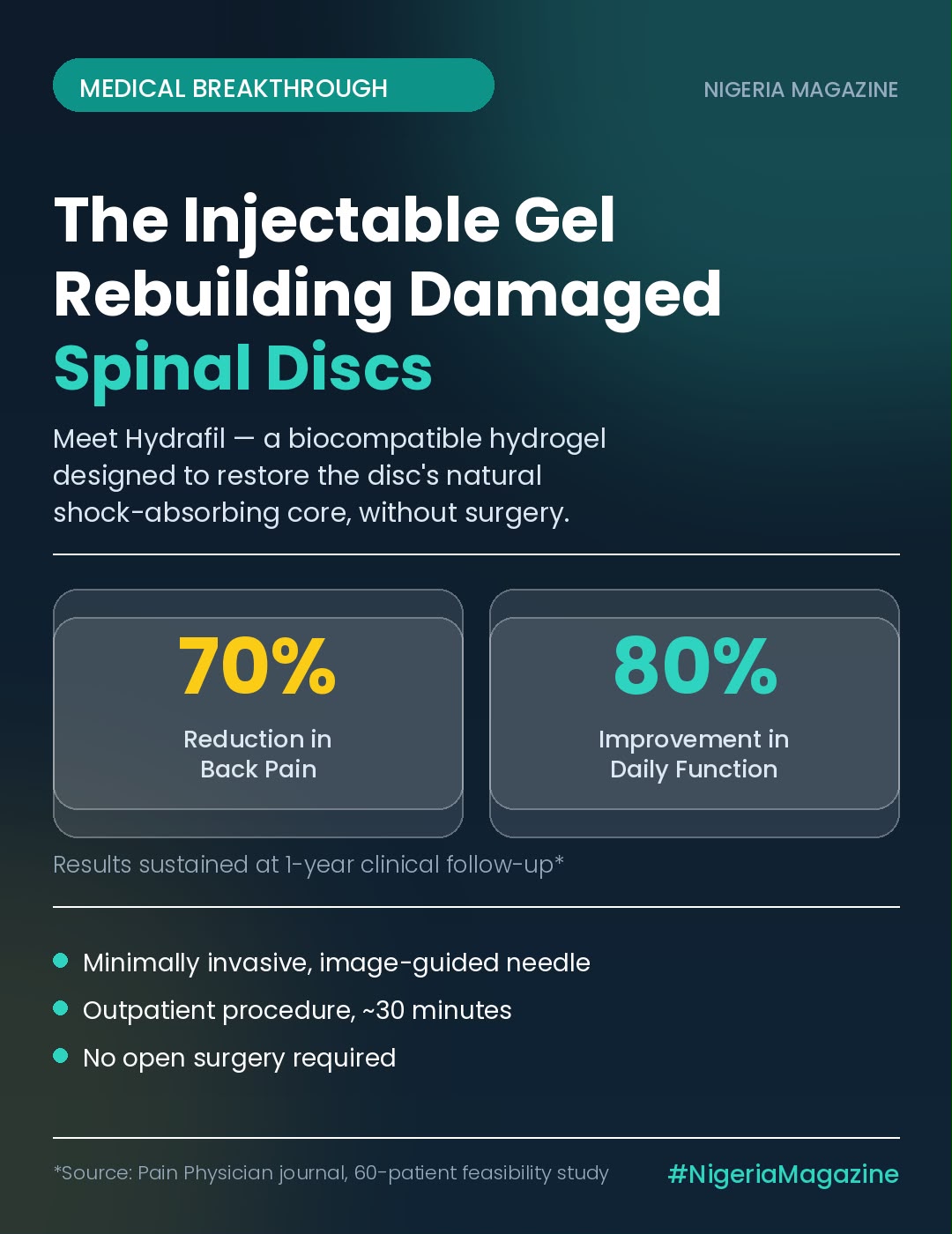
Hydrafil is a biocompatible material made mainly from polyvinyl alcohol, delivered in liquid form through a thin needle under image guidance. Once inside the disc, it cools & solidifies into a soft, flexible implant that fills fissures, helps restore lost disc height, & rehydrates the disc’s internal environment — all without open surgery.
An Outpatient Procedure, Not an Operating Table
One of the biggest draws of this approach is how it’s delivered. The procedure is performed by interventional radiologists or pain specialists using a needle roughly the width of a large syringe, under local anaesthesia, & typically takes around 30 minutes. Patients go home the same day — no hospital stay, no general anaesthesia, no lengthy surgical recovery.
What the Clinical Data Shows
A peer-reviewed feasibility study published in the journal Pain and Spine Physicians followed 60 chronic low back pain patients treated across multiple clinical sites. The results, tracked over a full year, were striking:
▶️Pain scores (measured on a standard 0–10 scale) dropped by more than 70%
▶️Disability scores, which measure how much pain interferes with daily function, improved by more than 80%
▶️Improvements appeared within the first month & were still holding steady at the 12-month follow-up
Based on this data, Hydrafil has received CE Mark approval in Europe, where it’s now commercially available. In the US🇺🇸, it remains under investigation as part of an ongoing pivotal trial working toward FDA approval.
As with any implant, it isn’t without risk: a small number of patients in the feasibility study experienced gel migration beyond the injection site, which required a follow-up procedure to correct. Researchers note this underscores the importance of the procedure being performed by trained, image-guided specialists.

