


By Moses Chibuike Ezechukwu
China and Egypt are taking another step toward reducing dependence on the US dollar in bilateral trade and investment. But beyond the headlines, the bigger question is what this shift could mean for Africa’s financial independence, trade costs and relationship with the world’s major economic powers.
The global financial system is changing, and Africa is increasingly finding itself at the centre of that change.
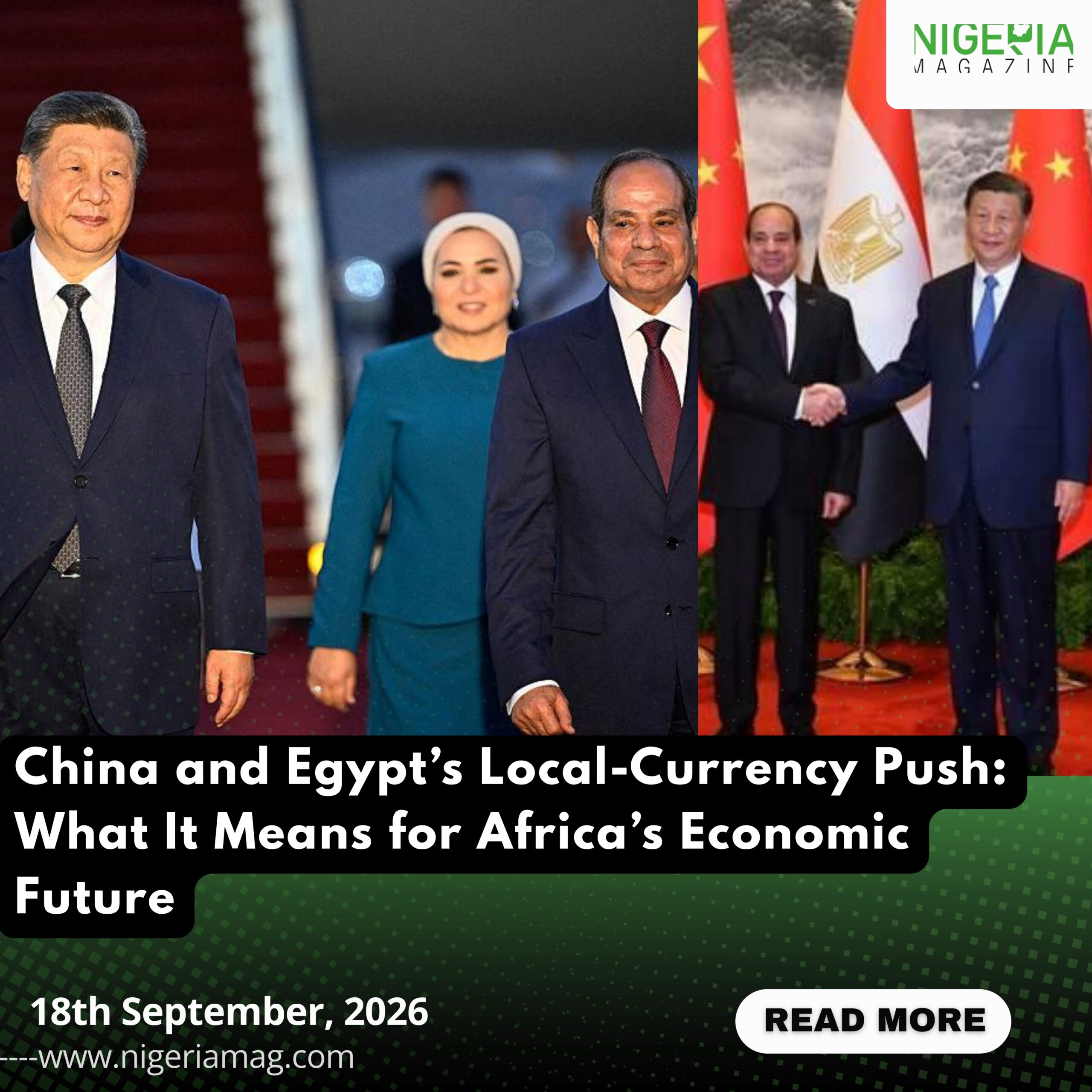
A recent development between China and Egypt has attracted attention after the two countries agreed to strengthen the use of their own currencies in trade and investment. The agreement came during Chinese President Xi Jinping’s state visit to Egypt, as both countries marked 70 years of diplomatic relations. (Xinhua News)
At first glance, this may look like another diplomatic announcement between two countries. It is, however, much bigger than that.
It is part of a wider movement in which countries are exploring ways to conduct international business without relying entirely on the US dollar.
For Africa, where China has become one of the continent’s most important trading and investment partners, this deserves serious attention.
A New Chapter in China-Egypt Trade
China and Egypt already have a significant economic relationship.
China has been Egypt’s largest trading partner for more than a decade, while Chinese companies have invested heavily in Egyptian infrastructure, manufacturing, renewable energy and the Suez Economic and Trade Cooperation Zone. (Xinhua News)
The relationship has now moved further into the financial sector.
In June 2026, the People’s Bank of China and the Central Bank of Egypt renewed their bilateral currency-swap agreement and increased its size from 18 billion yuan to 30 billion yuan. The three-year agreement is designed to support financial cooperation, facilitate bilateral trade and investment, and expand the use of the two countries’ currencies. (Xinhua News)
Then, during Xi’s September visit, the two governments formally encouraged greater settlement of trade and investment in the Chinese yuan and Egyptian pound.
That distinction matters.
This does not mean China and Egypt have suddenly abandoned the dollar. It means they are creating more room for their own currencies to be used directly when doing business with each other.
Why Countries Want Alternatives to the Dollar
For decades, the US dollar has dominated international trade, finance and foreign-exchange reserves.
That system provides enormous convenience because businesses around the world can use the dollar as a common medium for international transactions. But it also creates costs and vulnerabilities for countries whose own currencies are not widely accepted internationally.
Consider a simple example.
An Egyptian company importing machinery from China may need to convert Egyptian pounds into dollars and then use those dollars to pay a Chinese supplier. Every additional currency conversion creates potential costs, delays and exposure to exchange-rate movements.
If the transaction can instead be settled using the Egyptian pound and yuan through established financial channels, some of that friction can potentially be reduced.
That is one of the attractions of local-currency settlement.
Research by the International Monetary Fund has also examined how currency-swap arrangements can support trade by providing liquidity and enabling banks to access the currency needed for cross-border transactions. (IMF)
But there is an important reality: moving away from the dollar is easier to announce than it is to accomplish.
The Yuan Is Becoming More Important in Africa
China has spent years building the financial infrastructure necessary to make the renminbi more useful outside its borders.
That effort received another major boost in June 2026 when China authorised Standard Bank and Industrial and Commercial Bank of China to operate jointly as the “Renminbi Clearing Bank of Africa.”
The arrangement gives financial institutions in 19 African countries greater access to China’s onshore financial system and is intended to make yuan-denominated trade and investment easier. (Reuters)
This is potentially significant.
Financial infrastructure is often less visible than roads, ports or factories, but it can be just as important. If African banks can clear yuan payments more efficiently, African companies may find it easier to buy Chinese machinery, electronics, vehicles, industrial equipment and other goods without relying on the dollar for every transaction.
China’s growing economic relationship with Africa gives the development additional weight.
The IMF has noted that China has become an increasingly important economic partner for African countries, while bilateral currency-swap arrangements have emerged as one of the tools supporting trade and financial cooperation. (IMF eLibrary)
What Does This Mean for Nigeria?
Nigeria should be watching these developments closely.
China is already an important source of imported goods, machinery, equipment and infrastructure investment for Nigeria. At the same time, Nigerian businesses frequently struggle with foreign-exchange shortages, exchange-rate volatility and the cost of international payments.
A stronger African yuan-clearing network could eventually create more options for Nigerian businesses involved in China-Africa trade.
Imagine a Nigerian manufacturer purchasing equipment from a Chinese company. If the financial infrastructure allows the transaction to move efficiently between naira, yuan and appropriate settlement channels, the company may have alternatives to going through the dollar every time.
But this should not be misunderstood as an argument for simply replacing the dollar with the yuan.
That would miss the bigger issue.
Nigeria needs more choices, not another form of dependency.
The Real Opportunity Is African Economic Power
There is a temptation to describe these developments simply as “de-dollarisation.”
That phrase gets attention, but the deeper story is about financial infrastructure and economic sovereignty.
If African countries continue to export raw materials, import finished products and depend on foreign financial systems, changing the currency used for payment will not automatically transform their economies.
Africa’s real advantage will come when it begins to control more of the value chain.
For example, instead of exporting crude oil and importing refined petroleum products, African countries need stronger refining capacity. Instead of exporting raw agricultural products, they need processing industries. Instead of importing most manufactured goods, they need competitive domestic production.
Currency diversification can support that process, but it cannot replace it.
There Are Still Serious Challenges
Local-currency trade also has limitations.
A currency can only become widely useful internationally when there is sufficient demand for it, adequate liquidity, trusted financial institutions and a strong economic relationship behind it.
Trade imbalances can also create difficulties. If one country consistently exports far more than it imports, simply agreeing to use local currencies does not magically solve the imbalance.
There are also questions surrounding convertibility, exchange-rate risks, regulations and the availability of financial instruments.
The IMF has highlighted that the internationalisation of the renminbi has progressed, but that its global role still depends on the development of deeper financial markets and broader international use. (IMF)
So, while the yuan is becoming more prominent, the dollar remains deeply embedded in global commerce.
Africa Must Not Be a Spectator
The most important lesson from the China-Egypt development may therefore not be about China at all.
It is about Africa.
The world is gradually becoming more financially multipolar. BRICS is expanding, countries are discussing alternative payment systems, and central banks are exploring ways to make cross-border payments faster and less dependent on traditional channels. (Reuters)
Africa cannot afford to simply watch these changes happen.
Nigeria and other African economies need to strengthen their banking systems, deepen intra-African trade, support local manufacturing and develop payment infrastructure that makes it easier for African businesses to trade with one another and with the rest of the world.
The goal should not be to choose between Washington and Beijing.
The goal should be to build an Africa strong enough to negotiate with both.
The Bigger Picture
China and Egypt’s decision to encourage greater use of their local currencies is unlikely to bring about the end of the dollar.
But it is another sign that the global financial landscape is becoming more diversified.
For Africa, the opportunity is significant.
If local-currency systems are combined with stronger institutions, better payment infrastructure, productive industries and deeper African integration, they could help reduce some of the costs associated with international trade.
But currency is only one piece of the puzzle.
Africa’s economic future will ultimately depend on what it produces, what it controls and how effectively it converts its enormous population, resources and markets into sustainable economic power.
The China-Egypt agreement should therefore be viewed not simply as another currency story, but as a reminder that the rules of global trade are evolving.
Africa must decide whether it will simply adapt to the new system — or help shape it.

