


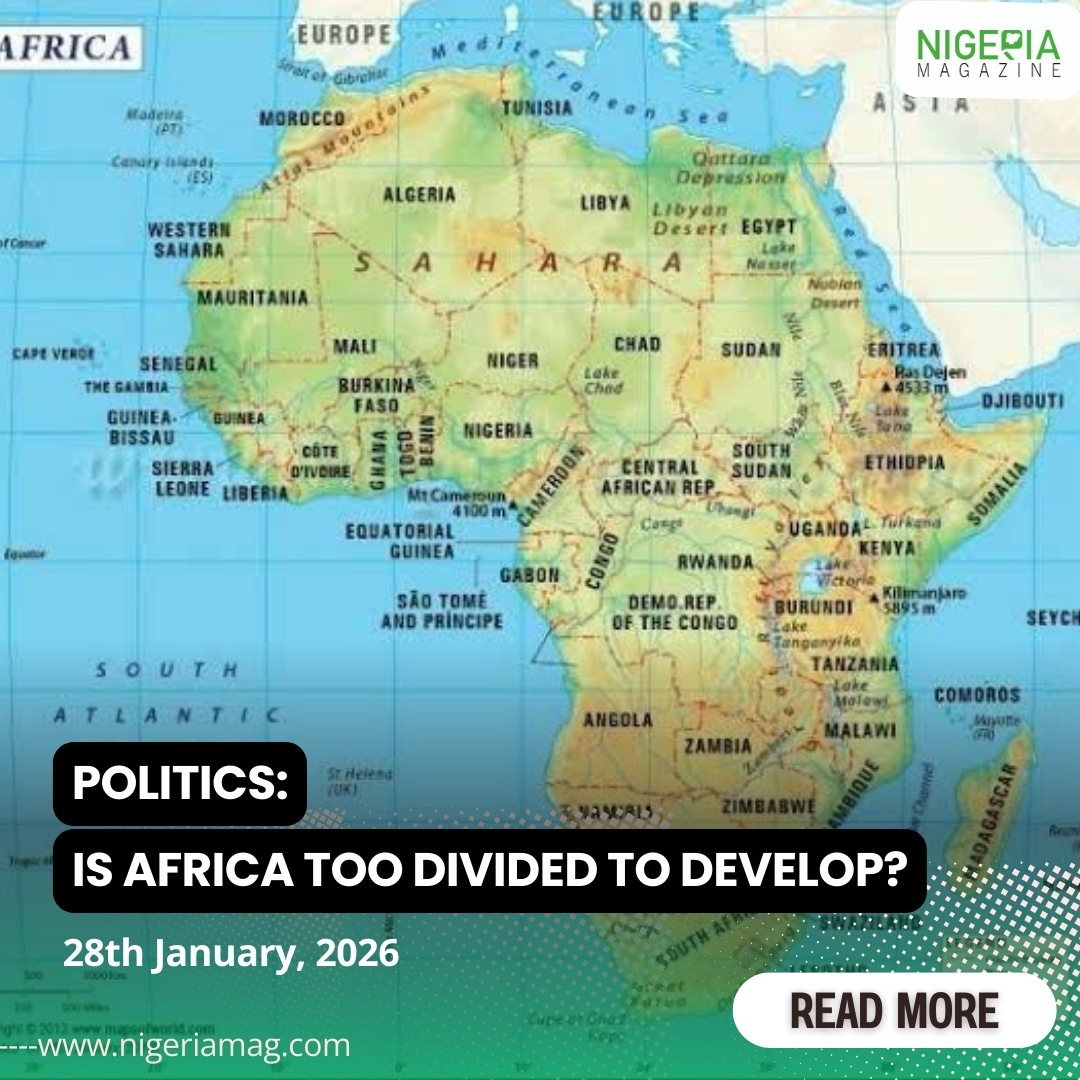
For as long as many of us can remember, conversations about Africa’s underdevelopment have followed the same script. Bad leadership. Corruption. Weak institutions. These problems are real and cannot be ignored, but they have also become the easiest explanations. Nearly seventy years after independence, Africa is still struggling to turn its enormous potential into real and lasting development. At some point, it becomes necessary to ask a harder question: what if we have been looking in the wrong direction?
What if Africa’s biggest problem is not only who leads us, but how we are organised?
Africa is one of the most resource-rich continents in the world.
From oil and gas in Nigeria and Angola, to vast farmlands across West and East Africa, to minerals in Central and Southern Africa, the continent lacks neither wealth nor manpower. Yet African countries largely operate as isolated units, hemmed in by borders that make movement, trade and cooperation unnecessarily difficult. These borders, drawn during colonial rule, were never meant to support development.
They were designed for control and convenience.
Nigeria offers a clear example. As Africa’s largest economy and most populous country, Nigeria should naturally be a major hub for regional trade and production. Instead, it is often easier for Nigerian businesses to import goods from Europe or Asia than to move them across borders to Benin, Niger or Cameroon. Border closures, inconsistent policies and poor regional coordination have turned what should be economic corridors into bottlenecks.
No country develops in isolation. Even the most powerful nations depend on cooperation. In the United States, the fifty states function within a shared economic space, each contributing according to its strengths. In Europe, countries with different languages, cultures and histories chose integration over division through the European Union, allowing goods, services and people to move freely. That decision transformed a once-war-torn region into a global economic force.
Africa has yet to make a similar commitment.
Across the continent, African countries trade more with distant nations than with their immediate neighbours. Landlocked countries struggle endlessly with access to ports. Small economies duplicate infrastructure refineries, power plants, rail systems, that could be shared regionally. The result is inefficiency, high costs and slow growth.
Beyond economics, African countries face shared challenges that do not respect national borders. Desertification affects communities from Northern Nigeria through the Sahel. Climate change disrupts farming patterns across regions. Insecurity spills across borders, yet responses remain largely national and uncoordinated. Heavy debt burdens further limit the ability of individual countries to invest meaningfully in development.
This reality raises a difficult but important question: can Africa truly develop while remaining so fragmented?
What if the problem is not just leadership or corruption, but closed borders, limited regional integration, and a lack of genuine cooperation?
Imagine an Africa organised not into 54 small and often weak states, but into a few strong regional blocs, West, East, North, Central and Southern Africa, each capable of planning development on a meaningful scale. In West Africa alone, Nigeria’s market size and population could combine with Ghana’s stability, Côte d’Ivoire’s agriculture, Senegal’s ports and Niger’s energy potential to form a powerful regional economy. Landlocked countries would no longer be trapped by geography, and infrastructure would be built to serve regional needs rather than narrow national interests.
This idea is not about erasing identities or cultures. Nigerians will remain Nigerians. Our languages, traditions and histories will endure. Unity does not require uniformity. It requires recognising that cooperation offers greater benefits than isolation.
The African Continental Free Trade Area is a step in the right direction, but trade agreements alone are not enough. True integration demands political will, open and predictable borders, shared infrastructure, and policies that prioritise regional prosperity over short-term national gains.
Interestingly, many African youths already understand this. Young Nigerians collaborate daily with peers in Kenya, Ghana, South Africa and beyond through technology, business and creative industries. For them, a connected Africa is not an abstract dream, it is a practical necessity.
Perhaps Africa’s challenge is not that it lacks ideas or resources, but that it remains too divided to fully use them.
If Africa is serious about development, it may need to look beyond the colonial map and ask deeper questions about structure, cooperation and integration. The future may not lie in endlessly fixing broken national systems, but in rethinking the system itself.
Africa does not lack potential.
What it lacks is connection.
And until that changes, development will remain a promise just beyond reach.
Ubong Usoro for Nigeria Magazine

