


By Kede Aihie
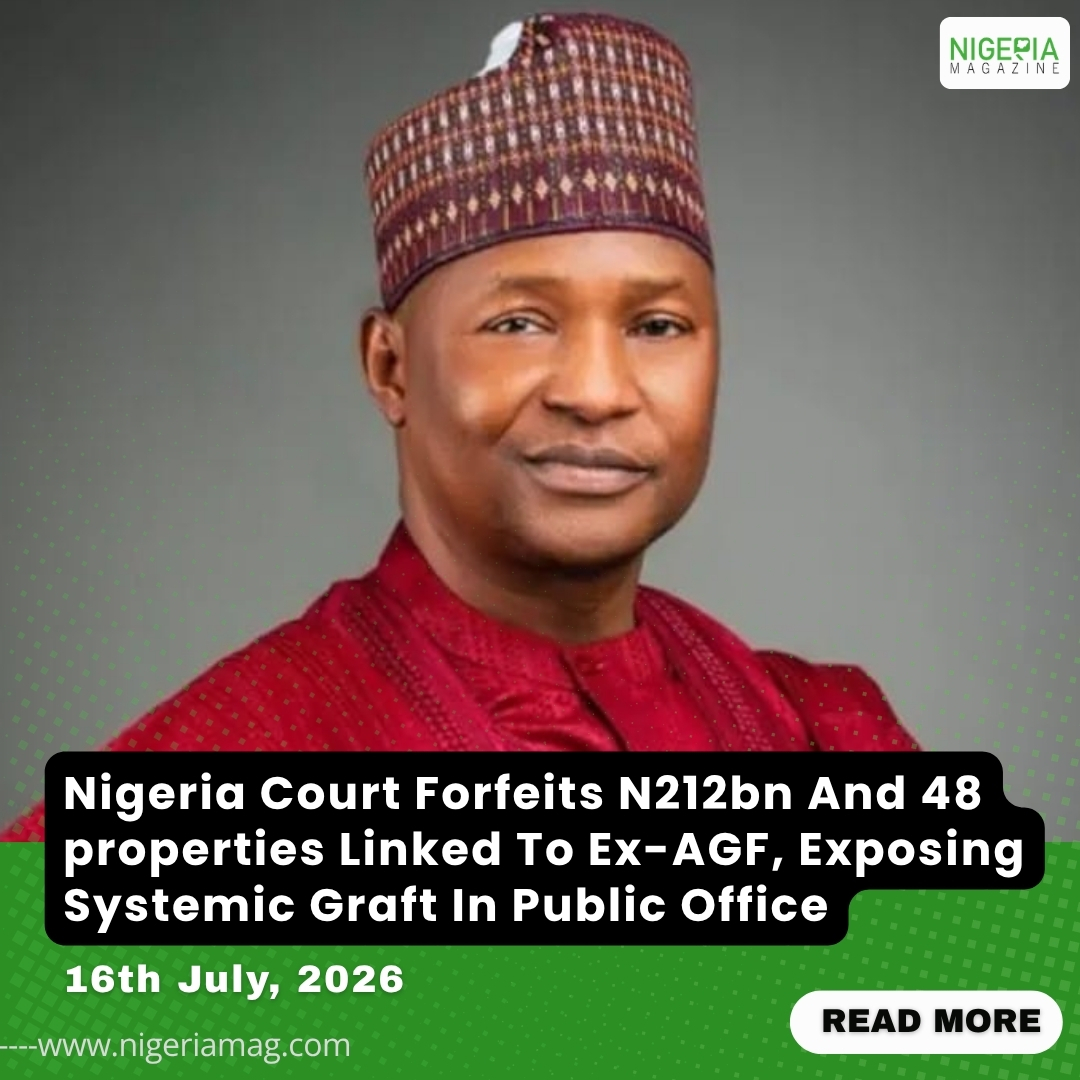
The headline dominating Nigerian television and newspapers today is not a rumor. It is a court judgment. A court has granted final forfeiture of 48 out of 57 properties, including a university, valued at N212 billion, linked to Nigeria’s former Attorney General and Minister of Justice in an EFCC suit. Read that number again. N212 billion.
This is Abubakar Malami, SAN. He was appointed on 11 November 2015 as Minister for Justice and Attorney-General of the Federation, the youngest in President Buhari’s first cabinet. He was re-appointed on 21 August 2019. He was the chief law officer. The man whose job was to prosecute corruption, defend the Constitution, and advise government on justice. Today, the EFCC is taking back assets allegedly traced to that same tenure. A university. Dozens of properties. Wealth that could have built 10 fully-equipped teaching hospitals, or fixed the Lagos-Ibadan and Abuja-Kano expressways, or paid ASUU for 3 years. This is not an isolated case. It is a pattern.
Since 2015, EFCC forfeiture cases have run into trillions of naira. From the “grasscutter” scandals to recovered billions in Ikoyi apartments, to forfeitures linked to ministers, governors, and heads of agencies. The Attorney General’s office has repeatedly appeared at the center of controversy because of the control it has over prosecution, over civil asset recovery, and over legal opinions that unlock billions. When the person meant to be the firewall becomes the subject of investigation, the entire anti-corruption architecture collapses from the inside. The message to Nigerians has been consistent for more than 20 years. Get into office, and wealth follows. Leave office, and the case drags for a decade. If there is a forfeiture, it comes after the assets have already been enjoyed.
Let’s stop pretending this is just “alleged mismanagement.” Corruption in Nigeria is now institutional. Public office has become a business. The playbook is known by everyone in power. First, get appointed. Then control procurement, legal opinions, and regulatory approvals. Then use proxies, shell companies, and family to acquire assets. Then delay investigation with injunctions and legal technicalities. Finally, rely on weak oversight and political protection. N212 billion does not grow on a salary. Universities are not built with estacode. 48 properties are not inherited. It takes a state where the National Assembly does not ask questions, where the Code of Conduct Bureau does not verify, and where the ICPC and EFCC move only after tenure ends. When the Attorney General is linked to this scale of acquisition, it tells every commissioner, director, and permanent secretary that the law is for the poor. The top can steal, and the worst that happens is forfeiture years later.
This keeps happening because the system is designed to allow it. The first problem is weak asset declaration and verification. Public officials declare assets, but there is no real-time check against bank records, CAC filings, and land registries. You can declare 2 houses and own 48. The second problem is prosecutorial control. The AGF has powers to enter nolle prosequi, take over cases, and give legal advice on recoveries. That concentration of power without independent oversight invites abuse. The third problem is delayed consequences. By the time EFCC secures a final forfeiture, the official has spent 8 years in office and another 4 in court. The penalty becomes losing what you stole, not jail, not disgrace, not a ban from public office.
What would actually change things is simple, but hard. Nigeria needs independent prosecution. The absolute control of federal prosecution should be removed from the AGF and given to an independent Director of Public Prosecutions. We need real-time asset tracking. Code of Conduct declarations should be linked to FIRS, CAC, and CBN so mismatches are flagged automatically. We need mandatory jail time plus a 10-year ban. Forfeiture alone is not a deterrent. Add prison time and a lifetime ban from public office and government contracts. And we need to publish the forfeited assets. Name the properties, their locations, and what they will be used for. Turn N212 billion into hospitals and schools, not just entries in a government ledger.
This forfeiture is evidence, not closure. It is evidence of how easily public funds are diverted. It is evidence of how power is monetized. It is evidence of a culture of impunity built over decades. Until stealing from Nigeria costs you your freedom, your name, and your future, public office will remain the fastest route to illegal enrichment. Nigeria cannot survive another generation where the people sworn to uphold the law become the case studies used to break it.

