


By Moses Chibuike Ezechukwu
From South Africa’s established banking powerhouses to Egypt’s influential financial institutions and Morocco’s expanding banking groups, Africa’s largest banks are shaping the continent’s economic future. A June 2026 ranking reveals how banking assets are concentrated across three countries—and what this means for investment, competition and Africa’s financial growth.
Africa’s Banking Power Is Concentrated in Three Countries
The figures in the June 2026 ranking tell an important story about the structure of Africa’s financial sector. South Africa accounts for five of the ten banks featured, Morocco has three, and Egypt has two. Together, these countries represent the entire top ten in the ranking.
The ranking is based on total assets, a measure that includes a bank’s financial resources, such as loans, investments, cash and other holdings. It provides an indication of institutional scale, although it does not necessarily tell us which bank is the most profitable, the most efficient or the best for customers.
The ten largest banks in Africa, according to the June 2026 ranking, are:
- Standard Bank Group — South Africa
- National Bank of Egypt — Egypt
- FirstRand — South Africa
- Absa Group — South Africa
- Nedbank — South Africa
- Banque Misr — Egypt
- Attijariwafa Bank — Morocco
- Investec — South Africa
- Banque Centrale Populaire — Morocco
- Bank of Africa — Morocco
Source: June 2026 ranking published by FirstBank Egypt. Figures are rounded.
Collectively, these ten institutions hold approximately $1.21 trillion in assets. That is a substantial concentration of financial resources, although the total represents the banks’ balance-sheet assets rather than money they can freely spend or lend.
Standard Bank Group: Africa’s Banking Leader
At the top of the ranking is South Africa’s Standard Bank Group, with approximately $232 billion in assets.
Its position reflects the scale of its operations and its established presence in personal banking, business banking, corporate finance and investment banking. The group also operates across several African markets, connecting businesses, governments and individuals to financial services.
For a bank of this size, the opportunities extend beyond collecting deposits and issuing loans. Large financial institutions can support international trade, finance infrastructure projects, facilitate cross-border payments and help businesses raise capital.
Standard Bank’s position also highlights the importance of South Africa’s relatively developed financial system in the continental banking landscape.
However, size comes with responsibilities. Large banks must manage credit risk, comply with regulatory requirements, protect customers against financial crime and maintain confidence during periods of economic uncertainty.
Its continued leadership will depend not only on its balance sheet but also on its ability to grow sustainably while responding to changing customer expectations.
National Bank of Egypt: A North African Giant
Egypt’s National Bank of Egypt ranks second, with approximately $198 billion in assets.
The bank occupies an important position in one of Africa’s largest economies. Its scale gives it a significant role in financing businesses, serving households and supporting economic activity.
Egypt’s large population and substantial domestic market create considerable demand for financial services. Banks operating in this environment must serve individuals, small businesses, large corporations and public-sector institutions.
The National Bank of Egypt’s position demonstrates that Africa’s banking power is not confined to the southern part of the continent.
It also illustrates the importance of North African financial institutions in connecting domestic economic activity with broader regional and international markets.
Nevertheless, Egypt’s economic conditions, currency movements and inflationary pressures can influence the banking environment. Maintaining growth requires balancing lending opportunities against the risks associated with economic uncertainty.
FirstRand: A Major Player in Corporate and Retail Banking
Another South African institution, FirstRand, occupies third place with approximately $168 billion in assets.
The group operates through banking businesses serving different customer segments, from individuals and small enterprises to major corporations.
Its scale provides opportunities to compete across retail banking, business finance and specialised financial services. For businesses, access to reliable financing can support expansion, investment in equipment and the creation of jobs.
For individuals, banking services provide ways to save, borrow, make payments and manage their finances.
FirstRand’s position among Africa’s largest banks also demonstrates that South Africa’s banking strength is not dependent on a single institution. Several large banking groups have developed substantial operations within the same national market.
That competition can encourage innovation and give customers more options, although the benefits depend on pricing, accessibility and the quality of service.
Absa and Nedbank: Strengthening South Africa’s Position
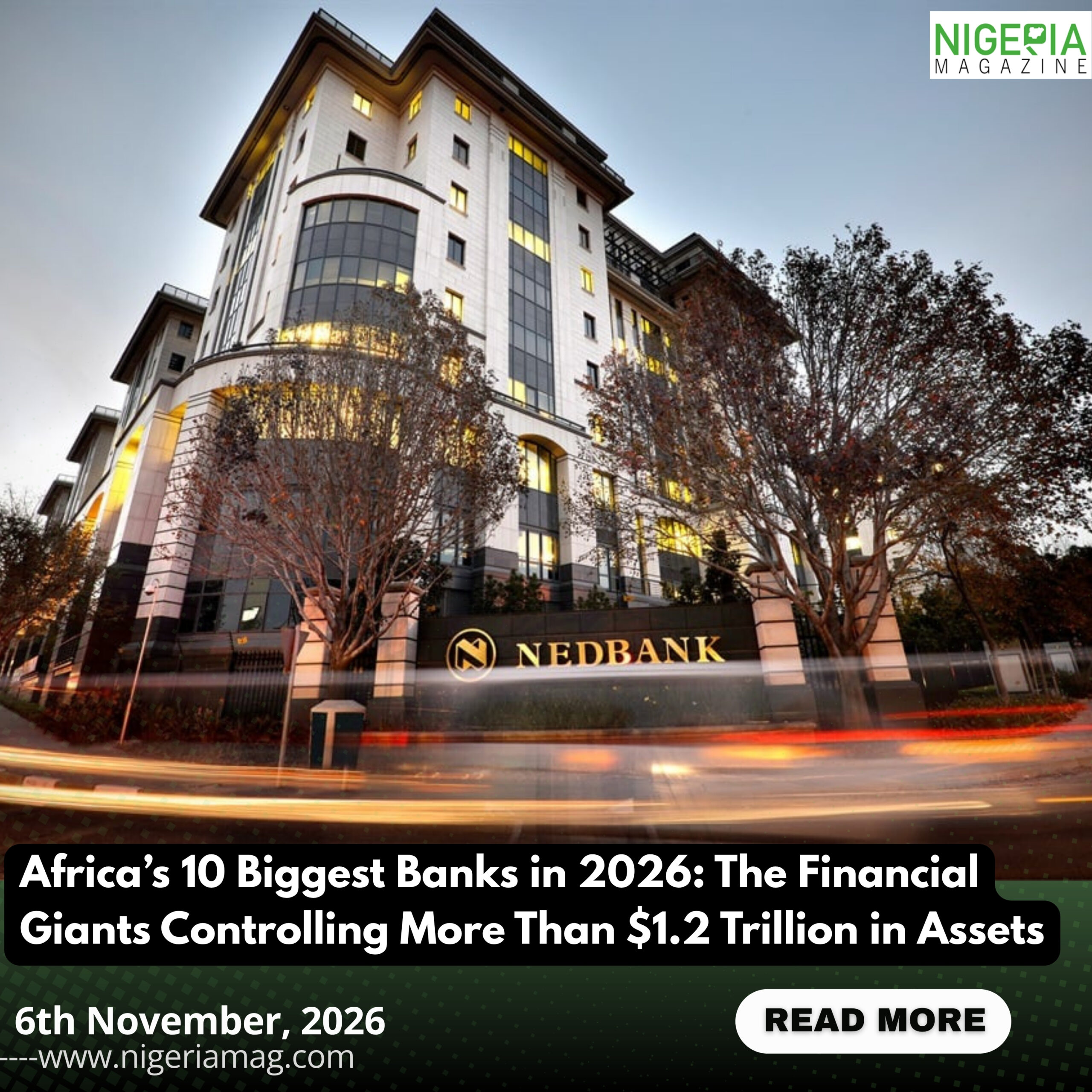
Absa, with approximately $139 billion in assets, ranks fourth, while Nedbank occupies fifth place with around $98 billion.
Both institutions contribute to South Africa’s strong representation in the ranking.
Their presence highlights the depth of the country’s banking sector, where several established groups compete to serve individuals, businesses and institutional clients.
The ability of multiple South African banks to maintain positions among the continent’s largest institutions suggests a financial system with considerable capacity to mobilise capital and support complex banking activities.
However, a large balance sheet does not eliminate challenges. Banks must continue to manage bad loans, cybersecurity threats, changing regulations and the costs of maintaining extensive branch networks and digital infrastructure.
They must also compete with financial technology companies that are introducing new ways for customers to make payments, transfer money and access financial services.
Egypt and Morocco: Expanding North Africa’s Influence
The ranking also highlights the importance of Egypt’s Banque Misr and Morocco’s banking sector.
Banque Misr ranks sixth, with approximately $95 billion in assets, reinforcing Egypt’s presence among Africa’s largest banking markets.
Morocco contributes three institutions:
Attijariwafa Bank, Banque Centrale Populaire and Bank of Africa.
Their respective positions—seventh, ninth and tenth—show that Morocco has developed several banking groups with substantial financial resources.
These institutions also have opportunities to serve customers beyond their domestic market. Cross-border banking can support trade, investment and business expansion, particularly when companies operate across several African countries.
For the continent, this matters because businesses need reliable financial partners to receive payments, finance imports and exports, and manage operations across different currencies and regulatory environments.
The challenge is to turn this financial capacity into wider access to credit, stronger businesses and more inclusive economic growth.
What Does This Mean for Nigeria?
For Nigerian readers, one of the most striking features of the ranking is the absence of a Nigerian bank from the top ten.
That absence should not be interpreted as evidence that Nigeria lacks major financial institutions. Nigeria has a large banking sector, substantial commercial activity and banks with significant regional operations.
A separate ranking of Africa’s 20 largest banking groups published in October 2026 placed Access Holdings at number 12, followed by United Bank for Africa at number 18, Zenith Bank at number 19 and First HoldCo at number 20. That ranking used different reporting dates for some institutions, so comparisons require caution.
The comparison nevertheless raises an important question: what would it take for more Nigerian banks to compete with Africa’s largest institutions?
One factor is capital. Banks need sufficient financial resources to expand lending, invest in technology and withstand unexpected losses.
Another is economic stability. Exchange-rate movements can substantially affect the dollar value of assets reported in naira. This means a bank’s position in an international ranking may change even when the underlying size of its domestic-currency balance sheet has not changed by the same proportion.
Regulatory compliance, corporate governance, access to international markets and the ability to manage credit risk also matter.
Nigeria’s banking recapitalisation programme has created pressure for institutions to strengthen their capital bases. The longer-term test will be whether stronger banks can use that capacity to finance productive businesses, expand services and compete more effectively across Africa.
Size Alone Does Not Guarantee Success
While the ranking offers a useful snapshot of Africa’s largest banks, total assets should not be the only measure of banking success.
A bank with a large balance sheet may still face profitability challenges, high operating costs or significant exposure to risky loans.
Investors should also consider profitability, capital adequacy, liquidity, asset quality and the bank’s ability to generate sustainable returns.
Customers, meanwhile, may be more concerned about transaction charges, customer service, digital reliability and access to credit than the size of a bank’s assets.
For governments and policymakers, the broader questions involve financial inclusion, support for small businesses and the banking sector’s contribution to economic development.
The strongest banking institutions are those that combine financial scale with responsible lending, sound governance and dependable services.
The Race to Build Africa’s Financial Future
Africa’s ten largest banks demonstrate how financial strength is concentrated in South Africa, Egypt and Morocco. Standard Bank Group leads the ranking, while several other established institutions underline the depth of these three countries’ banking markets.
But the figures represent more than a contest between large financial institutions. They offer a glimpse into the distribution of financial capacity across a continent with enormous economic potential.
For Nigeria, the challenge is to strengthen its banking institutions, improve economic stability and ensure that financial resources translate into productive investment.
For Africa as a whole, the opportunity lies in building stronger connections between financial markets, expanding access to banking services and supporting businesses capable of creating jobs across national borders.
Ultimately, the success of Africa’s banking giants should not be measured by their assets alone. It should also be measured by the businesses they help build, the people they serve and the role they play in creating a more prosperous continent.

