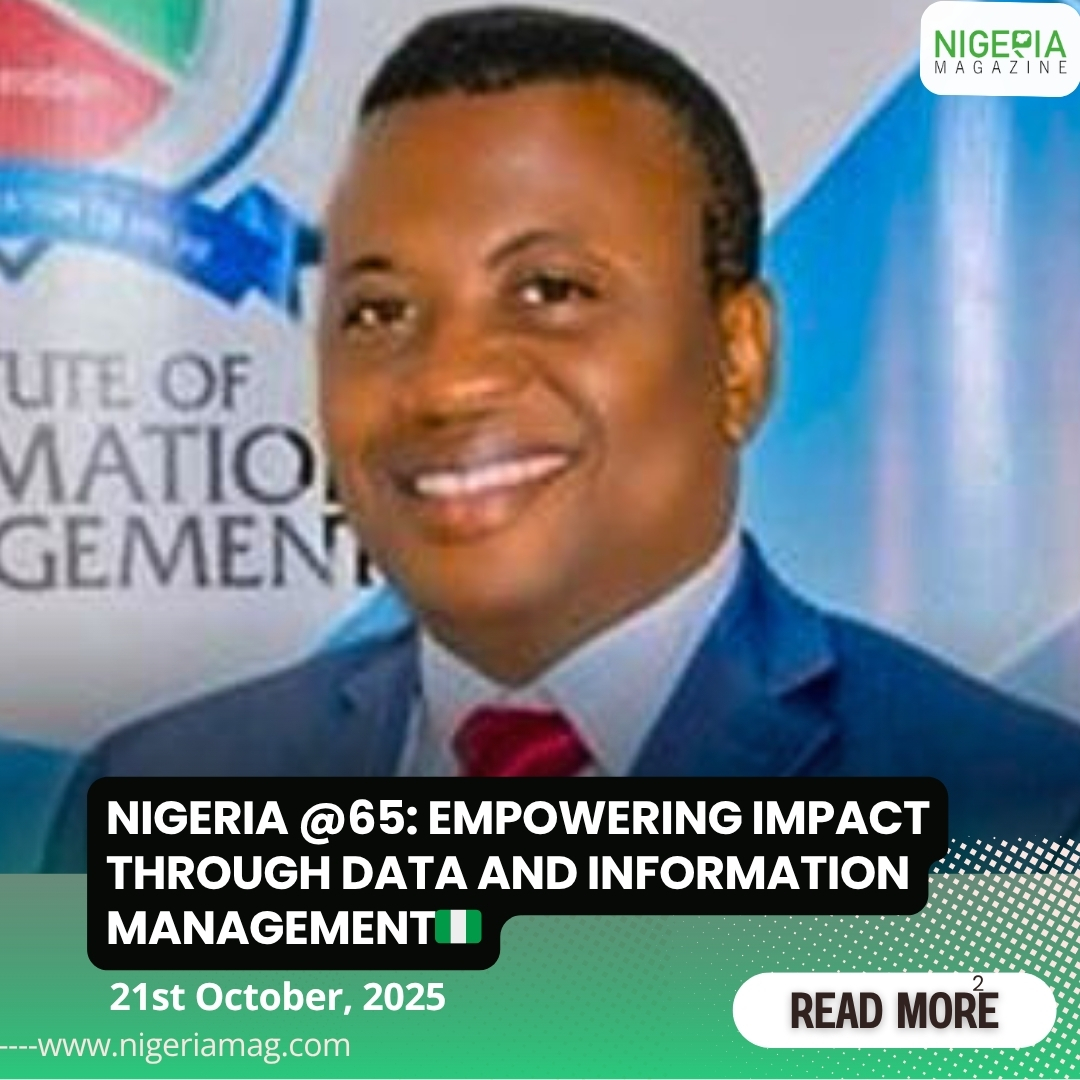
By Amb. (Dr) Oyedokun A. Oyewole – International President/Chairman, Institute of Information Management (IIM) Africa; Country Chief Data Officer Ambassador (Nigeria); Founder, International University of Information Management (IUIM), USA.
At sixty-five, Nigeria stands at a rare inflection point. We have experimented with oil, policies, and personalities, yet the true unlock for our next chapter lies in data and information management. Our challenge is not the absence of data but the lack of data fitness, data and information that is scattered, stale, siloed, or suspect. The national prize is to raise the quality, governance, and usability of what we already collect across ministries, states, local governments, agencies, and the private sector. Data is not the new oil if it keeps leaking. It only becomes wealth when it is governed, protected, and put to work.
Great governance may not be glamorous, but it saves billions. With clear stewardship, lifecycle management, metadata consistency, and auditability, data becomes a foundation for transparency and confidence. Beyond governance, trust itself is a national infrastructure. Citizens will only share data when they know their rights are respected and enforced. This is why Nigeria’s momentum on data protection and privacy, and the rise of Data Protection Officers, must translate into everyday practice where consent is meaningful, breach responses are swift, and sanctions are real.
The development impact of good data and information management is tangible. In healthcare, better patient records reduce errors and improve epidemiological responses. In education, clean EMIS data ties budgets to real needs and improves outcomes. In agriculture, geospatial and market data help farmers plant smarter and sell better. In infrastructure and power, registries and maintenance logs prevent waste and corruption. In finance, data integrity curtails leakages. In security, lawful data sharing saves lives. Even in the creative economy, rights and royalties can be safeguarded through structured data and information flows.
The next frontier is Digital Public Infrastructure, the “digital roads and bridges” of our nation, such as digital identity, secure data exchange, and registries. Designed with privacy and interoperability, they unlock innovation across GovTech, AgriTech, HealthTech, and FinTech. Alongside this, we must preserve our institutional memory through robust records and archives management, ensuring continuity across administrations and avoiding the costly habit of “national amnesia.” AI, too, can serve Nigeria, but only if grounded in quality, bias-checked, ethically sourced data. Without strong data foundations, artificial intelligence becomes artificial ignorance.
Ultimately, platforms will not save us, people will. We must build capacity through serious investment in data literacy, professional certifications, and industry-academic partnerships. Certified and competent professionals will drive the sustainability of our data ecosystem. Practical quick wins could include data leadership charters in MDAs, targeted clean-up of the most-used datasets, standardized retention schedules, operationalized privacyprograms, and cross-agency interoperability pilots. Citizens must be educated on their rights, and progress must be transparently tracked.
At 65, the real question is not whether Nigeria has data, but whether we can trust it, govern it, and use it ethically to transform lives. Data is not a department; it is a discipline, and it must become everybody’s business if we are to move the needle on development. Records don’t forget, and neither should we.
Reflecting also on Nigeria Magazine @15, I must commend the platform for its remarkable role as a consistent listener in a noisy world. As an awardee, sponsor, and advocate, I have seen how the magazine curates with conscience, bridging sectors, industries, and generations, and offering continuity with courage in a challenging media landscape. For fifteen years, it has been a platform that does not simply chase headlines but elevates conversations that matter. Its impact lies in being both a chronicler of our nation’s journey and a catalyst for progress. As it looks to the future, I encourage the magazine to continue spotlighting the quiet professionals who modernize our records, protect our data, and guard our privacy, because they are the unseen architects of national transformation.
Here’s to Nigeria at 65: a nation poised to unlock its next level of greatness through disciplined data and information management. And here’s to Nigeria Magazine at 15: a platform that has bridged, curated, and sustained our national narrative with integrity and purpose. Together, they both remind us that information is power, but only when it is stewarded wisely, ethically, and for the common good.
Author’s Bio
Amb. (Dr.) Oyedokun Ayodeji Oyewole is Nigeria’s Country Chief Data Officer Ambassador (CCDOA) and a passionate advocate for advancing the practice of data and information management across Nigeria and Africa. With over two decades of professional experience, he has designed, implemented, and consulted on enterprise content management, business process management, document and records management, and electronic information systems for diverse organizations.