


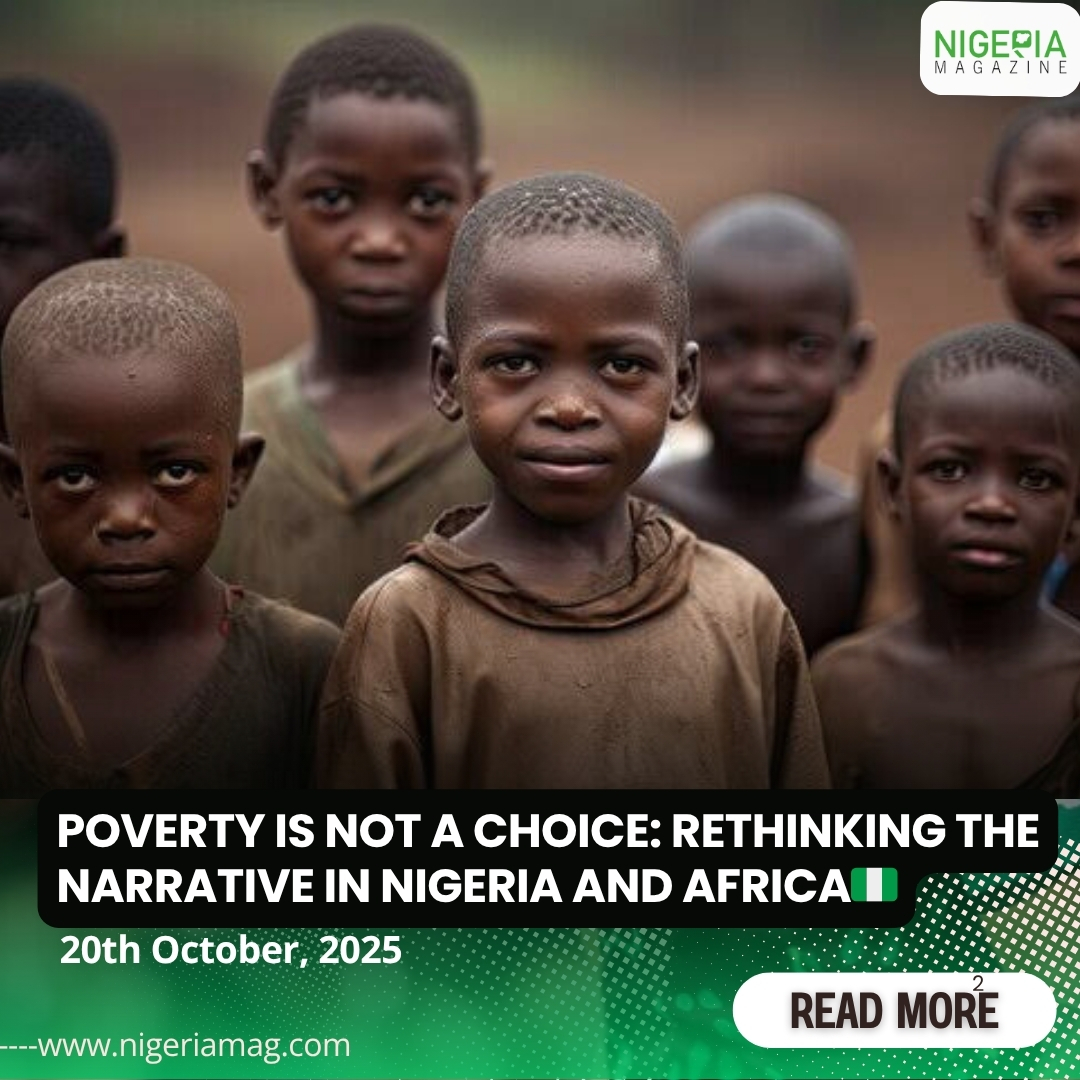
Too often, when poverty comes up in conversation, someone shrugs and says, “It’s their choice. If they worked harder, they wouldn’t be poor.”
But as Pope John Paul XIV wisely put it:
“The poor are not there by chance or by blind and cruel fate. Nor, for most of them, is poverty a choice. Yet, there are those who still presume to make this claim, thus revealing their own blindness and cruelty.”
In Nigeria today, over 133 million people live in multidimensional poverty—meaning they lack not just money, but also access to food, healthcare, clean water, education, and decent housing. Can we really call that a matter of “choice”?
Poverty is More Than Laziness
Poverty in Nigeria and across Africa is not about laziness. It is about structures. It is about being born in a community where schools are underfunded, jobs are scarce, and insecurity makes farming or business almost impossible. It is about leaders who mismanage resources and policies that widen the gap between rich and poor.
Yes, hard work matters. But in societies where opportunities are unfairly distributed, effort alone is not enough to break the cycle.
Why This Narrative Hurts Us
Blaming the poor doesn’t just insult people who are struggling—it also blinds us to the real issues. If we believe poverty is a personal choice, we excuse bad governance, corruption, and inequality. We allow broken systems to keep running because “it’s not our problem.”
But poverty is our problem. It holds back Nigeria. It holds back Africa. A nation is only as strong as its weakest members.
What We Can Do Differently
Instead of pointing fingers, we should be asking:
- How can we make education truly accessible to all?
- How can we ensure healthcare, food security, and jobs reach rural and urban poor alike?
- How can leaders be held accountable for resources meant to lift people out of poverty?
Poverty eradication is not about charity—it’s about justice.
The poor are not poor because they chose it. They are poor because society has failed to build fair systems. Once we stop blaming and start building, we can change the story—not just for individuals, but for Nigeria and Africa as a whole.
✨ Let’s replace blindness with compassion. Cruelty with justice. Excuses with action.
Nigeria
NigeriaMagazine
@Nigeria_BM

