


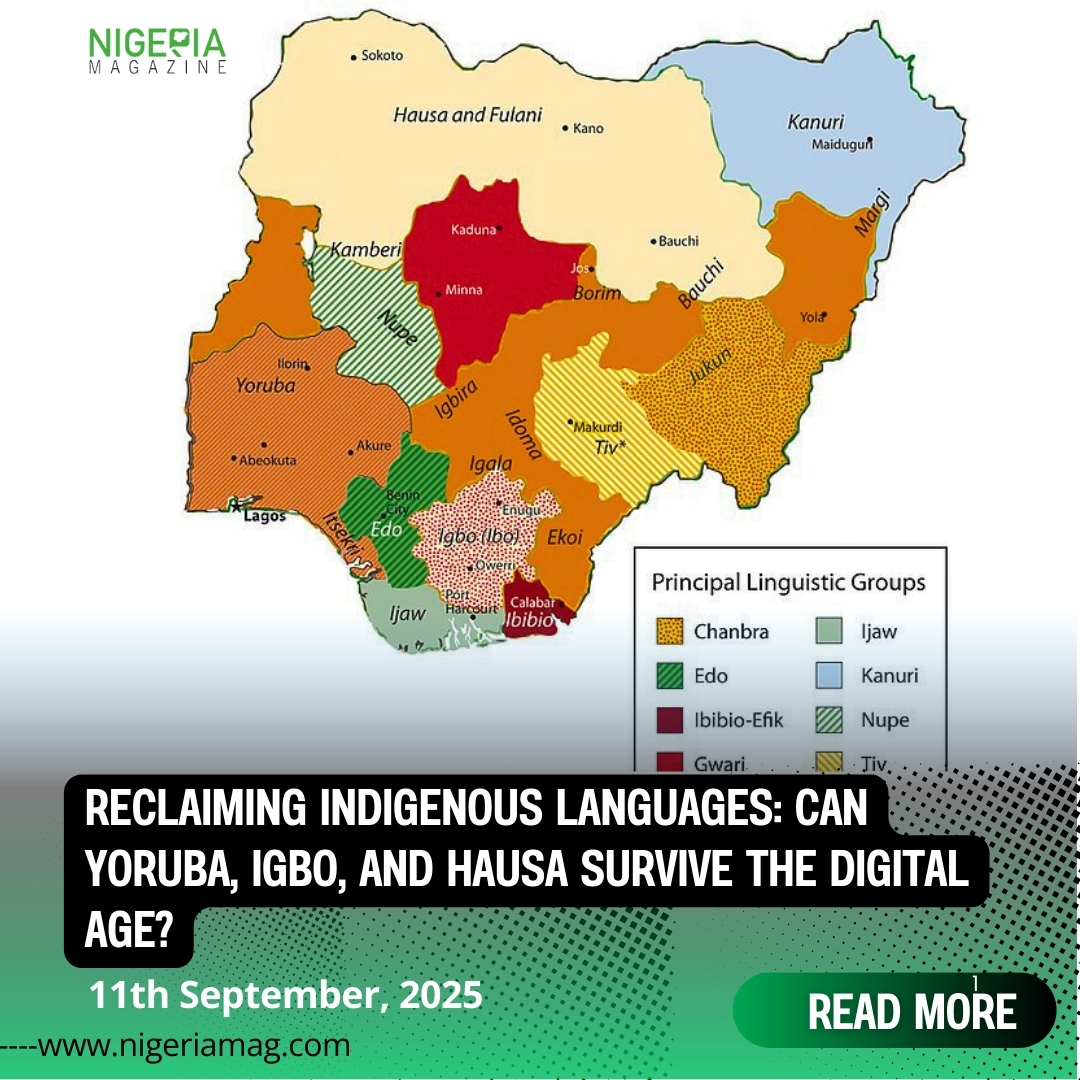
In the heart of Nigeria, three major indigenous languages—Yoruba, Igbo, and Hausa—have shaped cultural identity, oral tradition, literature, and collective memory for centuries. Yet, as the digital age accelerates, questions about their survival and relevance in a technology-driven world have become urgent. Will these languages adapt and thrive in digital spaces, or will they gradually fade under the dominance of English and other global tongues?
The Digital Age: A Double-Edged Sword
The digital revolution has brought both threats and opportunities for indigenous languages. On one hand, global platforms like social media, online education, and streaming services are dominated by English, French, Chinese, and other widely spoken languages. Young Nigerians, particularly in urban centres, often default to English in digital communication, perceiving it as more prestigious or practical. This has led to concerns that Yoruba, Igbo, and Hausa and other indigenous languages may lose ground among future generations.

On the other hand, the same digital tools offer unprecedented opportunities to document, teach, and promote indigenous languages. From mobile apps to online dictionaries, podcasts, and YouTube channels, creators and language activists are finding new ways to preserve and revitalize these tongues.
Yoruba, Igbo, and Hausa: State of the Languages
Yoruba: Spoken by over 40 million people in Nigeria and the diaspora, Yoruba boasts a rich literary tradition, including religious texts, poetry, and drama. It is also widely used in Nollywood movies and music. Digitally, Yoruba is relatively visible, with mobile applications, online Bible translations, and Yoruba keyboard tools helping sustain usage.
Igbo: With about 30 million speakers, Igbo has struggled more in recent decades, facing a noticeable decline in intergenerational transmission. Studies indicate that many Igbo families in cities prefer raising children in English, relegating Igbo to ceremonial or cultural contexts. However, digital projects such as Igbo podcasts, Instagram pages teaching Igbo words, and the “Nsibidi” script revival are showing promise.
Hausa: As one of the most widely spoken languages in Africa—over 50 million native speakers and 20 million second-language speakers—Hausa is relatively strong. Its role as a lingua franca in northern Nigeria and West Africa, combined with a robust tradition in radio, television, and print, gives it a strong digital presence. Hausa-language YouTube channels, blogs, and even Hausa-language content on international broadcasters like the BBC are flourishing.
The Role of Technology in Preservation
The survival of indigenous languages in the digital age will depend on deliberate innovation.
Key areas include:
Social Media: Platforms like TikTok, X (formerly Twitter), and Instagram are vital for engaging younger generations. Memes, skits, and short-form content in Yoruba, Igbo, and Hausa can normalize daily use.
Apps and Learning Tools: Language-learning apps such as Duolingo and Memrise now host Yoruba and Hausa, though Igbo’s presence remains limited. Expanding access through gamified learning could make indigenous languages more appealing to children.
Artificial Intelligence (AI): Voice recognition, machine translation, and text-to-speech tools must include Nigerian languages. Without this, digital exclusion may deepen, as speakers will lack access to services in their mother tongues.
Digital Literature and Archives: E-books, audiobooks, and digitised archives of folklore and oral traditions can make indigenous literature accessible globally, ensuring preservation for future generations.

Cultural Identity and Pride
Language is more than a communication tool—it is a vessel of identity. Reclaiming Yoruba, Igbo, and Hausa in the digital age is not just about preserving words but about maintaining cultural continuity. Nollywood’s use of Yoruba and Igbo, Afrobeat artists mixing indigenous lyrics with global sounds, and Hausa-language dramas have proven that local languages can thrive when integrated with popular culture.
However, challenges remain. Many Nigerians still view indigenous languages as markers of rural or “less educated” backgrounds, a stigma that discourages use in professional and elite spaces. Digital platforms, if leveraged correctly, can reverse this perception by showcasing indigenous languages as modern, vibrant, and globally relevant.
Government and Institutional Responsibility
Government policy plays a pivotal role in language preservation. While Nigeria’s constitution recognises Hausa, Yoruba, and Igbo as major languages, enforcement in education, media, and governance is inconsistent. Policies mandating mother-tongue instruction in early schooling exist but are poorly implemented.
Digital-era policies could include:
Funding for indigenous language content creation.
Incentives for tech companies to integrate Nigerian languages into software and devices.
Support for research and development of AI tools in Yoruba, Igbo, and Hausa.
The Diaspora Factor
The Nigerian diaspora, especially in Europe and North America, plays a crucial role in language survival. Many parents abroad are keen to pass Yoruba, Igbo, or Hausa to their children as a link to heritage. Online communities, digital learning platforms, and diaspora-led cultural initiatives often keep these languages alive even more vibrantly than at home. Diaspora musicians, writers, and filmmakers also popularise indigenous expressions globally.
Can They Survive?
The question of whether Yoruba, Igbo, and Hausa can survive the digital age does not have a simple answer. Hausa appears relatively secure, given its widespread usage and digital integration. Yoruba is resilient, buoyed by its cultural influence and diaspora strength. Igbo, however, faces the steepest challenge, with declining everyday use raising fears of language endangerment.
Survival will require collective effort—by governments, educators, tech developers, content creators, and ordinary Nigerians. The digital age can either accelerate extinction or spark a renaissance. The choice is ours.
Languages live or die in the hearts and minds of their speakers. The digital age is not inherently a threat; it is a mirror reflecting our choices. Yoruba, Igbo, and Hausa can not only survive but flourish if embraced as tools of pride, identity, and innovation. As Nigeria strides deeper into the 21st century, reclaiming and digitising these indigenous languages will be crucial to preserving the soul of a nation.

