


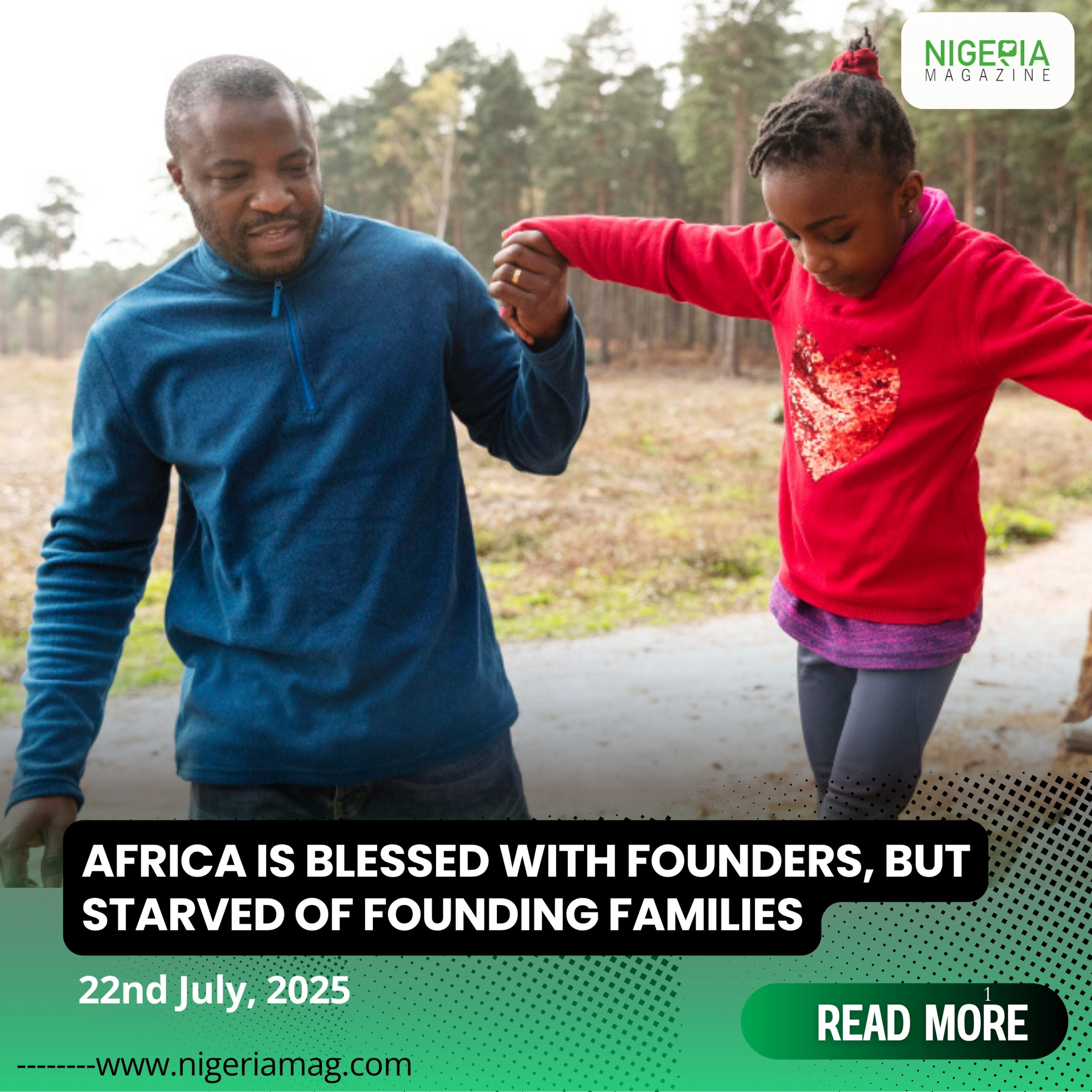
An urgent reflection on succession, structure, and the African legacy gap.
💡Inspired by David Coleman
Africa’s entrepreneurial spirit is unmatched. Our continent overflows with tenacity, invention, and hustle. From Lagos to Lusaka, Nairobi to Nouakchott, founders rise every morning with ideas burning in their hearts, ready to change their family’s story—and hopefully, their nation’s.
But there’s a deeper truth we must face in 2025:
Africa is blessed with a lot of founders—and not enough founding families.
We are rich in startups, but poor in succession plans. We are overflowing with first-generation breakthroughs, but dangerously short on third-generation legacies. We build, we run, we rise—then we fade. The businesses die with the founders, and the cycle begins again. Over. And over.
Why?
Because we have glorified the founder, but we have neglected the family. We have pursued the big idea, but not the lasting institution. We have hustled for today’s wins, without embedding tomorrow’s stewards.
And yet, the secret to wealth preservation—true generational power—has always been hiding in plain sight.
The Stallion Metaphor: A Family Business Built to Endure
A well-structured family business is a stallion. Not a sprinting cheetah. Not a lone lion. A stallion. Built to endure. To pull weight. To move in herds. To outlast every storm.

It isn’t glamorous in the beginning. It isn’t fast and flashy. But it is bred for resilience. When crises come—and they will—it remains. When founders age—and they will—it remains. When competition rises—it adapts.
Because a family business is not a phase. It’s a legacy. Each one, a mini-empire with deep roots and long shadows.
But dreams alone won’t build it. And passion won’t preserve it.
We need systems. We need vision that extends beyond the founder. We need structures that invite the next generation to own—not just inherit.
The Japan Model: Succession as Strategy
Let’s talk about Japan. A small, aging, resource-poor country with regular earthquakes, and yet:
Over 33,000 companies more than 100 years old. 41% of the world’s centenarian businesses.
Home to the oldest running business in the world—founded in 578 AD.
Why?
Because Japanese businesses are not built for survival. They’re built for succession. They are passed down like ancient swords: with honour, ritual, and preparation. What’s passed down isn’t just a company—it’s structure, identity, trade secrets, pride, and purpose. And yes, sometimes heirs aren’t even biological children. They’re adopted for their competence and commitment to continuity.
Meanwhile in Africa, most founders are still the face, the brains, and the bank. When they retire—or die—their business retires or dies with them.
If Africa wants to outgrow aid, build true wealth, and reclaim its economic sovereignty, we must stop building businesses that end with funerals.
Looking East, Not Just West
We have often been told to mimic Silicon Valley—to build unicorns, chase billion-dollar valuations, and disrupt everything. But unicorns are fantasy beasts. They’re not designed to pull carriages, feed villages, or walk with us for a lifetime. Africa doesn’t need only unicorns. Africa needs stallions.
Let’s study the Indian, Japanese, and Lebanese family business playbooks. Let’s learn from what’s worked:
Long-term thinking over quick exits
Shared leadership across generations
Intentional education of heirs
Family constitutions and governance systems
Rituals of transfer—not just titles, but values
Take India: 10 heirs to massive businesses joined an MBA class. Not because they needed the degree, but because their families were training them for succession. Together. They weren’t waiting to stumble into inheritance—they were being groomed to lead.
Africa’s next breakthrough won’t be a new app or fintech tool. It’ll be the normalisation of family business empires with succession at their core.
The Numbers Don’t Lie
Africa is home to over 100 million small family businesses. If just 3% of them were systemised over the next 10 years—that’s 3 million enduring enterprises.
That’s enough to spark a totemic shift in Africa’s economy—no DFIs needed. It means wealth retained in families. Jobs protected across decades. Institutions that outlive elections. A private sector that doesn’t just rise—but stays.
An entrepreneur recently began transitioning her 25-year-old company to her 21-year-old daughter. Unheard of, you’d say? Perhaps. But it shouldn’t be.
Everyone wants to be the one who inherits, but how many are preparing to hand over? Succession isn’t an event. It’s a discipline. A strategy. A duty.
Weaponising Continuity
This isn’t about blindly copying success. It’s about recognising our natural advantage. It’s not about romanticising tradition, but weaponising continuity. We’re sitting on powerful engines of wealth. We just haven’t trained them to run—or taught them to run together.
Imagine: if we got this right, future African children wouldn’t just inherit land or a house. They’d inherit boards, brands, and battle-tested business models. They’d inherit tools and trade secrets, not just debts and drama. They’d be born into stewardship, not just survival.
The Vision: One Shop at a Time
There’s a dream rising—#Oneshopatatime.
Every shop. Every stall. Every SME.
Turned from hustle into heritage.
From gig into generational wealth.
This is how we rewrite Africa’s economic future. Not in conference halls alone. Not with lofty foreign-funded initiatives.
But one structured family business at a time.
It starts with asking:
Are you building for the next generation—or just for your next invoice?
Are your children equipped to take over—or will they take it apart?
Is your business documented, governed, transferable—or is it all in your head?
Because what we don’t hand over, dies with us.
From Founders to Founding Families
Founders are critical. But founding families change history. They don’t just start companies. They build institutions. They set standards. They defy time.
Let 2025 be the year we stop idolising the lone genius founder, and start investing in generational stewardship.
Let us birth a new era of African family empires.
Because Africa’s story doesn’t need to be rewritten—it just needs to be continued. And that’s a job only families can finish.

