


When Abuja became Nigeria’s capital in 1991, it was a city planned for beauty, order, and environmental excellence. Its designers imagined wide roads, green belts, and controlled development. But over the past two decades, Abuja has grown in a way that no one fully prepared for. Today, the capital city is expanding rapidly, swallowing up surrounding villages, welcoming thousands of new residents each month, and becoming a sprawling urban centre. With this growth has come a quiet but dangerous threat, air pollution.
The air in Abuja once smelled of trees and dust after a dry breeze. Now, especially in the morning and evenings, a hazy cloud sometimes sits over the city. This is no harmless fog. It is a sign of harmful substances like particulate matter, carbon monoxide, and ozone floating in the air. Particulate matter (commonly referred to as PM10 or PM2.5) are tiny solid or liquid particles in the air, often smaller than the width of a human hair. PM2.5, for instance, can get deep into the lungs and even enter the bloodstream, causing serious health problems like asthma, heart disease, and strokes.
According to real-time data, Abuja’s PM10 levels hit 292.1 micrograms per cubic metre on March 2, 2025, almost six times higher than the safe limit recommended by the World Health Organization (WHO), which is just 50 micrograms. The situation has not improved over time. On February 15, 2025, PM10 levels peaked at a staggering 410.3 micrograms. The smaller and even more dangerous PM2.5 hovered around 17.4 micrograms as of May 2025, above the WHO guideline of 15. For a city once regarded as the clean face of Nigeria, these numbers paint a troubling picture.
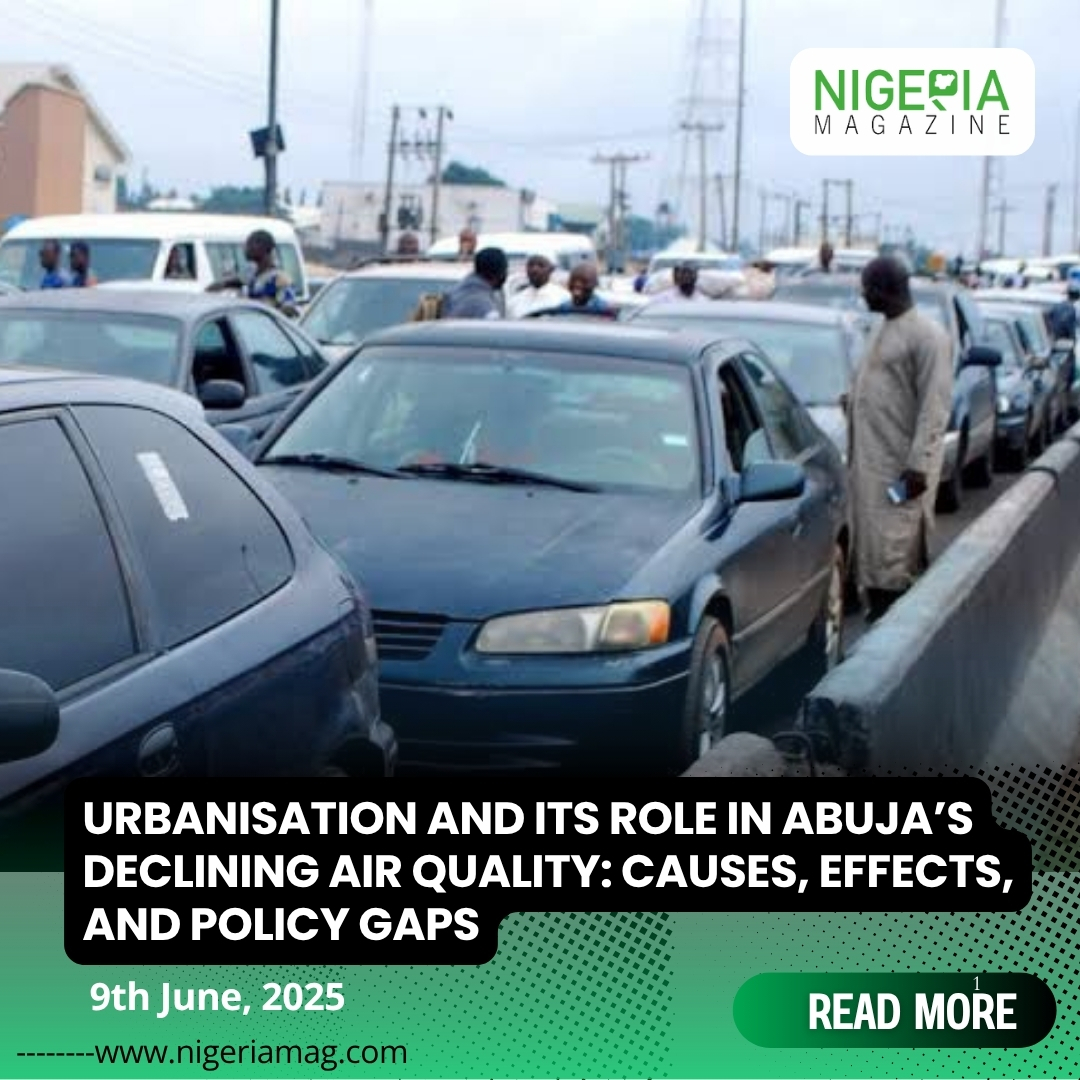
One of the primary reasons is the rise in cars. As Abuja spreads outwards into places like Lugbe, Kuje, and Gwagwalada, more people rely on private cars and commercial buses for transport. The city lacks a functional, affordable mass transit system. In 2018 alone, more than 25,000 driving licenses were issued in Abuja. Today, those numbers are likely much higher. With each car and bus comes the release of carbon monoxide, nitrogen oxides, and fine particles into the air, many of them invisible, but deeply harmful.
Then there are the generators. In most Abuja neighbourhoods, the hum of diesel and petrol generators is as common as birdsong. Power outages remain frequent, and nearly every home or business has a backup generator. These machines release not only noise but also dangerous gases and soot. Over time, these emissions build up, especially when there’s no wind or rain to clear the air.
Another often overlooked source of pollution is the way Abuja handles its waste. Across informal settlements and even developed areas, open waste burning remains common. Residents without access to proper waste collection systems burn their refuse, plastic, food waste, rubber tyres, producing thick smoke that releases harmful chemicals into the atmosphere. In many communities surveyed, over 60% of residents admitted to either burning or dumping their waste nearby.
Add to this the traditional practice of bush burning during the dry season, used by farmers to clear land, and you have a toxic cocktail in the air.
The effects of this pollution are not abstract. In the Abuja Municipal Area Council alone, over 46,000 people reported cases of air pollution-related illnesses in 2016. That number has likely grown since then. Children will sneeze more, adults will complain of constant coughing and fatigue, and people with underlying health conditions may suffer even more.
Yet, despite this, the government’s response has been largely silent or slow. Nigeria does have an environmental agency, NESREA (National Environmental Standards and Regulations Enforcement Agency) tasked with monitoring and controlling pollution. But NESREA is underfunded and lacks the facilities to properly monitor air quality in real-time across the city. Few air monitoring stations exist, and those that do are not always functional or accessible to the public. Policies that could help, such as better waste management systems, stricter vehicle emission standards, or a clean energy transition plan, are often stuck on paper without practical enforcement.
In Abuja today, a person can walk through a traffic-heavy junction like Area 1 or Nyanya in the morning and breathe in what feels like dust and exhaust fumes. But unlike the noise of traffic, the danger of polluted air is quiet. You do not see the damage instantly. But over months and years, it settles into lungs, weakens hearts, and shortens lives.
Abuja’s air tells a story, one of ambition without caution, growth without planning, and urbanisation without adequate environmental protection. But it is not too late. Cleaner air is possible. It begins with recognising the warning signs and taking bold steps to rewrite the ending of Abuja’s environmental story, from a capital choked by progress to one that breathes freely again.
Ubong Usoro for Nigeria Magazine

