


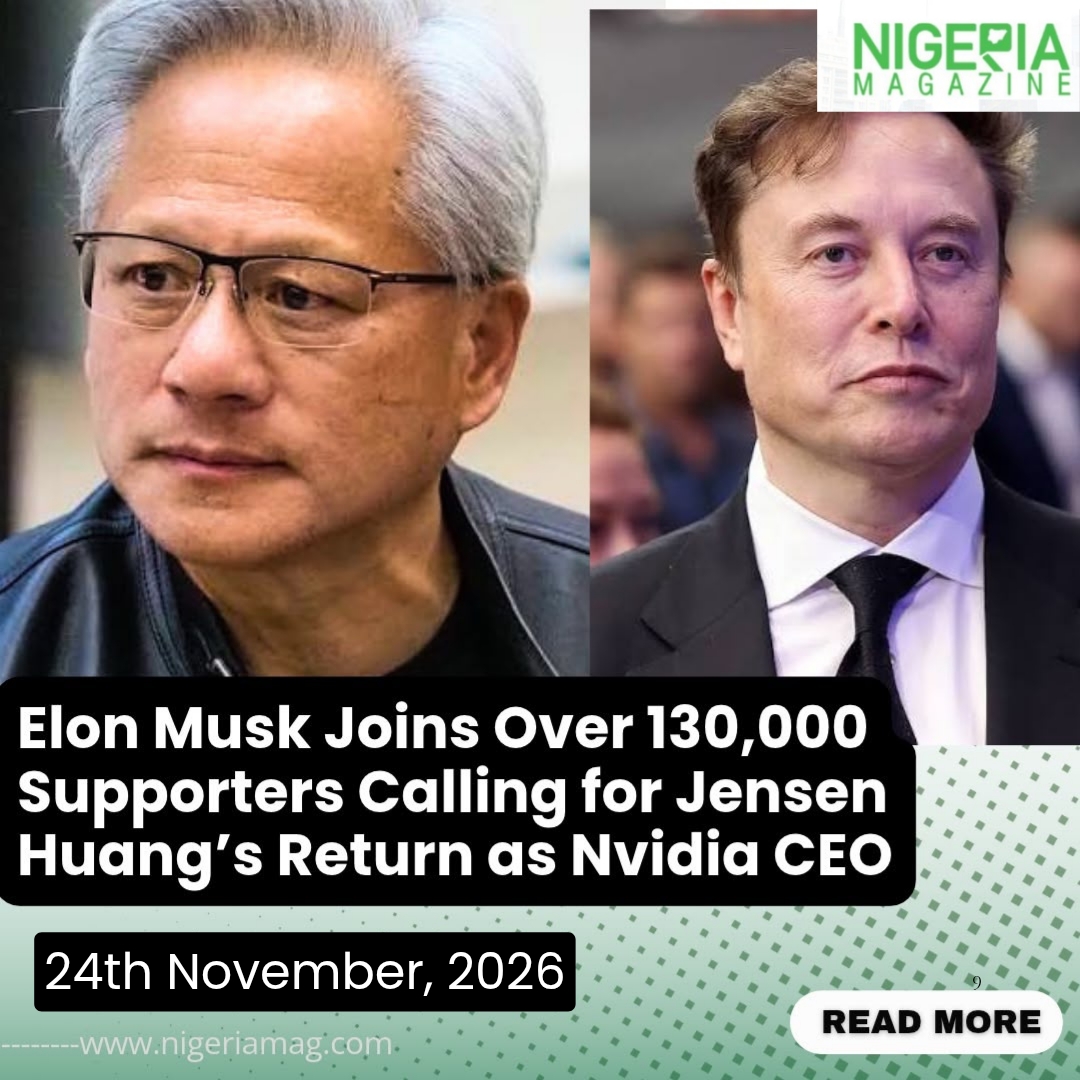
A growing campaign to reinstate Jensen Huang as chief executive of Nvidia has attracted more than 130,000 signatures, with Elon Musk and several prominent Silicon Valley executives joining employees and investors in calling for the return of the company’s longtime leader.
The petition emerged following Huang’s resignation on November 12, 2026, after a controversy involving his personal relationships and questions about potential national security risks.
Although Nvidia has appointed Chief Financial Officer Colette Kress as interim CEO, the campaign is putting pressure on the company’s board to reconsider its leadership decision.
The development has sparked a broader debate across the technology industry about corporate governance, due process and whether the founder of one of the world’s most influential AI companies should be given an opportunity to return while investigations continue.
How the Petition Started
The campaign, organised through a website called Stand with Jensen, was launched following Huang’s departure from Nvidia.
Its supporters argue that the board should reconsider his removal and ensure that any investigation into his conduct is conducted fairly.
The petition does not simply ask Nvidia to ignore the controversy.
Instead, it calls for Huang’s reinstatement while an independent investigation establishes the facts.
It also urges the board to provide greater transparency about the circumstances surrounding his departure.
The organisers argue that Huang’s record of building Nvidia over more than three decades should be considered alongside the allegations.
By November 14, the petition had attracted more than 115,000 signatures.
Reporting on November 15 indicated that the number had surpassed 130,000, demonstrating how quickly the campaign had gained attention.
However, the reported totals come from the petition platform and have not been independently audited.
Elon Musk Throws His Support Behind Huang
One of the most prominent figures supporting the campaign is Elon Musk, the billionaire entrepreneur behind Tesla, SpaceX and xAI.
Musk publicly announced his support for Huang’s reinstatement and encouraged others to consider the petition.
He also warned that Nvidia could lose important commercial opportunities without Huang’s leadership.
His involvement is particularly significant because Musk’s companies operate in industries that depend heavily on advanced computing infrastructure.
AI development requires enormous computing capacity, and Nvidia has become a major supplier of the hardware used to train and operate sophisticated AI systems.
Musk’s support therefore reflects more than personal admiration.
It also highlights the importance of Nvidia’s leadership to companies investing heavily in artificial intelligence.
However, Musk’s position represents his own assessment of the situation, not evidence that Nvidia would necessarily lose particular contracts if Huang remains outside the company.
Other Technology Leaders Join the Campaign
Musk is not the only prominent executive calling for Huang’s return.
Other reported supporters include Replit CEO Amjad Masad, Epic Games CEO Tim Sweeney and Y Combinator CEO Garry Tan.
Their participation has helped turn the petition into a broader discussion within Silicon Valley.
The campaign reflects concerns among some technology leaders that removing Huang could create uncertainty at a particularly important moment for Nvidia.
The company is central to the global AI infrastructure industry.
Its products support major cloud computing providers, research laboratories and technology companies developing advanced AI systems.
For some supporters, Huang’s continued leadership is closely connected to Nvidia’s ability to maintain its position in that ecosystem.
But the campaign also raises a difficult question.
Should a founder’s contribution to building a successful company influence how its board responds to allegations of misconduct?
Supporters argue that his achievements and the importance of continuity justify reconsideration.
Critics of that approach may argue that corporate governance standards should apply consistently, regardless of an executive’s reputation or business accomplishments.
Nvidia Employees Are Also Speaking Out
The petition has reportedly attracted support from thousands of people identifying themselves as current and former Nvidia employees.
As of November 14, the campaign website listed approximately 5,965 current employees and 1,108 former employees among its signatories.
It also listed more than 63,000 shareholders.
These figures suggest that the campaign extends beyond prominent technology executives.
Some employees have reportedly expressed frustration about the circumstances surrounding Huang’s departure.
Huang has been associated with Nvidia since its founding in 1993, and his leadership has played a central role in shaping the company’s culture.
For many employees, he represents more than the company’s chief executive.
He is closely associated with Nvidia’s technical direction, management philosophy and rise to global prominence.
That relationship helps explain why his departure has generated such strong reactions.
However, the petition’s self-reported employment and shareholder categories have not been independently verified, and the signatures should not be interpreted as representing the views of Nvidia’s entire workforce or shareholder base.
Why Jensen Huang Matters So Much to Nvidia
Nvidia’s transformation under Huang has been extraordinary.
The company began as a developer of graphics technology and became a global leader in the semiconductor industry.
Its GPUs eventually became essential tools for artificial intelligence research and development.
As AI adoption accelerated, demand for Nvidia’s computing infrastructure increased dramatically.
The company became one of the most valuable businesses in the world.
Huang was closely involved in that transformation.
He helped guide Nvidia’s long-term technology strategy, build relationships with major customers and position the company for the growth of AI computing.
His supporters believe replacing him could disrupt important parts of that strategy.
The concern is not necessarily that Nvidia would immediately lose its technological capabilities.
Rather, it is that leadership uncertainty could complicate decision-making, customer relationships and the execution of future plans.
These concerns are particularly relevant because Nvidia operates in an industry where product development cycles, capital investment and strategic partnerships require long-term planning.
Investors Want the Board to Keep Its Options Open
Beyond the public petition, some major investors have urged Nvidia’s board not to rule out Huang’s return.
Altimeter Capital founder Brad Gerstner and Atreides Management founder Gavin Baker published an open letter calling on the company to consider all available leadership options.
Their position reflects the challenge facing Nvidia’s board.
On one hand, the company must maintain appropriate governance standards and respond seriously to concerns about executive conduct.
On the other, it must protect the interests of shareholders and ensure that its leadership decisions support the company’s long-term performance.
The investors’ intervention does not necessarily mean Huang will return.
But it demonstrates that the question of reinstatement is being discussed beyond social media.
Could Jensen Huang Actually Return?
According to reporting by the Financial Times on November 15, Huang has discussed the possibility of returning to Nvidia with allies.
Some supporters are reportedly organising efforts to persuade the company’s board to reconsider its position.
The campaign has also attracted attention from influential figures outside Nvidia.
Nevertheless, several obstacles remain.
The board is conducting an independent investigation into the conduct associated with Huang’s departure.
The controversy also involves questions about relationships with employees, potential conflicts of interest and compliance risks connected to the export of advanced semiconductor technology.
These are issues the board cannot simply dismiss because a petition has become popular.
There is also no guarantee that Huang’s return would resolve investor concerns.
Some stakeholders may prioritise leadership continuity, while others may believe that a different executive is needed to restore confidence in the company’s governance.
For now, Nvidia has not announced a decision to reinstate Huang.
Colette Kress remains interim CEO while the company considers its longer-term leadership arrangements.
The Corporate Governance Question
The controversy raises a broader issue about the relationship between founders and the companies they create.
Many successful technology companies are closely associated with charismatic founders.
These individuals often shape the company’s culture, strategy and public identity.
Their leadership can become a competitive advantage.
But as companies grow, they also develop responsibilities to shareholders, employees, customers and regulators.
Boards of directors are expected to exercise independent oversight, including when difficult decisions involve the company’s founder.
This can create tension.
A founder may have built the business and contributed enormously to its success.
Yet the board must still assess allegations and governance concerns according to the company’s responsibilities and applicable rules.
The Nvidia situation illustrates how complicated that balance can become when a founder remains central to a company’s identity.
The public petition adds another layer of pressure by bringing employees, investors and outside technology leaders into the debate.
However, the ultimate decision rests with Nvidia’s board rather than the petition’s organisers.
What Happens Next?
Nvidia faces several immediate challenges.
The company must continue operating under interim leadership, manage the ongoing investigation and maintain the confidence of customers and investors.
It is also preparing to release quarterly financial results on November 17.
Those results could shift attention back toward Nvidia’s financial performance, but the leadership question is unlikely to disappear immediately.
The board must decide whether to appoint a permanent successor, consider Huang’s return or pursue another arrangement.
Meanwhile, the petition’s supporters are likely to continue pressing for greater transparency and a reconsideration of the decision.
For Huang, the campaign demonstrates that he retains considerable support within parts of the technology industry.
But public support alone does not resolve the allegations or determine whether reinstatement would be appropriate.
A Defining Moment for Nvidia
The petition to reinstate Jensen Huang has become one of the most closely watched developments in the technology industry.
It reflects the extraordinary influence Huang built over more than three decades and the extent to which Nvidia’s identity remains connected to its co-founder.
The support of Elon Musk and other technology executives has given the campaign international attention.
But the controversy is about more than one executive’s future.
It raises questions about the responsibilities of corporate boards, the treatment of influential founders and the importance of due process when serious allegations emerge.
For Nvidia, the challenge is finding a path that protects both its business and its governance standards.
For Huang, the campaign represents a possible route back to the company he helped build.
Whether he returns or not, the controversy has already demonstrated how difficult it can be for a global technology giant to separate its future from the founder who shaped its success.

