


By Olugbenga Oyeniran
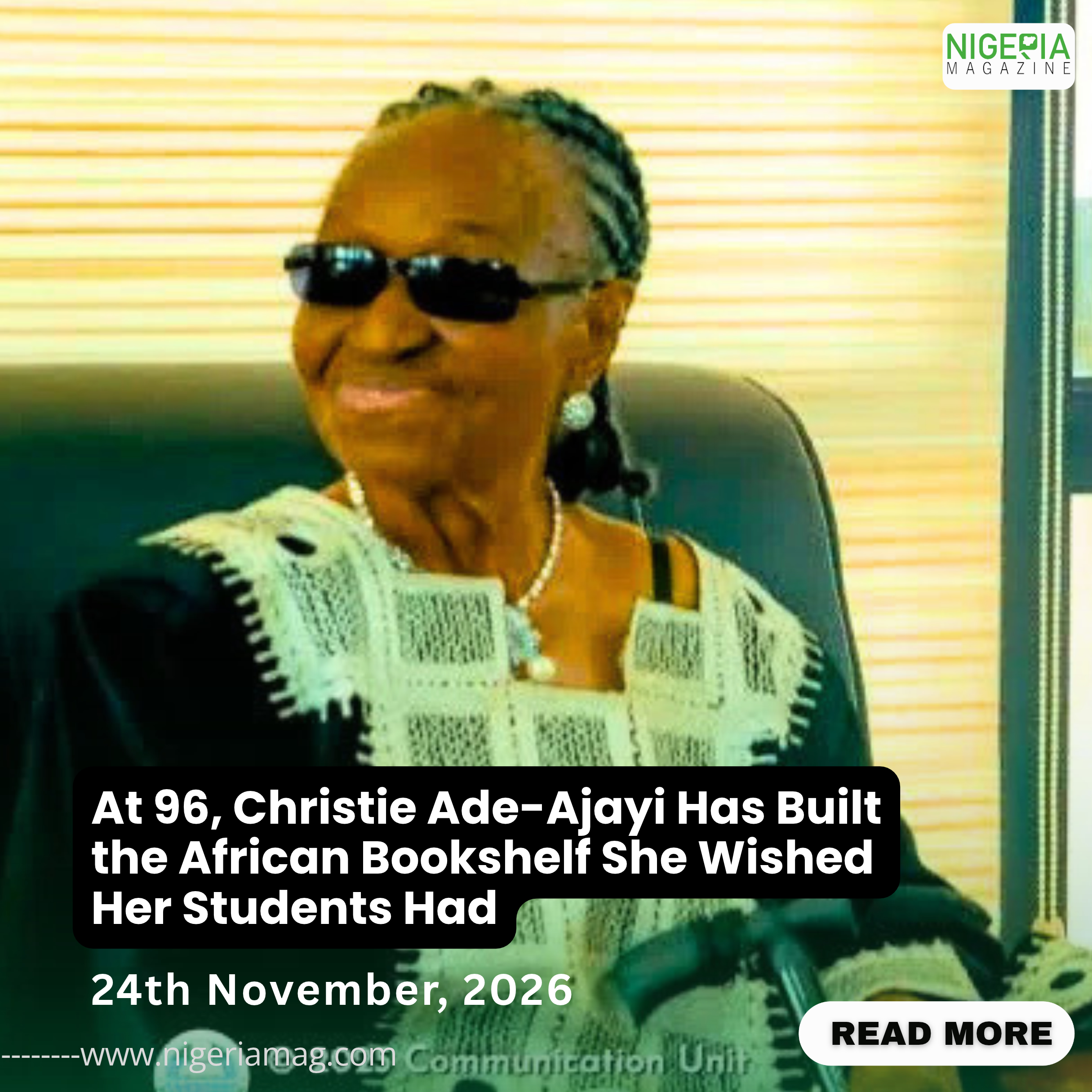
At 96, Chief (Mrs) Christie Aduke Ade-Ajayi (née Martins) remains a living pillar of Nigerian early childhood education—a pioneer who reshaped African children’s literature not out of grand political ambition, but out of a teacher’s simple, urgent observation.
Born on March 13, 1930, in Ile-Oluji, Ondo State, Ade-Ajayi began her own educational journey at Kudeti Girls’ School (now St. Anne’s School) and the United Missionary College in Ibadan. Between 1952 and 1978, as she taught and served as a headmistress across classrooms in Nigeria and London, she noticed a glaring absence on the bookshelves. The stories available to young learners were overwhelmingly written by European authors, filled with snowy winters, British boarding schools, and unfamiliar customs. Nigerian children were learning to read through a lens that had nothing to do with the world outside their windows.
Determined to change that, Ade-Ajayi began writing English-language stories rooted in West African settings, Yoruba folktales, and everyday Nigerian family life—giving African children the vital gift of seeing themselves on the page.
Drawing directly from her own household and teaching career, she launched a prolific literary catalogue that became a staple in Nigerian homes and classrooms. Inspired by her own son, she published Ade, Our Naughty Little Brother in 1974, followed quickly by The Old Story-Teller in 1975. In 1978, she collaborated with historian Michael Crowder on Akin Goes to School—a story inspired by her father’s childhood journey to education—before expanding her reach across decades with titles like Ali’s Bicycle (1982), Emeka’s Dog (1982), Which Way, Amina? (2001), and The Big Yellow House (2004). Her books resonated because they captured the humour, warmth, and rhythm of Nigerian childhood while steadily building young readers’ vocabulary and comprehension.
Her craft was sharpened by specialised international training—earning a diploma in Child Development from London’s Froebel Institute/Institute of Education in 1958 and a diploma in elementary school leadership from San Jose State University in California in 1971—which she blended seamlessly with local realities. Beyond her writing, she shaped early childhood policy for decades. She served as an Early Childhood Education Consultant at the University of Ibadan, chaired the Nursery School Board and sat on the Board of Governors at the University of Lagos from 1972 to 1978, and founded the Ibadan branch of the World Organisation for Early Childhood Education (OMEP) in 1986, later helping host its 2009 world assembly in Lagos.
For Ade-Ajayi, literacy has always been inseparable from service. In 1956, she married the late renowned historian and former University of Lagos Vice-Chancellor, Professor J.F. Ade-Ajayi (1929–2014), with whom she raised five children. Together, they mentored generations of young people and established a free family library housing academic texts alongside her children’s books, ensuring students and researchers could study without financial barriers.
Today, at 96, she attributes her longevity to faith in God, prayer, love, and a life spent lifting others. Yet her gaze remains fixed on the future. Her enduring message to younger generations is clear: embrace education, serve your community with kindness, and never lose sight of your cultural identity.

