


By Moses Chibuike Ezechukwu
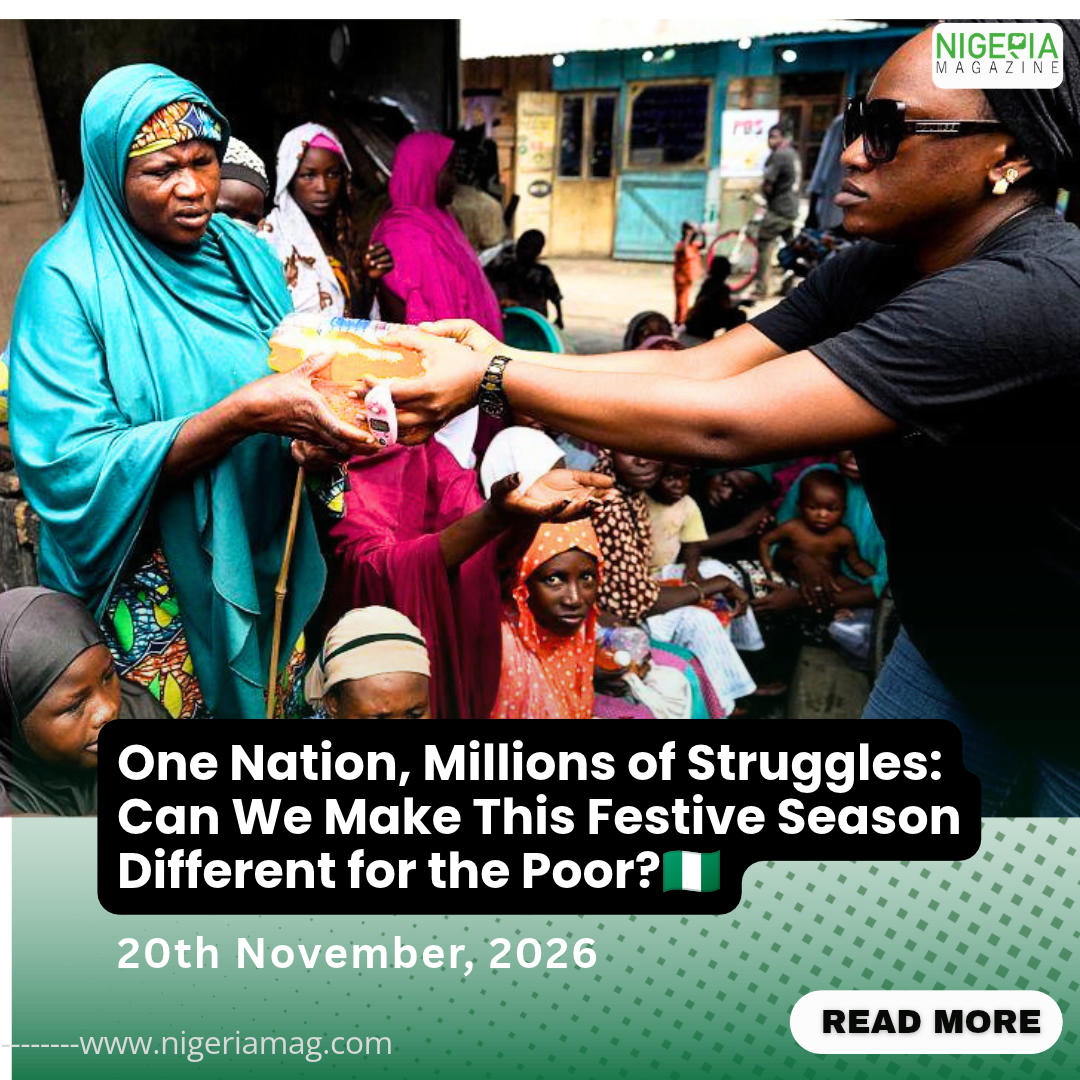
As Nigeria approaches another festive season, millions of families face the holidays with worries about food, shelter, healthcare and basic survival.
This is a call for NGOs, businesses, government agencies, communities and individuals to turn the spirit of celebration into meaningful action for vulnerable Nigerians.
There is something beautiful about the festive season in Nigeria.
The music becomes louder.
Markets become busier.
Families begin travelling home. Churches organise special programmes. Friends make plans to meet. Social media fills with photographs of new clothes, Christmas decorations, parties and plates of rice, chicken and other delicacies.
For many Nigerians, it is a season of joy.
But for millions of others, the festive season can be a painful reminder of what they cannot afford.
While some families are deciding where to spend Christmas or what gifts to buy, others are asking a much more basic question: Will there be enough food on the table?
That question deserves our attention.
Nigeria is not short of generous people. Nigerians are famous for helping relatives, neighbours and strangers when they can. Churches, mosques, charities, businesses, philanthropists and community groups regularly organise food distributions, medical outreaches and other forms of assistance.
Yet the scale of the challenge is enormous.
The United Nations Population Fund reported in February 2026 that at least 25 million Nigerians were projected to require humanitarian assistance during the year, while about 60 percent of the population was living in multidimensional poverty.
The Food and Agriculture Organization has also projected that 34.7 million people could face crisis-level or worse acute food insecurity in Nigeria during 2026.
These are not simply statistics.
Behind every number is a person.
A mother wondering how she will feed her children.
A widower struggling to pay rent.
An elderly person choosing between medication and food.
A child who watches other children receive Christmas gifts while quietly accepting that there may be nothing for them.
A displaced family trying to rebuild a life after losing a home.
This is why the festive season should be more than a period of celebration. It should also be a period of reflection.
The Other Side of Christmas
It is easy to see Christmas through the eyes of people who can afford it.
Shopping centres become crowded. Tailors work overtime. Restaurants are busy. Transport companies prepare for increased movement. Families travel across states to reunite.
But there is another Nigeria existing alongside this celebration.
It is the Nigeria of families counting every naira before buying food.
It is the Nigeria where rising living costs have made ordinary household purchases increasingly difficult.
It is the Nigeria where vulnerable families can easily disappear from public attention because poverty often happens quietly.
And perhaps that is the greatest danger: becoming comfortable with other people’s suffering simply because we do not personally experience it.
The festive season gives us an opportunity to interrupt that cycle.
This Should Not Be Charity for One Day
There is nothing wrong with distributing rice, beans, cooking oil, clothing or other essential items during Christmas. For a struggling household, such assistance can make a genuine difference.
But we should also ask a bigger question: What happens after Christmas?
A food package may feed a family for several days. It cannot, by itself, create employment.
A cash donation may pay a bill. It may not solve the problem that caused the financial crisis.
A Christmas party can bring happiness to children for an afternoon. It cannot replace education, healthcare or long-term economic opportunity.
This does not make seasonal charity meaningless.
Rather, it means we should use it as a starting point.
The best festive interventions should combine immediate relief with pathways towards independence.
That could mean providing vocational training, supporting small businesses, supplying farming inputs, offering educational assistance, connecting young people to employment opportunities or helping vulnerable families access healthcare.
The Federal Government itself announced a $1 billion Household Prosperity and Economic Social Protection Project in August 2026, describing the initiative as a move from temporary palliatives towards sustainable pathways, with greater coordination of humanitarian assistance and poverty-reduction programmes.
That principle deserves wider adoption.
NGOs Cannot Do It Alone
This is where partnerships become extremely important.
Non-governmental organisations often understand communities better than large institutions do. They know where vulnerable families live.
They may already have relationships with widows, persons with disabilities, displaced people, children and low-income households.
But many NGOs face limitations.
Some have passionate volunteers but limited funding.
Others have funding but lack the logistical capacity to reach every community.
Some organisations have food but need transportation.
Others have medical professionals willing to volunteer but need equipment and supplies.
This is where collaboration can change the equation.
Imagine an NGO with a database of vulnerable families partnering with a supermarket to provide food.
Imagine a technology company providing digital tools for beneficiary registration and transparent distribution.
Imagine transport companies donating logistics support.
Imagine hospitals providing free medical screening.
Imagine banks supporting financial literacy and small-business grants.
Imagine media organisations telling these stories—not to exploit people’s suffering, but to connect them with people who can help.
That is the kind of collective action Nigeria needs.
Businesses Have a Role Too
Corporate social responsibility should not only appear in annual reports.
Companies operating in Nigeria have an opportunity to use their resources to make the festive season meaningful.
A company could sponsor food packages for vulnerable families.
Another could support school fees.
Another could provide business equipment to selected entrepreneurs.
A telecommunications company could provide communication support to humanitarian organisations.
A fintech company could facilitate transparent donations.
A manufacturing company could contribute essential products.
The possibilities are enormous.
The important thing is that support should be organised, transparent and directed towards genuine needs.
Let Us Also Remember the Invisible Poor
Poverty does not always look the way we imagine it.
Sometimes, the struggling family lives next door.
Sometimes, it is the security guard who opens the gate every morning.
Sometimes, it is the cleaner who works in the office.
Sometimes, it is the young graduate who has been searching for employment for years.
Sometimes, it is the elderly neighbour who rarely asks anyone for help because of pride.
Sometimes, it is the single parent quietly carrying the financial responsibility of an entire household.
This is why community action matters.
We do not have to wait for a large organisation before we help.
A neighbour can share food.
A landlord can give a struggling tenant more time.
A business owner can employ someone.
A professional can offer mentorship.
A family can support another family.
A community can identify its most vulnerable members and create a support fund.
Small acts become powerful when many people participate.
Dignity Must Be at the Centre
There is another issue we must address: dignity.
Helping people should never mean humiliating them.
The poor are not content for social media.
They are not photographs to be used simply to demonstrate generosity.
They are human beings.
Any festive outreach should protect the dignity and privacy of beneficiaries. Organisations should avoid turning poverty into entertainment or making people feel grateful for basic necessities they should have access to as human beings.
The objective should be empowerment, not humiliation.
This is especially important when children are involved.
Their vulnerability should never become an opportunity for publicity without proper consideration of their privacy and protection.
We Can Make This Season Different
There is evidence that organised compassion can work.
In 2026, organisations and community groups across Nigeria continued to provide food and assistance to vulnerable households. One recent Christmas initiative, Project Christmas With Hope, called for partnerships to support families facing poverty, displacement, disability, illness and unemployment.
Another initiative documented by GlobalGiving is seeking support to reach 220 Nigerian families during the Christmas period with food and essential supplies, building on previous annual outreach efforts.
These efforts show something important.
People are willing to help.
The challenge is connecting that willingness with effective organisation.
Nigeria does not need only more people who want to help.
It needs more people willing to organise help, measure its impact and sustain it.
A Call to Collective Action
This festive season, Nigeria Magazine calls on NGOs, foundations, businesses, religious organisations, community leaders, philanthropists, media organisations and ordinary citizens to consider what they can do.
Not everyone can donate millions.
Not everyone can sponsor hundreds of families.
But almost everyone can do something.
Feed one family.
Support one child.
Pay for someone’s medication.
Buy from a struggling small business.
Donate clothes that are still in good condition.
Give someone a skill.
Create an opportunity.
Volunteer your time.
Or simply check on the person next door.
The goal should not be to make ourselves feel generous.
The goal should be to make someone’s life a little easier.
One Nation, One Responsibility
Nigeria is a country of enormous contradictions.
We have extraordinary wealth alongside extraordinary hardship.
We have successful entrepreneurs alongside unemployed graduates.
We have luxury developments alongside communities struggling for basic infrastructure.
We have people spending millions on celebrations while other families struggle to afford a single decent meal.
This does not mean celebration is wrong.
We should celebrate.
We should enjoy Christmas.
We should travel home.
We should wear beautiful clothes, share meals and spend time with loved ones.
But perhaps we can celebrate differently this year.
Perhaps there can be one more plate at the table.
One more family supported.
One more child given a gift.
One more entrepreneur given a chance.
One more vulnerable person reminded that they have not been forgotten.
The festive season should not be measured only by how much we spend.
It should also be measured by how many lives we touch.
Nigeria is one nation. Our struggles may be different, but our responsibility to one another is shared.
This year, let us make the question bigger than “What are we buying for Christmas?”
Let us ask:
“Who can we help experience Christmas with dignity?”
Because sometimes, the greatest gift is not what we receive.
It is what we choose to give.
#NigeriaMagazine #OneNationMillionsOfStruggles #ChristmasInNigeria #FestiveSeason #HelpThePoor #VulnerableNigerians #NGOPartnerships #CollectiveAction #GiveBack #Humanity #PovertyInNigeria #FoodSecurity #SocialImpact #CommunitySupport #Charity #ChristmasWithHope #Nigeria #AfricanPhilanthropy #SupportTheVulnerable #MosesChibuikeEzechukwu

