


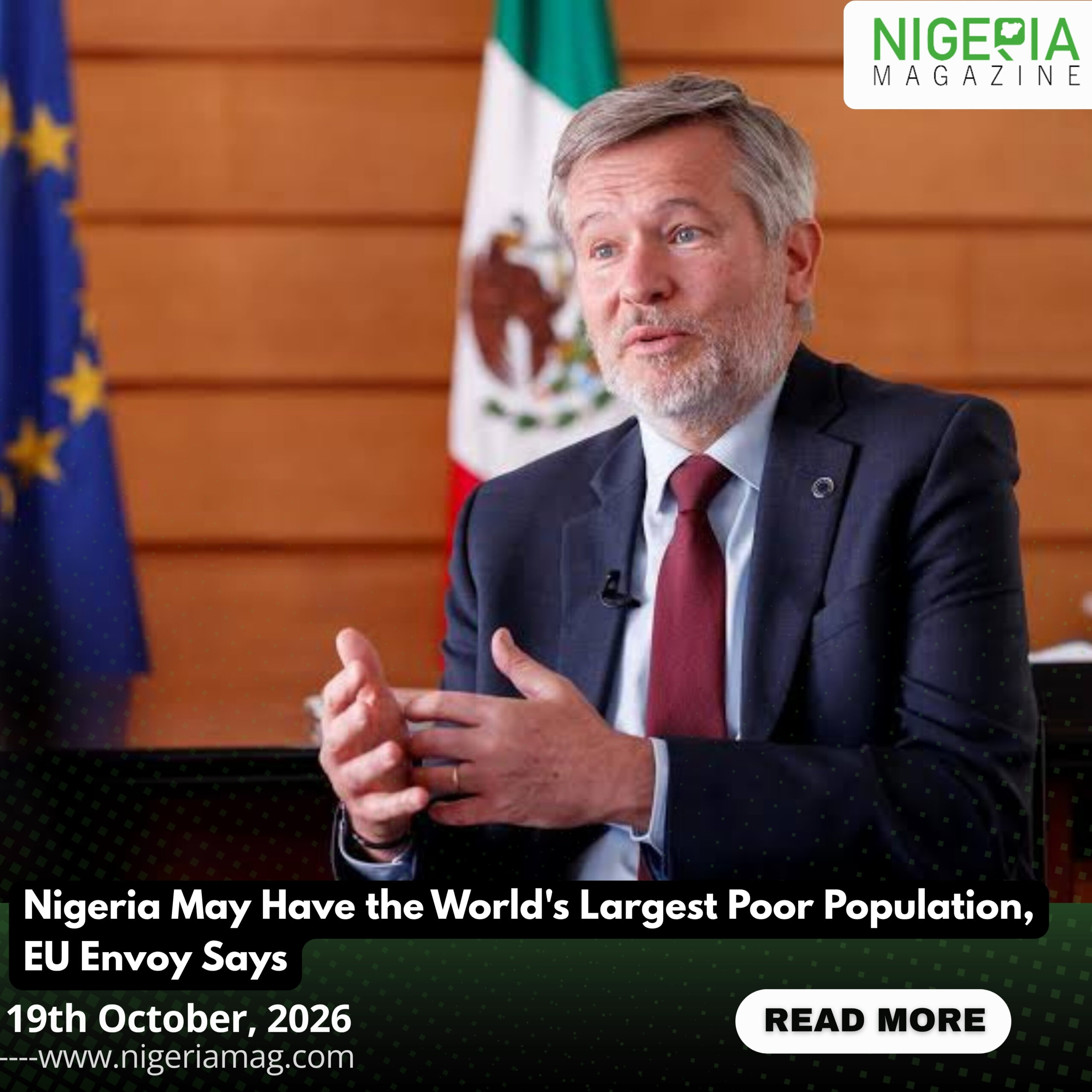
The European Union’s ambassador to Nigeria has put a stark label on the country’s poverty problem. Speaking in Abuja, Gautier Mignot said Nigeria is probably home to more people living below the poverty threshold than any other country on earth.
Mignot, who represents the EU in both Nigeria and ECOWAS, made the remark at an event marking this year’s International Day for the Eradication of Poverty. The gathering, themed around peace, human rights and safe homes for all, brought together government officials, development partners and civil society groups. He called poverty one of the country’s most pressing challenges and urged a sustained, year-round response rather than occasional attention.
To support his point, the ambassador referred to Nigeria’s 2022 National Multidimensional Poverty Index, which found that about 133 million Nigerians were deprived across several areas of life, including education, health, nutrition and living standards. He added that more recent estimates from different sources suggest conditions have deteriorated since then.
Other figures were cited at the same forum. A representative of ActionAid Nigeria pointed to World Bank estimates that roughly 123 million people, a little over half the population, were living in extreme poverty in 2025. The two sets of numbers measure different things. One looks at overlapping deprivations, the other at income, so they should not be treated as interchangeable.
Notably, Mignot’s wording was cautious. He said “probably,” not “definitely,” an acknowledgement that global poverty rankings shift depending on the measure used and the data available.
A central theme of his address was that poverty cannot be tackled in isolation. He argued that lasting progress depends on peace, security and respect for human rights, since families who cannot meet their basic needs are unlikely to feel safe or able to enjoy their rights fully. He said that emergency relief should be tied to long-term resilience, noting that poor households are especially exposed during crises, including outbreaks of severe child malnutrition.
He also acknowledged the Nigerian government’s efforts, pointing to cash transfers, livelihood support and the strengthening of social protection systems. The EU, he said, has helped review the National Social Protection Policy and has backed the development of state-level policies and a proposed Social Protection Bill. He welcomed the ongoing humanitarian transition, in which Nigerian authorities at every level are expected to take on more responsibility for funding and coordinating aid.
Alongside the warning came a pledge. The EU says it has committed close to €45 million in humanitarian assistance to Nigeria this year, directed mainly at conflict-affected and crisis-prone areas. The announcement was made during a working visit to Defence Minister General Christopher Musa (rtd), where both sides also discussed security cooperation.
The statement lands at a difficult time for millions of households struggling with high living costs, insecurity and displacement. Nigeria’s large population means that even a moderate poverty rate translates into enormous absolute numbers, and that is the core of the ambassador’s point. Whether or not Nigeria tops every global ranking, the figures cited at the forum show a challenge that touches more than half the country in one form or another.
For policymakers, the takeaway is that cash transfers and emergency aid are only part of the answer. Jobs, security and stronger public systems will decide whether these numbers fall.

