


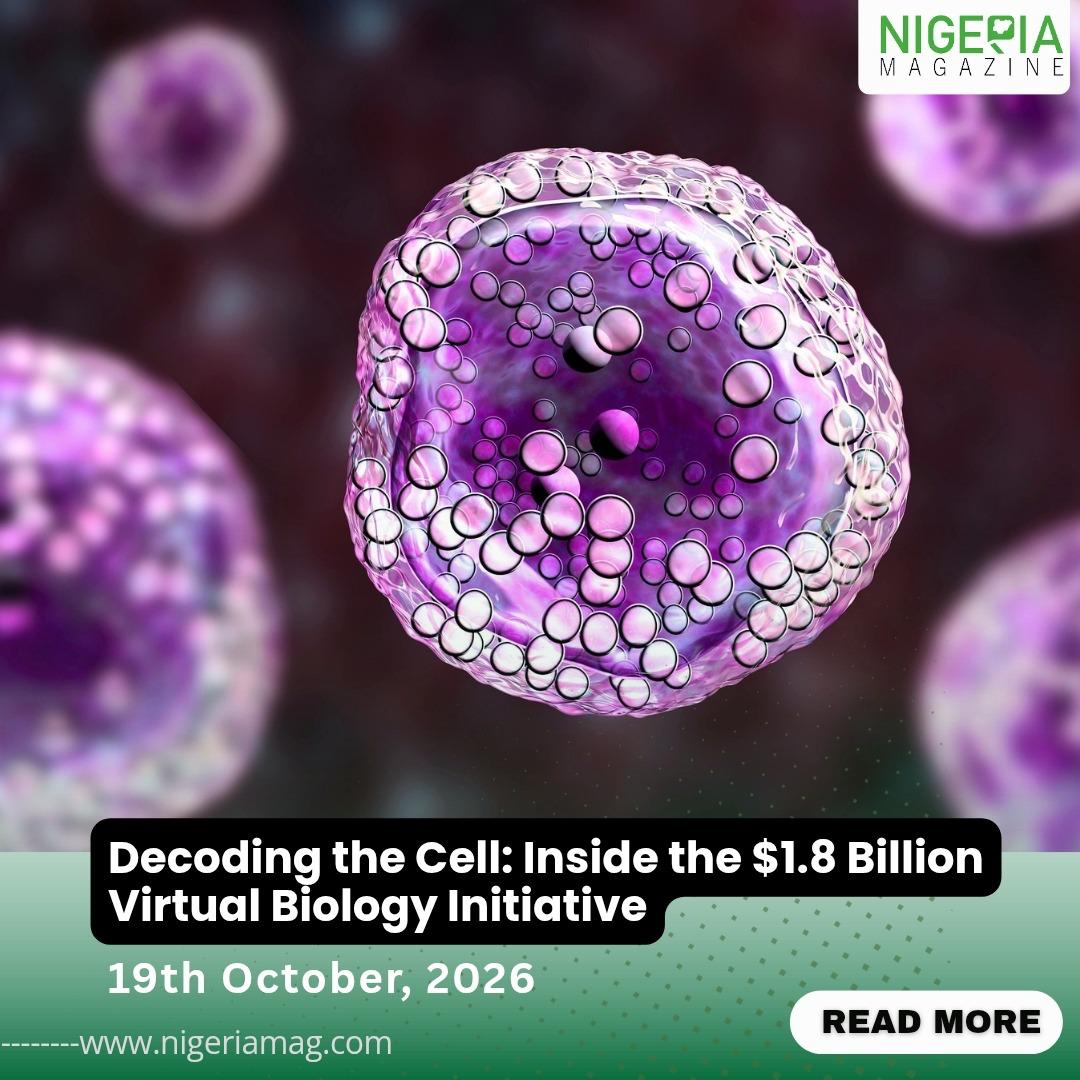
In a monumental effort to bridge the gap between artificial intelligence and life sciences, the U.S. government, tech giants, and leading research institutions have joined forces in a $1.8 billion project known as the Virtual Biology Initiative. Announced on October 7, 2026, the ambitious public-private partnership aims to construct high-precision AI models capable of predicting how living cells react under diverse biological and environmental conditions.
Spearheaded by Biohub—the non-profit research institute established by Mark Zuckerberg and Priscilla Chan—the initiative seeks to transform cellular biology from a reactive laboratory science into a predictive, computationally driven discipline.
The Core Objective: Predicting Living Systems
At its core, the project addresses one of biology’s greatest challenges: understanding the sheer complexity of cellular behaviour. When a cell encounters a pathogen, a drug molecule, or a genetic mutation, millions of chemical reactions occur simultaneously.
By systematically gathering massive, standardised datasets showing how cells respond to varied stimuli, scientists plan to train AI models to forecast these cellular behaviours accurately. In practice, this would allow computational models to suggest which drug targets or genetic modifications hold the most promise, guiding researchers toward the most effective physical experiments in laboratories.
Decoding the $1.8 Billion Funding Structure
While the $1.8 billion headline figure represents a massive commitment, it is important to note that it is not entirely newly allocated cash. Instead, it combines direct capital investments, computational infrastructure, existing biological datasets, and advanced measurement technologies.
========================================================================
VIRTUAL BIOLOGY INITIATIVE FUNDING BREAKDOWN
========================================================================
[Biohub Initial Commitment (April 2026)] ——————- $500M
[U.S. Department of Energy (DOE – Over 5 Years)] ———– $500M+
[NIH Coordinated Assets (Prior Federal Investment)] ——– $500M+
[Private Sector (Meta, Google DeepMind, Isomorphic Labs)] — $300M
TOTAL VALUE: $1.8 BILLION
- Biohub: Laid the foundation by committing $500 million in April 2026.
- U.S. Department of Energy (DOE): Investing over $500 million across five years, providing access to federal supercomputing infrastructure and scientific modelling tools.
- National Institutes of Health (NIH): Coordinating biological data repositories and research assets built on more than $500 million in existing federal investment.
- Commercial Tech Sector: Meta, Google DeepMind, and drug-discovery firm Isomorphic Labs are jointly contributing $300 million toward data generation and AI modelling.
Timeline and Data Governance
The Virtual Biology Initiative operates on a multi-phase timeline, balancing public science goals with commercial incentive structures:
Milestone / Policy Expected Timeline & Details
First Comprehensive Dataset Expected within 1 year.
Predictive Model Framework Targeted for full operation within 5 years.
Commercial Exclusivity Tech partners receive 1 year of exclusive access to datasets they help fund before they are released publicly.
Public Sector Access Datasets created through direct government funding will remain free of exclusivity restrictions.
Potential Impact and Realistic Expectations
If successful, the Virtual Biology Initiative could change how biomedical research is conducted, helping scientists map disease mechanisms faster and prioritise laboratory resources more efficiently.
However, organizers emphasize that predictive models are goals, not yet results achieved. The initiative has not yet proven it can generate novel disease cures or significantly shorten the lengthy timelines required for clinical drug development. Nevertheless, combining world-class supercomputing with cellular biology represents one of the most comprehensive bets ever placed on the future of computational medicine.

