


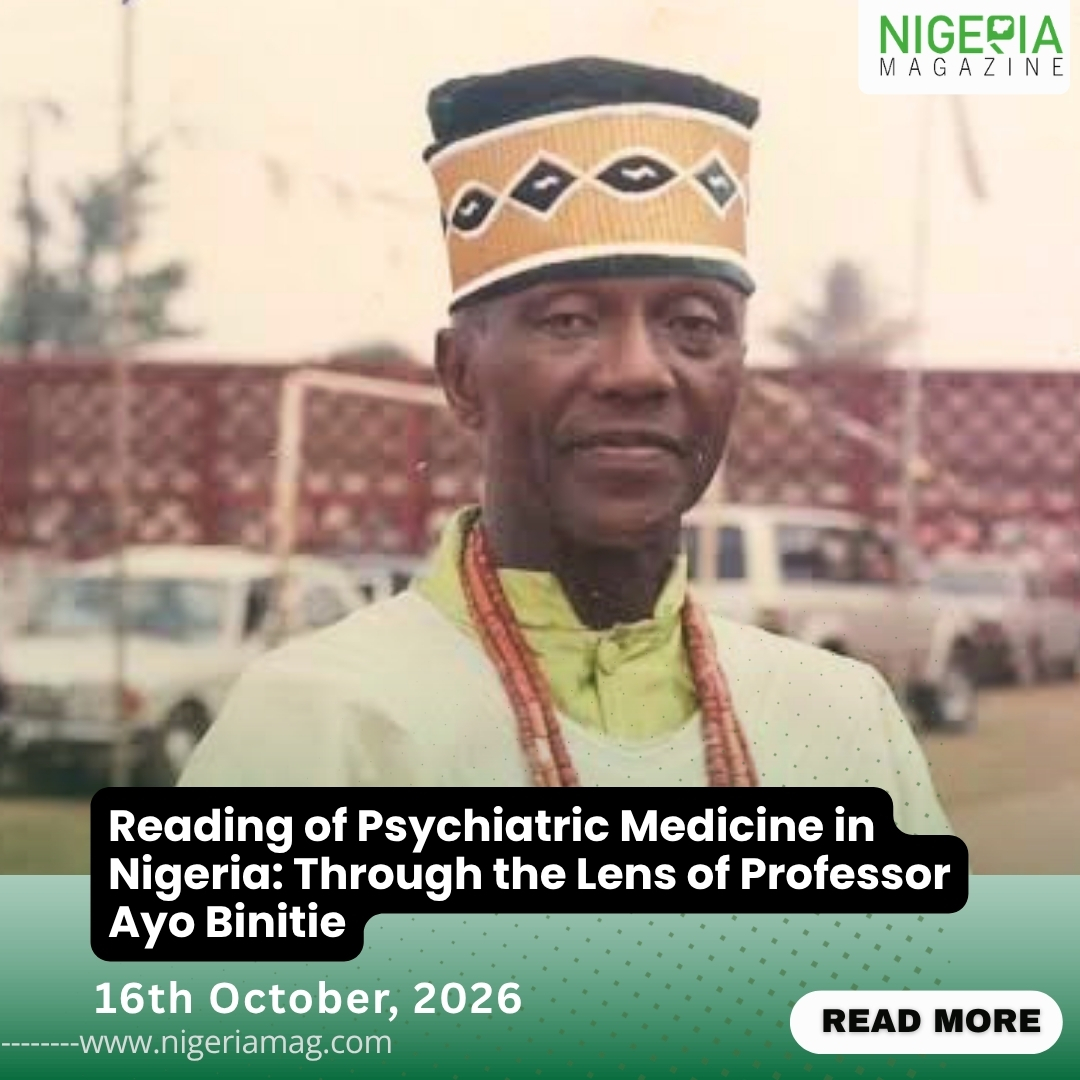
When I look at the development of psychiatric medicine in Nigeria, I see it not as a straight line of progress but as a series of contested transitions, and Professor Ayo Binitie’s career sits right at the most important of those transitions.
Before there was anything like western psychiatry, traditional healers were already running a form of custodial care, admitting people into their compounds or churches for months at a time. The colonial state then imposed its own custodial model. The first asylum was in Calabar in 1904, followed by Yaba in Lagos in 1907 with just 48 patients. This was not treatment in any modern sense. It was drug therapy and physical restraints, run by general medical officers rather than psychiatrists, and it was legally held together by the Lunacy Ordinance of 1916 which later became the Lunacy Act. A revealing moment is Lantoro in Ogun State, which was a colonial prison that in 1944 was converted to an asylum for soldiers returning with mental disorders from the Burma war front. That tells you what the system was for.
The real therapeutic turn came in 1954 with Aro Mental Hospital near Abeokuta. The British built a hundred-bed hospital modelled on Euro-American centres, complete with wards, occupational therapy, an outpatient clinic, pharmacy and space for research and training. For me, this is when the question changed from how to lock people away to how to treat and teach.
At independence in 1960 the infrastructure was still tiny and the number of Nigerian psychiatrists was small. The challenge my father’s generation inherited was double. They had to expand specialist services while also asking how psychiatry should function in African societies where ideas about illness, spirituality, family and causation do not neatly match European assumptions. This is the period of expansion they built. In 1964 we got the Nervous Diseases Clinic in the Mid-West, later Uselu Psychiatric Hospital in Benin City, and what many in Benin still call the Mile 18 Edo Asylum. University centres were built in Ibadan, Ife, Lagos, Benin and Zaria. By 1979 Aro, Yaba and Uselu were brought under a common Federal Board, and in the late 1990s the Federal Government added five more federal neuro-psychiatric hospitals in Maiduguri, Kaduna, Kware-Sokoto, Calabar and Enugu.
It is within this post-independence expansion that I locate Professor Ayo Binitie. He belonged to my father’s generation, the formative generation that made psychiatry Nigerian, and I see his legacy in four areas that mirror the growth of the field itself. First, in hospital development, he not only set up the Mile 18 Edo Asylum in Benin City but became the first consultant psychiatrist at the Uselu institution in 1968 and led it until 1973, helping to establish specialist psychiatric services at a critical time. Second, in university teaching, he was part of the pioneer academic generation at the University of Benin’s Department of Mental Health, establishing psychiatry as a university discipline. Third, and for me most importantly, in research on culture and mental illness, he published in international journals on depression, neurotic disorders and cultural beliefs, investigating how psychiatric symptoms are understood in different social settings. He was confronting the old debate about whether mental illnesses are culture-bound or universal. Finally, in postgraduate professional leadership, he served the National Postgraduate Medical College’s Faculty of Psychiatry and chaired it from 1989 to 1993, and by 1988 he was President of the West African College of Physicians. His legacy lives on in the Federal Neuro-Psychiatric Hospital in Benin City, in UNIBEN, and in the postgraduate college.
What many in Benin colloquially call the Mile 18 Asylum is in official terms the permanent site of the Federal Neuro-Psychiatric Hospital, Benin City. The asylum language and mile-marker references are historical jargon from the old transport arteries leading out of Benin City, but the official facility is now located along the Benin-Agbor Highway. Its official name is the Federal Neuro-Psychiatric Hospital, Benin City, with its permanent site at Urora Road off Iduomwinna and Benin-Agbor Roads, while retaining its original city site at No 39 Uselu-Lagos Road. It is a premier federal specialty hospital for comprehensive psychiatric care, clinical psychology, drug addiction rehabilitation and general medical services, serving Edo, Delta and the wider South-South. This is the facility Professor Binitie helped establish as Uselu Psychiatric Hospital and later developed as the first consultant psychiatrist in 1968, and it evolved from that Mile 18 and Uselu origin into one of the eight federal neuro-psychiatric hospitals in Nigeria today.
When I step back, I see that Binitie’s career reflects a wider transformation where specialist psychiatry became rooted in Nigerian hospitals, universities and research programmes. Yet the tension he wrote about remains. The 1991 Mental Health Policy was never properly implemented for lack of funding and political will, integration into primary care never happened, and we operated under the colonial Lunacy Act for far too long. Most Nigerians still seek help first from traditional healers and Pentecostal churches, not the hospital. That is why his question about viewing the African world through Western eyes still matters to me today.

