


By Nigeria Magazine | #NigeriaMagazine
The World Economic Forum has released the 20th edition of its Global Gender Gap Report. For Nigeria the news is mixed: real progress in the economy and the classroom, and a serious failure in politics.
The global picture
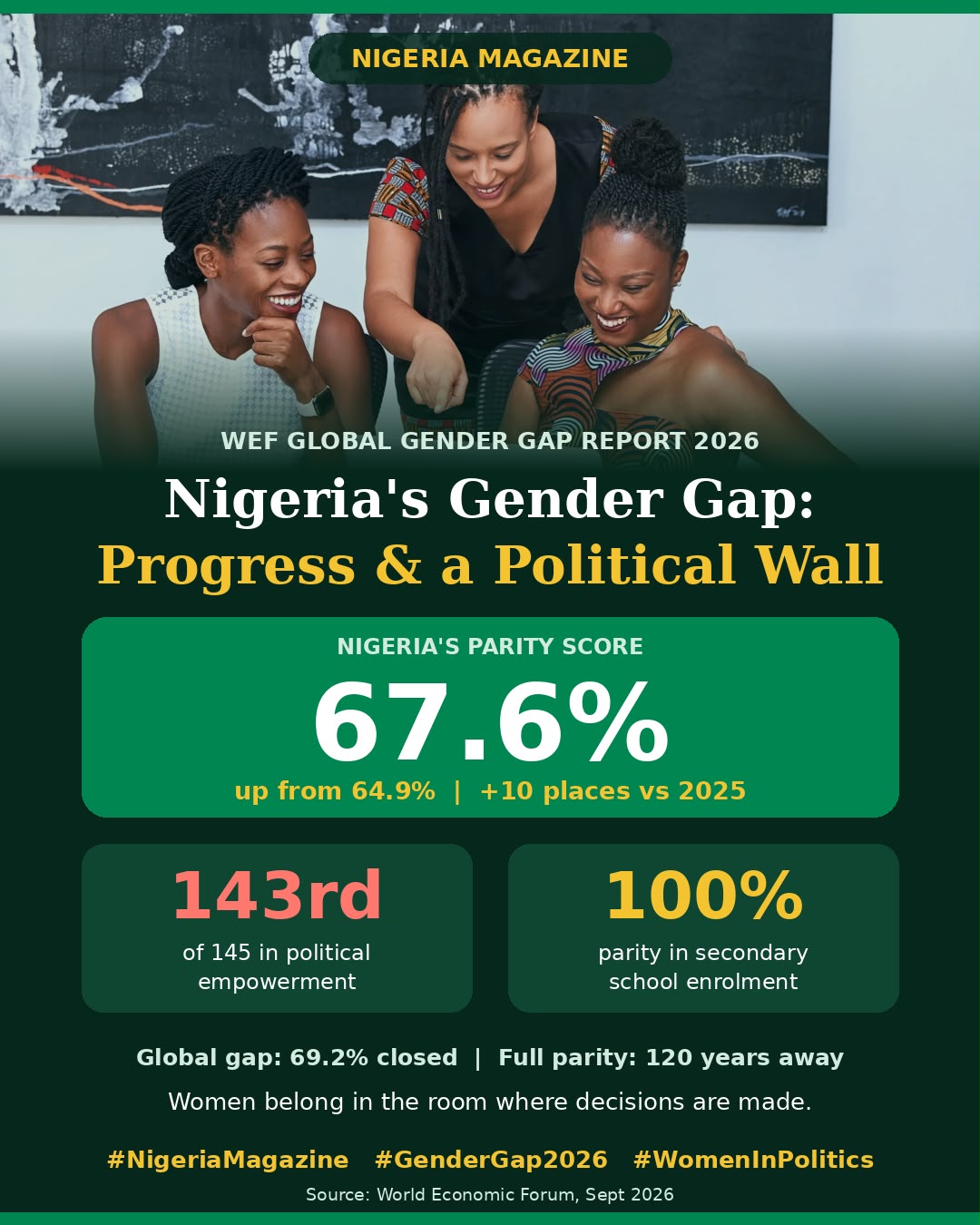
The global gender gap is now 69.2% closed, up 0.4 percentage points over the past year. At the current rate of progress, full parity is still 120 years away. The WEF also warns that progress is fragile and some of it is reversing. The report covers 145 economies, and no economy has reached full parity.
Where Nigeria stands
Nigeria has closed over two-thirds of its gender gap, with a parity score of 67.6 per cent. That is up from 64.9% in 2025, a gain of 2.7 percentage points. Nigeria also climbed ten places from its 2025 ranking of 124th. Over two decades, the country has gained 6.6 points from its 2006 score of 61%. The WEF describes this as one of the economy’s strongest annual improvements after years of limited movement.
The good news
- Education: Nigeria has reached full parity in secondary school enrolment, up 17.5 percentage points since 2006.
- Health and survival: Nigeria scores 96.2%, and outcomes have stayed broadly stable over time.
- Economy: Last year’s edition recorded Nigeria’s highest ever female labour-force participation. Nigerian women are also well represented in management compared with the rest of the world.
The wall: politics
Nigeria ranks 143rd of 145 countries on political empowerment, with a score of 0.037. The WEF says 96.3 per cent of the gap is still open. Only Papua New Guinea and Vanuatu rank below Nigeria. Inter-Parliamentary Union data lists women as just 4.1% of Nigeria’s legislators. Education also remains one of Nigeria’s weakest sub-indexes, which the WEF attributes to gaps in access that have accumulated over many years.
How Nigeria compares in the region
The WEF projects that Sub-Saharan Africa could take another 102 years to reach parity. The region varies widely: Namibia has closed 84.5% of its gap and ranks fourth globally, while Chad has closed 57.8%. Nigeria’s 2026 gain shows it can move quickly, but it is still well behind the regional leaders.
What Nigeria should do next
- Reserve seats for women. The Special Seats Bill would help close the political gap. Voluntary party quotas have not worked.
- Fix education. Parity in secondary enrolment is a milestone, but completion, literacy and tertiary access still lag, particularly in the North.
- Turn jobs into opportunity. Female labour-force participation counts for little if the work is informal, low-paid and without protection or access to credit.
- Back women in leadership. Mentorship, funding and safer political spaces matter as much as policy.
Bottom line
A ten-place climb is worth celebrating. But ranking 143rd of 145 in political empowerment shows the progress is uneven and incomplete. Nigeria’s women are educated, working and leading in business, and the country should not leave them out of government.

