


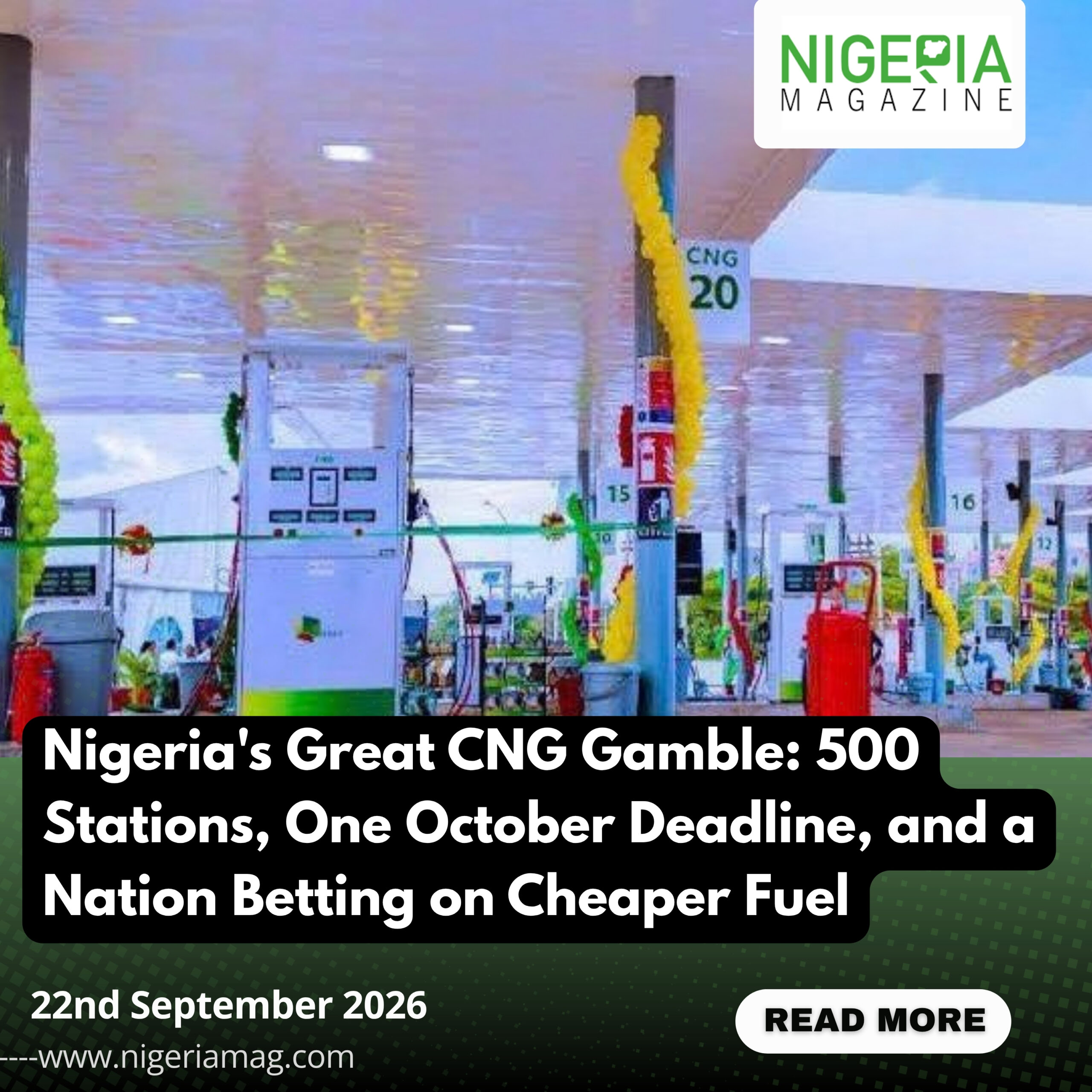
For millions of Nigerians who watch their transport fares climb with every fuel price hike, October 2026 has quietly become a date to circle. It’s the month the Federal Government says the first wave of a promised revolution in how the country fuels its cars, buses, and okadas will finally begin arriving; not as another political promise, but as physical infrastructure rolling into ports and construction sites across the nation.
The numbers being floated are eye-catching: 500 new Compressed Natural Gas (CNG) refuelling stations by the end of October, with another 500 to follow, bringing the total planned network to 1,000 stations nationwide. If it holds, this would represent one of the most ambitious energy infrastructure pushes Nigeria has attempted in years; and a direct response to a question that has dogged the Tinubu administration since it removed fuel subsidies: when will Nigerians actually feel relief at the pump?
Where the numbers come from
The Executive Chairman of the Presidential Compressed Natural Gas Initiative (PCNGI), Ismael Ahmed, confirmed in an interview that the first batch of 500 stations has already been ordered and is expected by the end of October. A second batch of 500 would subsequently be ordered, completing the 1,000-station target. This builds on President Bola Tinubu’s August directive for an additional 500 CNG refuelling points nationwide, stacked on top of 500 stations previously commissioned through the Midstream and Downstream Gas Infrastructure Fund.
The push follows a meeting between Tinubu and the Nigeria Governors’ Forum, where governors reportedly resolved on their own to pursue measures that would bring down transportation costs, with a strong focus on leveraging the savings CNG and electric vehicles offer over petrol. The federal and state governments have agreed to set up a joint committee to begin implementing these measures immediately, and the President has set a symbolic marker: October 1, 2026, as the date Nigerians should begin partaking in the savings through lower transport fares.
The gap between “ordered” and “open”
Here’s the nuance that matters most for anyone tracking this story: receiving 500 stations is not the same as 500 stations being open for business. Ahmed was candid about this, explaining that stations cannot be deployed the moment they arrive; each one requires construction, transportation, and connection before it becomes operational. The government is currently profiling locations across the country to determine where demand is greatest, with Lagos, Kano, Abuja, and Port Harcourt named among the areas under assessment. Notably, Abuja currently has just 26 operational gas stations; the highest count in the country; a figure that puts the scale of the 1,000-station ambition into perspective.
The government’s case rests on a simple pitch: a vehicle running on CNG spends 60 to 80 percent less on fuel than one running on petrol. With more than 120,000 vehicles already converted to CNG nationwide and over 100,000 additional conversion kits reportedly in the pipeline, the infrastructure bottleneck; not driver appetite; has been the real constraint. Whether October delivers stations that are merely ordered or stations that are actually pumping gas into vehicles will determine whether this becomes a genuine turning point for Nigeria’s transport economy, or another milestone that arrives on paper before it arrives on the road.

