


By Moses Chibuike Ezechukwu
Africa and the Caribbean are separated by an ocean, but history, culture and ancestry have connected them for centuries. As relations between the two regions deepen, the challenge now is to turn that connection into real opportunities for trade, travel, education, investment and a stronger global voice.
The Atlantic Should Carry More Than Memories
For generations, the Atlantic Ocean has represented two very different things for Africa and the Caribbean.
It is a body of water that separates continents and islands. But it is also the route through which millions of Africans were forcibly taken from their homes during the transatlantic slave trade.
That history cannot simply be erased.
Yet, perhaps, the meaning of the Atlantic can change.
That is the powerful idea behind recent calls for Africa and the Caribbean to build what Barbados Prime Minister Mia Amor Mottley describes as a new “passage of possibilities” — one where the same Atlantic that once carried suffering can eventually become a route for trade, tourism, education, investment, ideas and human connection. (nationnews.com)
Her message came as Africa and the Caribbean marked the fifth anniversary of CARICOM–Africa Day on September 7, 2026. The annual observance was established following the first Africa–CARICOM Summit in 2021. (CARICOM)
And this time, the conversation feels different.
It is becoming less about remembering what was lost and more about deciding what can still be built.
Five Years of a Relationship Taking Shape
The first Africa–CARICOM Summit was held virtually in September 2021 under the theme “Unity Across Continents and Oceans: Opportunities for Deepening Integration.”
At the time, African and Caribbean leaders recognised the importance of strengthening their historic relationship and creating greater cooperation in areas including trade, investment and people-to-people exchanges. (CARICOM)
Four years later, the relationship took another important step.
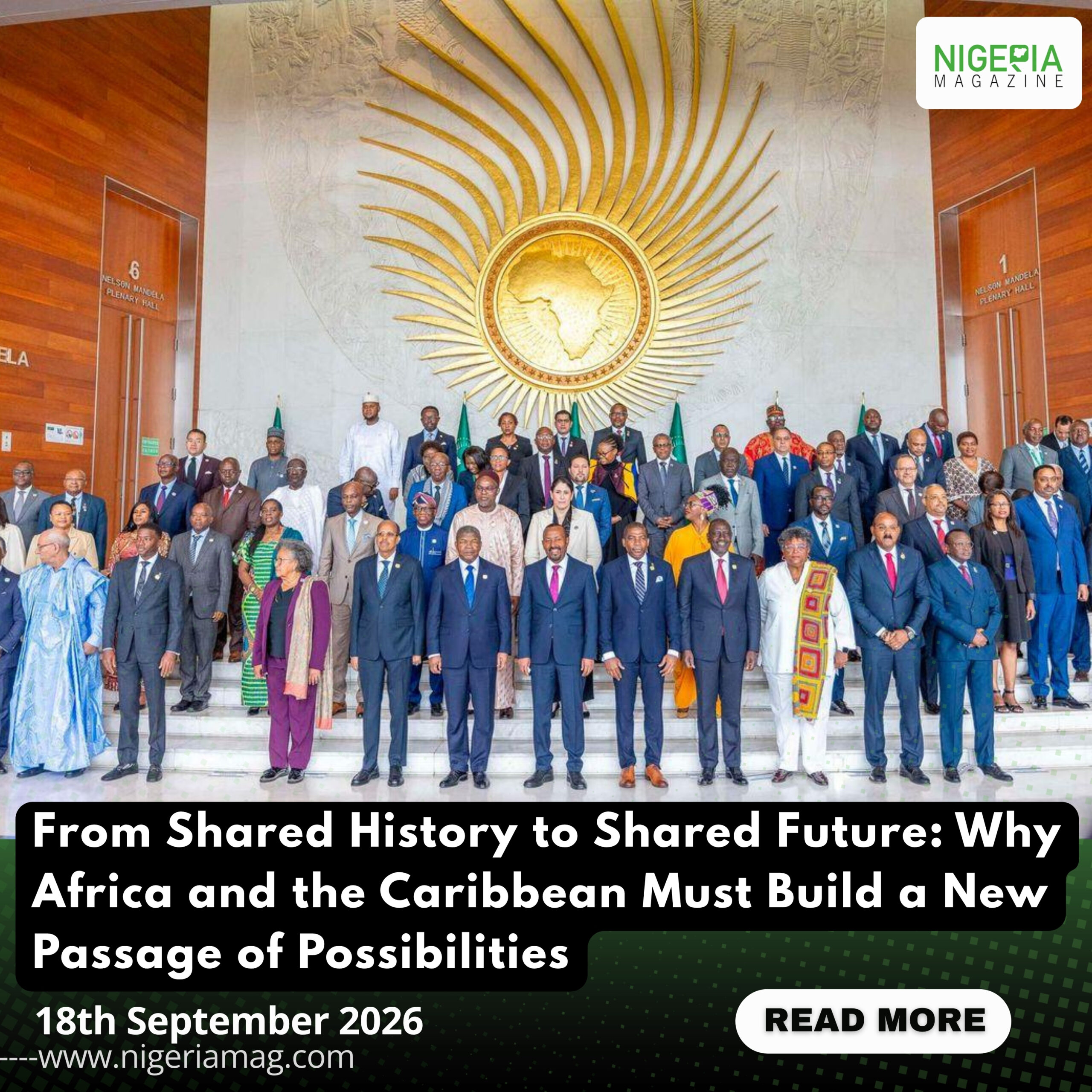
In September 2025, leaders gathered physically at the African Union headquarters in Addis Ababa, Ethiopia, for the second CARICOM–Africa Summit. It was the first in-person gathering of its kind after the inaugural summit had been held virtually. CARICOM Secretary-General Dr Carla Barnett described the meeting as a kind of homecoming for people connected by history and heritage. (CARICOM)
That symbolism matters.
But symbolism alone cannot feed families, create jobs or move businesses forward.
The next phase must therefore be about practical results.
The Opportunity Is Bigger Than History
Africa and the Caribbean have something that many modern partnerships spend years trying to manufacture: a natural cultural connection.
Music, food, language, religion, fashion and traditions reveal similarities that cannot be explained simply by geography.
But cultural familiarity should be the beginning, not the end.
There is a huge economic opportunity waiting to be developed.
Africa is home to more than 1.4 billion people, while the Caribbean represents a collection of markets with strategic access to North and South America. Together, the regions can create stronger commercial networks that allow African businesses to reach Caribbean consumers and Caribbean companies to establish deeper relationships with African markets.
The same applies to tourism.
Imagine a stronger tourism corridor linking Lagos, Accra and other African cities with Barbados, Jamaica, Trinidad and Tobago and other Caribbean destinations.
That is not merely an idea anymore.
Air Peace has already helped create a physical connection between West Africa and the Caribbean through direct services linking Lagos with Barbados and Antigua. The airline described the route as a growing bridge between Africa and the Caribbean. (Air Peace)
Every additional flight makes the relationship less theoretical.
Trade Needs to Become the New Language
Perhaps the most important area for cooperation is trade.
Africa and the Caribbean have enormous potential to trade with each other, yet geographical distance, transportation costs, financing challenges and limited awareness of available markets have historically restricted that potential.
That is beginning to change.
Afreximbank has been establishing a stronger presence in the Caribbean, including the development of its African Trade Centre in Barbados.
The project, located at Jemmotts Lane in St. Michael, represents an important attempt to create an institutional bridge between African and Caribbean businesses. (Foreign Affairs Barbados)
This is the type of infrastructure the relationship needs.
A successful Africa-Caribbean partnership cannot depend only on speeches at international conferences. It needs banks, airlines, ports, digital platforms, universities, entrepreneurs and governments working together.
A small business owner in Nigeria should eventually be able to understand how to sell to a Caribbean customer.
A Barbadian entrepreneur should be able to explore opportunities in Ghana, Nigeria, Kenya or Rwanda without facing unnecessary barriers.
That is what meaningful integration looks like.
Education and Young People Could Change Everything
There is another area where the relationship could become even more powerful: education.
Africa and the Caribbean have millions of young people, many of whom are increasingly connected through social media and digital technology.
Universities could establish exchange programmes.
Technology companies could create cross-continental training programmes.
Young African entrepreneurs could collaborate with Caribbean innovators.
Artists, filmmakers, writers and musicians could work across borders.
The possibilities are enormous.
The question is whether governments and institutions are willing to make movement between the two regions easier.
Mottley has specifically called for travel, trade, education and opportunity to flow more freely between Africa and the Caribbean. (nationnews.com)
That should become one of the central priorities of the relationship.
A Partnership Rooted in Reparative Justice
The relationship also has an important historical dimension.
Africa and the Caribbean continue to campaign for recognition of the consequences of slavery, colonialism and the transatlantic slave trade.
Ghana has taken a particularly prominent role in the reparations conversation. In 2026, President John Dramani Mahama’s government established a Global Advisory Panel on Reparatory Justice, alongside panels focused on the restitution of cultural artefacts and legal issues surrounding reparatory justice. (The Presidency, Republic of Ghana)
This is important because reparations should not be viewed only through the narrow question of financial compensation.
Reparative justice can also involve returning stolen cultural objects, improving historical education, strengthening economic relationships and addressing structures that continue to disadvantage developing societies.
The past cannot be changed.
But the future can be negotiated.
Africa Is Also Changing How the World Sees It
There is perhaps no better example of this than the recent United Nations vote on global maps.
In September 2026, the UN General Assembly overwhelmingly backed a resolution supporting greater use of the Equal Earth projection, which represents the relative sizes of continents more accurately than the traditional Mercator projection.
The resolution, led by Togo with African Union backing, passed with 164 votes in favour, one against and six abstentions. (Reuters)
At first glance, changing a map might appear insignificant.
It is not.
Maps influence how people understand the world.
For centuries, many people grew up seeing Africa represented in ways that visually reduced its enormous geographical scale. The Equal Earth projection provides a different perspective, showing Africa in proportions much closer to reality.
Africa is about 14 times the size of Greenland, despite the familiar Mercator map making them appear surprisingly similar in size. (Reuters)
The debate therefore goes beyond cartography.
It is also about who gets to tell the story of the world.
The Future Must Be More Than a Beautiful Idea
There is something deeply attractive about the vision of an Africa-Caribbean partnership.
But history has taught us that beautiful declarations are not enough.
The people of Africa and the Caribbean need measurable outcomes.
More flights.
More scholarships.
More investment.
More trade.
More cultural exchanges.
More business partnerships.
Easier movement.
Better diplomatic cooperation.
And, importantly, greater opportunities for young people.
The fifth anniversary of CARICOM–Africa Day should therefore not simply be another date on the diplomatic calendar.
It should be a moment to ask a difficult question: What has actually changed for ordinary Africans and Caribbean people?
If the answer is more opportunities, stronger businesses, easier travel and greater cooperation, then the partnership is working.
If not, then there is still work to do.
A New Atlantic Story
The Atlantic has carried many stories.
Some were stories of violence, displacement and loss.
But there is no reason that its future story must be defined by its past.
Africa and the Caribbean now have an opportunity to write something different.
They can build an Atlantic corridor where airplanes carry entrepreneurs instead of captives, where ships carry products instead of chains, where universities exchange knowledge, where artists exchange culture and where young people on both sides of the ocean see one another not as distant strangers, but as members of a wider family.
That is the real meaning behind the idea of a passage of possibilities.
The goal should not be to romanticise history.
It should be to transform it.
Africa and the Caribbean already have the history.
They already have the culture.
They already have the people.
Now they need the political will, economic structures and practical partnerships to turn that shared inheritance into shared prosperity.
The Atlantic once separated them.
Perhaps the next chapter should be about using it to bring them together.

