


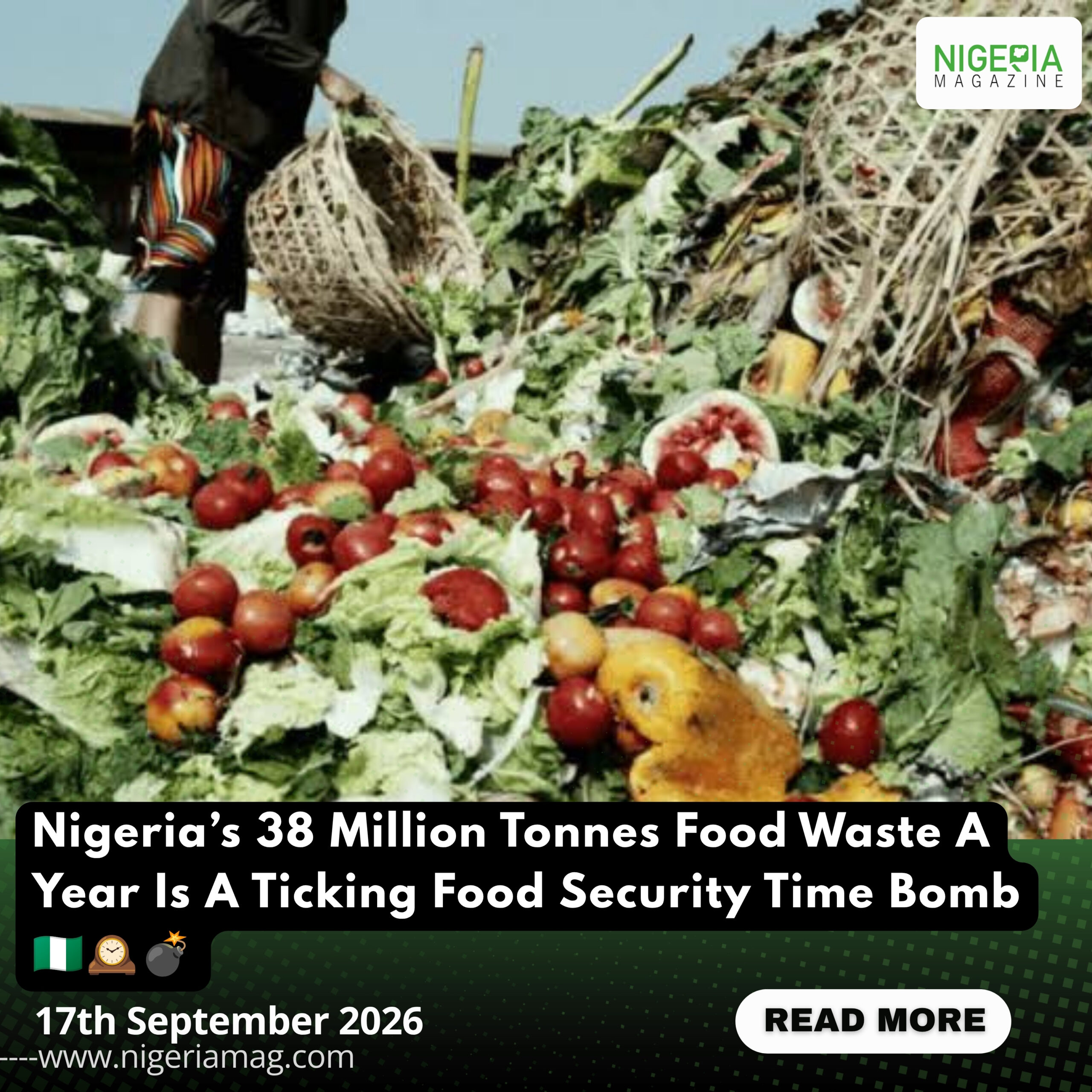
Nigeria has a hunger problem and a waste problem at the same time, and they’re feeding each other. According to the European Union, the country loses an estimated 38 million tonnes of food annually; more than any other nation on the African continent.
The figure was disclosed by Zissimos Vergos, Deputy Ambassador of the EU Delegation to Nigeria and ECOWAS, speaking in Abuja during the commemoration of this year’s International Zero Waste Day, themed “Food Waste Reduction; Minimisation and Valorisation.” The EU made the disclosure jointly with the Nigerian Federal Government and the United Nations Industrial Development Organization (UNIDO), describing the situation as alarming and calling for urgent, coordinated action across government, the private sector, and citizens.
A Global Crisis, With Nigeria at the Sharp End
Nigeria’s numbers don’t exist in isolation. Globally, nearly one billion tonnes of food; almost one-fifth of all food available to consumers; was wasted in 2022 alone. Food loss is now understood to contribute up to 10% of global greenhouse gas emissions and nearly 40% of global methane emissions, making it as much a climate issue as an economic one.
Vergos framed the stakes plainly: wasting food doesn’t just waste the food itself. It wastes the water, energy, and labour that went into growing, transporting, and preparing it; resources that vanish the moment produce rots on a truck, spoils in a market stall, or gets thrown out after a wedding or a restaurant service.
Why the Losses Happen
The causes trace across the entire food value chain rather than sitting at one point of failure. Poor rural road networks mean produce degrades before it reaches urban markets. A shortage of cold storage and processing infrastructure means perishables that could be preserved simply aren’t. Limited value-added processing means raw produce that could be turned into shelf-stable products instead gets discarded. And cultural practices around large-scale food preparation for events add another layer of loss on top of the structural gaps.
UNIDO’s representative in Nigeria, Amb. Philbert Johnson, put the broader stakes in stark terms: food is far more than a commodity; it is a foundation of wealth, a driver of health, and a pillar of security. When food systems function efficiently, he noted, they generate income, build resilience, and improve wellbeing. When they fail, the consequences ripple across economies, environments, and communities alike.
What’s Being Proposed
The EU delegation outlined a set of interventions drawn from its own experience tackling food waste: investment in rural roads and cold storage to keep produce viable for longer, support for value-added processing of fresh produce so surplus doesn’t simply spoil, and the introduction of zero-waste education into schools to shift habits at the earliest stage.
On the Nigerian side, Minister of Environment Balarabe Lawal reaffirmed the government’s commitment to tackling the issue, pointing to ministry projects already targeting post-harvest losses in major markets. UNIDO, for its part, reaffirmed its readiness to support Nigeria through funding and technical cooperation aimed at building more resilient, inclusive agro-industrial systems.
The Uncomfortable Contradiction
What makes the 38-million-tonne figure land hardest is the contrast it sits inside. Nigeria continues to grapple with significant food insecurity and malnutrition in parts of the country, even as the equivalent of Africa’s largest food-waste bill accumulates elsewhere in the system; on the farm, in transit, in the market, on the plate. Closing that gap isn’t just an environmental target. It’s a food-security one.
Figures and statements cited are drawn from the EU Delegation to Nigeria and ECOWAS, the Nigerian Federal Ministry of Environment, and UNIDO, as disclosed during International Zero Waste Day commemorations in Abuja.

