


By Moses Chibuike Ezechukwu
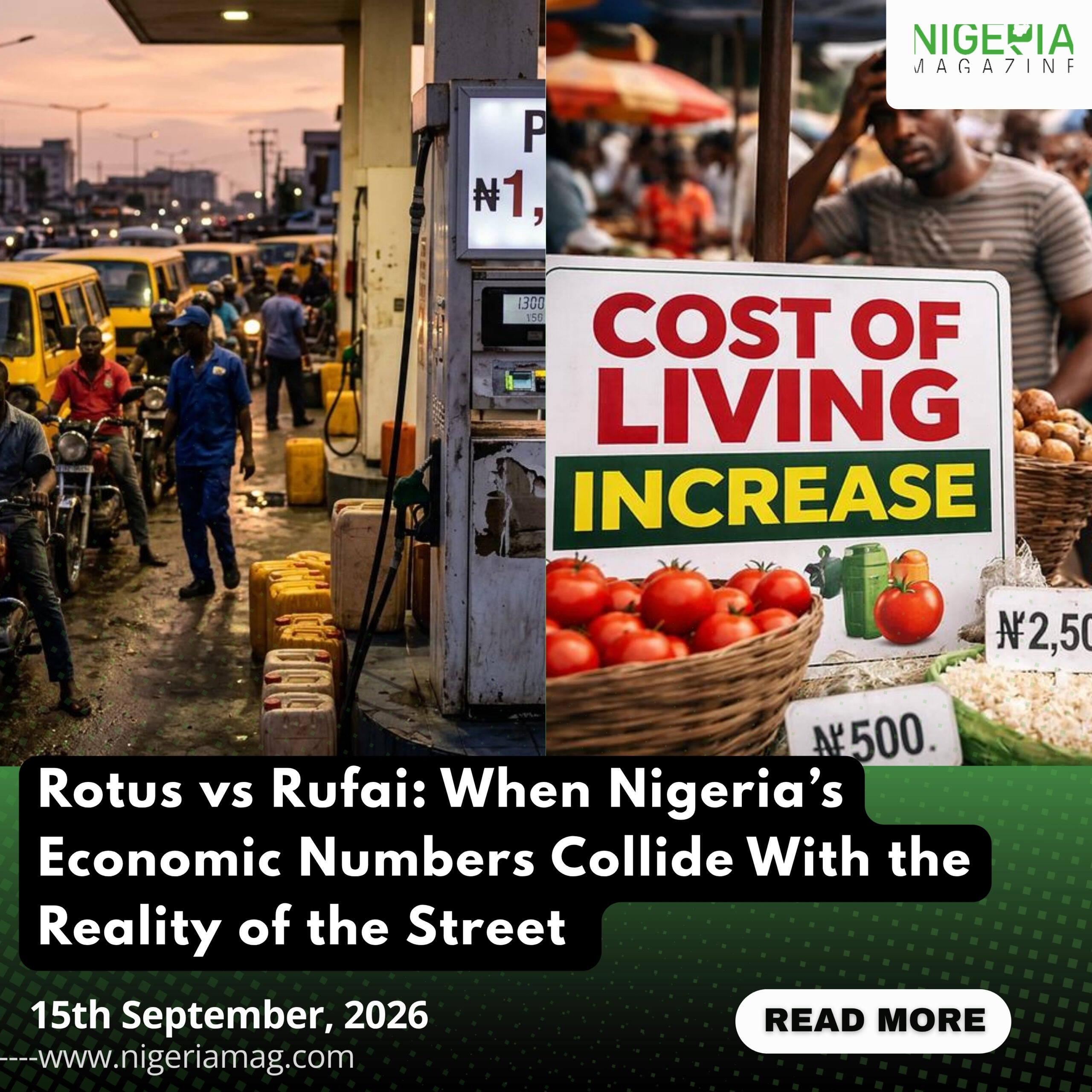
An intense exchange on Arise News has reignited an important debate about Nigeria’s economic reforms: can the government point to stronger GDP growth and improving macroeconomic indicators while millions of Nigerians continue to struggle with the cost of living?
The Question That Turned Into an Argument
It started with what sounded like a straightforward economic question.
But within minutes, the discussion between Rotus Oddiri and Rufai Oseni on Arise News became another example of how difficult it has become to discuss Nigeria’s economy without emotions entering the room.
The subject was Nigeria’s economic reforms, particularly the removal of the fuel subsidy and the foreign exchange reforms introduced after President Bola Ahmed Tinubu assumed office in 2023.
Rotus was making the case around economic output and growth. Rufai, meanwhile, was pushing the conversation toward what Nigerians actually lost in purchasing power and living standards.
Then came the question that changed the temperature of the conversation:
What was Nigeria’s GDP before the reforms, and what was it afterwards?
Rotus acknowledged that the naira depreciation had significantly affected the dollar value of Nigeria’s economy but challenged Rufai to distinguish between economic growth and the dollar-denominated size of GDP.
That distinction is at the heart of the argument.
And, interestingly, both sides were touching on something important.
GDP Growth Is Not the Same as Getting Richer
One of the easiest ways to misunderstand an economy is to look at one number and assume it tells the whole story.
GDP measures the value of goods and services produced within an economy. Real GDP growth, meanwhile, attempts to measure whether the economy is producing more after accounting for price changes.
Nigeria’s official statistics show that real GDP grew by 2.74 percent in 2023, compared with 3.10 percent in 2022. So the economy did not contract in the year the major reforms began. (National Bureau of Statistics)
That fact supports Rotus’ broader argument that the economy continued to grow.
But there is another side to the story.
A country can record economic growth while households become poorer in real terms.
The World Bank has repeatedly highlighted precisely this problem in Nigeria. Its 2026 assessment says macroeconomic stability has improved, but household incomes have not fully recovered and poverty remains high. (World Bank)
That is why Rufai’s line of questioning resonates with many Nigerians.
People do not experience GDP statistics when they enter a market.
They experience the price of rice.
They experience the cost of transportation.
They experience electricity bills.
They experience rent.
They experience the exchange rate when they need to pay for something priced in dollars.
And that is where the economic debate becomes much more complicated.
What Actually Happened to Nigeria’s GDP?
This is where the figures require some careful explanation.
Nigeria’s GDP in current US dollars was approximately $647 billion in 2022, according to the World Bank’s latest historical series. In 2023, it fell to roughly $487 billion. (DataBank)
So, yes, there was a very substantial decline in the dollar value of Nigeria’s GDP between those years.
But saying simply that “the reforms destroyed Nigeria’s GDP” would be misleading.
Why?
Because GDP measured in US dollars is heavily affected by the exchange rate.
When the naira loses substantial value against the dollar, Nigeria’s economic output, when converted into dollars at the prevailing exchange rate, can suddenly appear much smaller even if domestic production has not fallen by the same proportion.
This is one of the crucial points missing from many public arguments about Nigeria’s economic size.
The World Bank noted in December 2023 that the naira had depreciated by approximately 41 percent against the US dollar in the official market, following the move toward a unified, market-reflective foreign exchange system. (World Bank)
So the fall in Nigeria’s dollar GDP was real as a measurement.
But it should not automatically be interpreted as an equivalent collapse in the physical amount of goods and services Nigerians produced.
But Rufai’s Question Still Matters
Having said that, Rufai’s concern about households cannot simply be dismissed.
The reason is simple.
Economic statistics and household welfare are connected, but they are not the same thing.
Nigeria’s reforms were designed partly to correct major distortions in the economy.
The fuel subsidy was removed.
The foreign exchange system was changed.
The World Bank has described these reforms as necessary steps toward restoring macroeconomic stability, but it has also acknowledged that they created painful short-term adjustments for households and businesses. (World Bank)
The impact was immediate.
Fuel became dramatically more expensive.
Transportation costs increased.
Businesses faced higher operating expenses.
Imported goods became more expensive because of the weaker naira.
And inflation ate into household income.
The World Bank reported that inflation reached 33.7 percent in April 2024, significantly hurting purchasing power. (World Bank)
So when Rufai asks what the reforms took out of people’s pockets, he is asking a legitimate economic question.
The challenge is that the answer cannot be obtained simply by subtracting one year’s GDP figure from another.
Nigeria’s Economy Is Now Growing Faster
There is also another part of the story that deserves attention.
Nigeria’s economy has continued to expand after the difficult adjustment period.
The World Bank says Nigeria’s economy grew by about 4 percent in 2025, driven mainly by services, while inflation declined from 33.2 percent in 2024 to 23 percent in 2025. (World Bank)
And more recent official data show that momentum continued into 2026.
The National Bureau of Statistics’ Q2 2026 GDP report was released on August 31, 2026. (Microdata Nigerianstat)
According to figures reported from the latest government economic update, real GDP growth reached 4.43 percent in the second quarter of 2026, following 3.89 percent in the first quarter.
That is significant.
It suggests that the Nigerian economy has not remained stuck in the immediate shock created by the reforms.
But growth alone does not end the argument.
The Real Question: Growth for Who?
This may be the most important question coming out of the Rotus-Rufai exchange.
Nigeria can grow.
The government can improve revenue.
Foreign reserves can rise.
The exchange-rate market can become more stable.
Inflation can begin falling.
And investors can become more confident.
All of those things matter.
But if the average Nigerian cannot afford food, transport, housing or healthcare, then the economic story remains incomplete.
The World Bank’s 2026 assessment makes this point clearly: Nigeria has made progress in macroeconomic stabilization, but household incomes have not fully recovered and poverty remains high. (World Bank)
That is the gap policymakers now have to close.
The first phase of reform may have been about preventing a deeper economic crisis.
The next phase has to be about making Nigerians feel the recovery.
Where Rotus and Rufai May Actually Agree
Interestingly, the argument may look bigger than the disagreement.
Rotus appears concerned about defending economic facts and avoiding the impression that Nigeria’s reforms have simply destroyed the economy.
Rufai is concerned about the human consequences of those reforms and whether economic growth means anything to ordinary Nigerians.
Both concerns are legitimate.
The danger comes when one side of the equation is used to completely dismiss the other.
It is possible for Nigeria’s economy to be growing and for Nigerians to be suffering.
It is possible for inflation to be falling and for food to remain too expensive.
It is possible for foreign reserves to improve and for millions of households to struggle.
It is possible for investors to become more optimistic and for ordinary citizens to remain deeply frustrated.
That is not a contradiction.
It is the reality of an economy going through a painful adjustment.
The Debate Nigeria Needs
Perhaps the biggest lesson from the Rotus-Rufai exchange is that Nigeria needs fewer arguments about whether the economy is simply “good” or “bad.”
The country needs a more mature conversation.
What are the reforms achieving?
What are they costing?
Who is benefiting?
Who is being left behind?
How quickly can purchasing power recover?
How can government revenue be converted into better infrastructure, healthcare, education, security and jobs?
Those are the questions that matter.
Because ultimately, GDP is not the reason an economy exists.
People are.
Beyond the Numbers
Nigeria’s economic reforms have produced genuine changes.
Some indicators have improved.
Growth has strengthened.
The foreign exchange market has become more stable than during the worst period of the crisis.
Inflation has begun to ease.
But the hardship created by the adjustment cannot simply be talked away with statistics.
The responsibility now lies with policymakers to ensure that macroeconomic stability eventually becomes household stability.
That is when the Nigerian public will truly believe that the sacrifices were worth it.
Until then, arguments like the one between Rotus and Rufai will continue.
And perhaps that is not necessarily a bad thing.
A country as economically important and politically complex as Nigeria needs journalists, analysts and policymakers who are willing to challenge one another.
But the arguments should ultimately lead somewhere.
Beyond GDP figures. Beyond political talking points. Beyond television debates.
They must lead to a Nigeria where economic growth can finally be felt in the pockets, homes and everyday lives of its people.

