


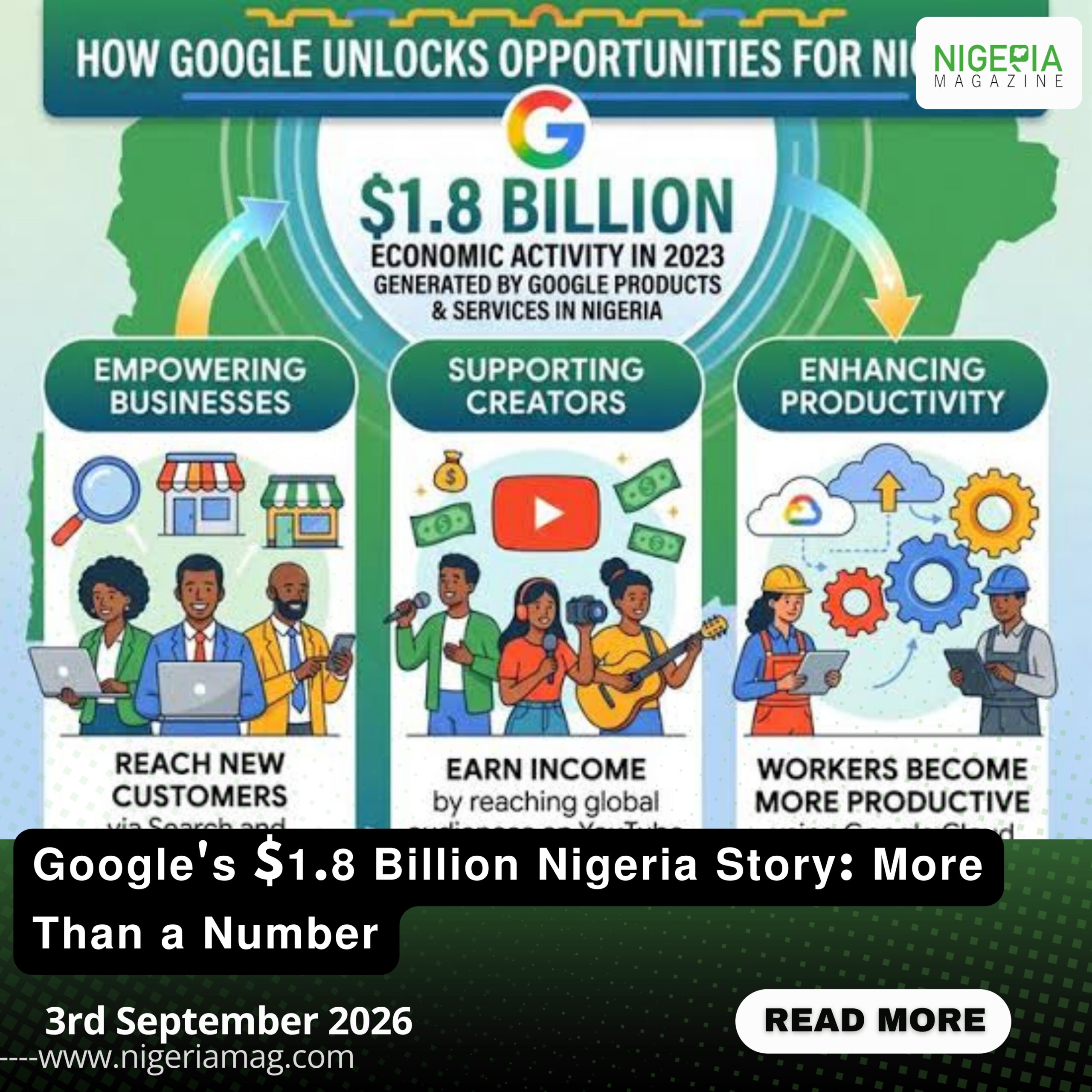
When U.S. Mission Nigeria highlighted Google’s economic footprint in the country this week, the headline figure; $1.8 billion in economic activity in 2023; is easy to skim past.
But behind that number sits a quieter story about how ordinary Nigerians are turning global technology into local livelihoods.
The figure comes from an independent report by global consultancy Public First, commissioned to measure Google’s real-world impact across Nigeria. It found that Search, Ads, Google Play, YouTube, and Google Cloud combined to generate an estimated $1.8 billion in economic activity in a single year.
To put that in perspective, Google says the impact is equivalent to supporting over 200,000 jobs annually; not jobs created by Google directly, but livelihoods built on top of its platforms by Nigerians themselves.
That distinction matters. This isn’t a story about a foreign company extracting value from a market; it’s about a market using foreign infrastructure to build its own value.
A small business owner in Lagos using Ads to reach new customers, a developer in Abuja deploying an app on Google Cloud, a creator in Port Harcourt earning a living from YouTube; each is a data point inside that $1.8 billion, and each represents a piece of economic agency that didn’t require permission from a bank, a government grant, or a foreign investor.
The report’s most telling statistic isn’t the $1.8 billion itself; it’s the multiplier behind it: every $1 invested in digital technology in Nigeria generates over $8 in economic value. Few sectors offer that kind of return. It’s a quiet argument for where the country’s next wave of infrastructure spending should go; not just roads and power, but bandwidth, cloud access, and digital literacy.
Google isn’t leaving that pipeline to chance. Its Digital Skills for Africa and Career Certificates programmes helped over 1.5 million young Nigerians learn new digital skills in 2023 alone; part of a broader $1 billion commitment made in 2021 to accelerate Africa’s digital economy through better internet access, entrepreneur support, and innovation funding. The logic is straightforward: a $1.8 billion impact today is only the floor if the workforce behind it keeps growing.
And the ceiling could be much higher. The report projects that artificial intelligence could add a further $15 billion to Nigeria’s economy by 2030; nearly ten times this year’s figure; but only if the country builds the STEM education, AI fluency, and cloud-first policy environment to capture it.
That’s the real subtext of this report: Nigeria isn’t just a consumer of global technology, it’s positioned to be one of its biggest beneficiaries, but only if the groundwork keeps pace with the ambition.
$1.8 billion, then, isn’t the ceiling. It’s the proof of concept.

