


By Nigeria Magazine
Every August Bank Holiday, west London turns into a two-mile-long celebration of Caribbean and African heritage. Sequins, steel pan, soca, jerk chicken smoke curling into the sky, sound systems shaking scaffolding — Notting Hill Carnival is, on the surface, a party. But 2026 marks its 60th anniversary, and the bigger story is what the Carnival has quietly become: one of Europe’s largest self-sustaining Black economic ecosystems, and one that is still being run, year after year, without the infrastructure it needs to grow.
For Nigeria Magazine’s readers — the diaspora entrepreneurs, investors, and culture-makers who move between Lagos, London, and beyond — Carnival is a case study in what happens when a community builds enormous economic value and still has to fight annually just to keep the lights on.
The Numbers Nobody Argues AboutCarnival began in 1966, grown out of an earlier indoor Caribbean carnival organised by activist Claudia Jones and a local street festival led by Rhaune Laslett, as a response to the racial tensions and isolation Caribbean migrants faced in post-Windrush Britain. Six decades later, it draws an estimated two million people over the weekend, making it Europe’s largest street festival and the second-largest carnival in the world after Rio.
The economic estimates vary depending on who’s counting, but they all point the same direction:
▶️Early Greater London Authority-commissioned research, based on visitor spend alone, put Carnival’s contribution to the London economy at somewhere between £23 million and £54 million a year.
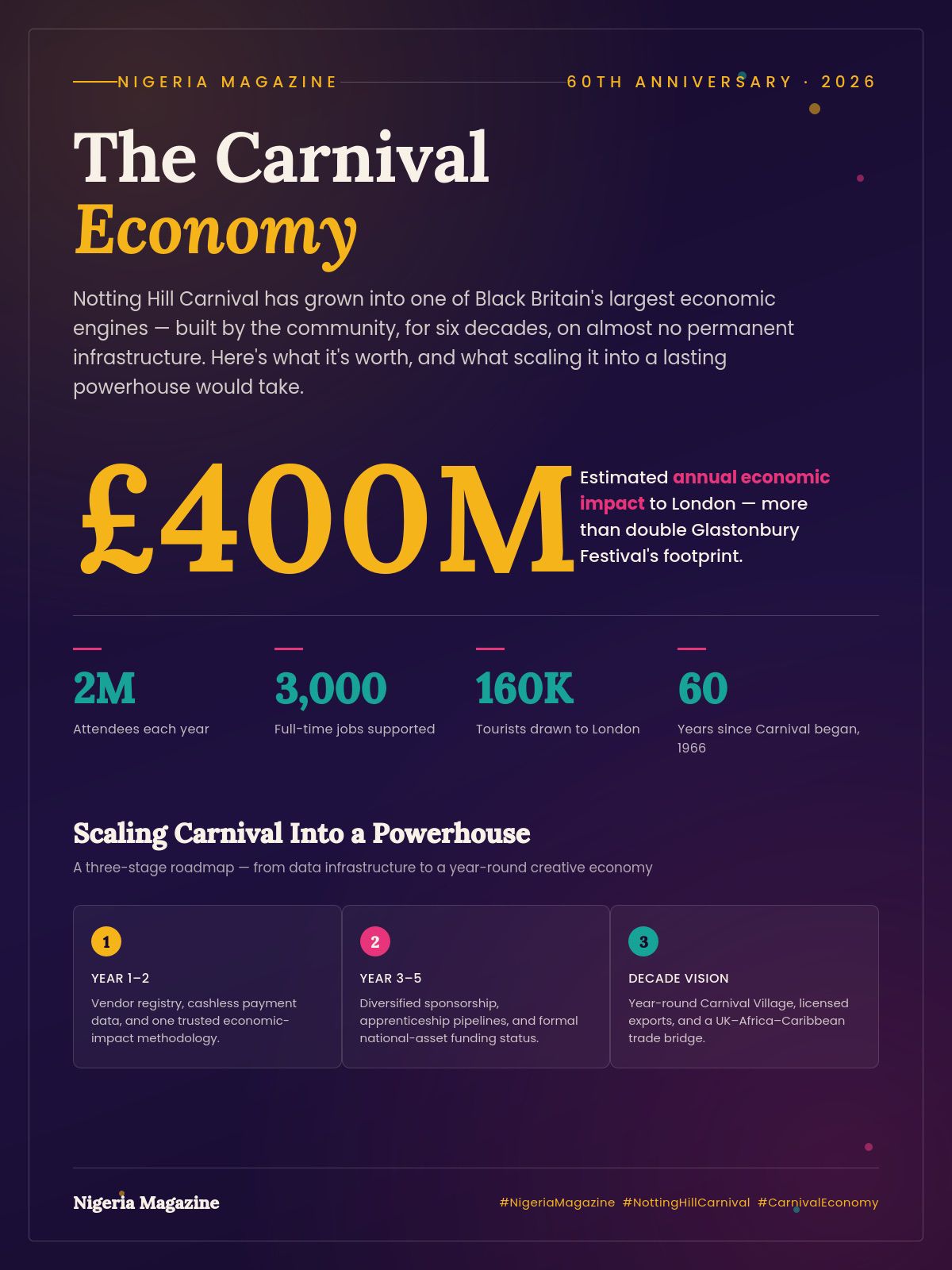
▶️More recent estimates from the Mayor of London’s office put Carnival’s value to London’s economy at close to £400 million annually.
▶️A 2024 study commissioned by The Voice newspaper estimated a direct economic impact of over £396 million, supporting roughly 3,000 full-time jobs and drawing around 160,000 tourists to the capital.
▶️For comparison, that would make Carnival worth more than double Glastonbury Festival’s estimated £168 million impact, and roughly ten times Wireless Festival’s £30 million — on a fraction of the sponsorship and infrastructure budget either of those events enjoys.
That value flows through Black-owned costume houses (or “mas bands”) that design and build outfits year-round, sound system crews who’ve operated on the same corners for generations, food vendors selling jerk, roti, and suya, independent designers, security and stewarding firms, hospitality venues, and an entire informal economy of pop-up traders who only exist for one weekend a year but plan their finances around it for months.
The Paradox: Huge Value, Fragile Foundations
Here’s the uncomfortable part. Despite generating hundreds of millions of pounds, Carnival nearly didn’t happen in 2025. Organisers needed an emergency £1 million bailout from City Hall, Kensington & Chelsea, and Westminster councils just to keep the event safe and viable. For its 60th anniversary in 2026, the Mayor of London had to step in with an additional £4.66 million on top of existing funding, largely driven by rising safety and crowd-management costs. Total running costs — policing, cleanup, stewarding — have climbed sharply, with policing alone costing more than £13.5 million in 2024.
In other words: an event that may be generating close to £400 million a year for the wider economy is funded like a struggling local fête, dependent on last-minute council rescue packages rather than a sustainable, diversified funding model. That’s the paradox at the heart of Carnival, and it’s a pattern familiar to Black cultural and business institutions across the UK — massive cultural and economic footprint, minimal structural investment.Why “Data Infrastructure” Is the Missing PiecePart of the reason Carnival’s funding stays precarious is that nobody actually agrees on what it’s worth. Estimates swing from £23 million to £400 million depending on the methodology, the year, and who commissioned the study. That’s not a rounding error — it’s a sign that Carnival has never had the kind of standardised, year-round economic data infrastructure that other major UK events and industries take for granted.
If Carnival is going to be treated — and funded — as the national economic asset the numbers suggest it already is, the next one to two years need to focus on building that evidence base:
1️⃣ A standing vendor and trader registry. A formal, digitised record of the thousands of food stalls, mas bands, designers, and sound systems that operate at Carnival, updated annually, so economic impact can be measured consistently rather than estimated after the fact.
2️⃣ Cashless and trackable payment infrastructure. Encouraging (not mandating) digital payment options at stalls and vendors would generate real transaction data — the same kind of data that festivals like Glastonbury already use to justify sponsorship and public investment.
3️⃣ A single, independent economic impact methodology, published annually, ideally run in partnership with a university or the Office for National Statistics, so the £23m-to-£400m range becomes one trusted, defensible figure that City Hall, sponsors, and investors can plan around.
4️⃣ A visitor and tourism tracking system, working with TfL, hotels, and hospitality partners to properly capture how much international and domestic tourism spend Carnival actually pulls into London — not just on the weekend, but in the surrounding week.
5️⃣ A public dashboard, similar to how tech and sports events publish live economic and attendance data, that lets sponsors, government, and the diaspora business community see Carnival’s value in real time rather than relying on a study every few years.
None of this requires reinventing Carnival. It requires treating it, finally, as the economic institution it has already become.Scaling Carnival Into a Powerhouse: A One-to-Two-Year and Decade ViewNext 12–24 months:
▶️Build the data infrastructure above, starting with the vendor registry and a single agreed economic methodology.
▶️Diversify funding away from last-minute council bailouts toward a mix of long-term corporate sponsorship, a Carnival-specific lottery or levy, and diaspora investment funds — the same models used by festivals with equivalent footfall.
▶️Formalise apprenticeship and training pipelines in costume design, event production, and sound engineering, turning informal, generational skill-transfer into certified career pathways.
Over the next decade:
▶️Extend Carnival from a two-day event into a year-round creative economy: a permanent Carnival Village or museum in west London housing costume archives, workshops, and retail, similar to how Rio and Trinidad have built carnival-adjacent tourism industries that run all year.
▶️Position Carnival as a formal UK–Caribbean–Africa trade and creative-industries bridge — a natural counterpart to the growing Afrobeats, Nollywood, and fashion export links between Lagos, London, and the wider diaspora.
▶️License and export the Carnival brand and expertise (production, safety management, mas-band design) to other cities building their own carnivals, turning six decades of institutional knowledge into a consultancy and licensing revenue stream.
▶️Push for the “national treasure” protections campaigners are already calling for in 2026 — formal, statutory recognition and multi-year funding commitments, rather than annual survival mode.
The Takeaway for the DiasporaNotting Hill Carnival is proof, in the most literal financial sense, of what Black British and Caribbean culture is worth to the UK economy. The gap isn’t cultural relevance — that’s been settled for 60 years. The gap is infrastructure: data, funding architecture, and long-term planning that matches the scale of what’s already being built, unpaid and under-resourced, by mas bands, sound systems, and vendors every single year.
For Nigeria Magazine’s readers, the opportunity is clear. Diaspora investors, fintech founders, hospitality operators, and creative entrepreneurs have a rare chance to help build that missing infrastructure — and to plug Lagos-London-Caribbean commercial links into an event that is already proving, at a scale of hundreds of millions of pounds, what a properly resourced Black cultural economy can do.
#NigeriaMagazine #NottingHillCarnival #CarnivalEconomy #BlackPound #DiasporaBusiness #UKDiaspora #NottingHillCarnival60 #London🇬🇧 #NHC2026 #BlackBritishBusiness #CreativeEconomy #CulturalEconomics #EventEconomy #DataInfrastructure #EconomicPowerhouse#BlackBritain #CaribbeanCulture #WindrushLegacy #AfroCaribbean #BlackExcellence #UKDiaspora #LagosToLondon #London🇬🇧 #WestLondon #LadbrokeGrove #UKEvents #EuropesBiggestCarnival
This article is for general information. Economic estimates cited are drawn from publicly available third-party research and vary by source and methodology.
Sources: Greater London Authority / London Assembly; Office of the Mayor of London; Notting Hill Carnival Ltd; The Voice newspaper (2024 commissioned research); ITV News London; City A.M.; London Crime News.

