


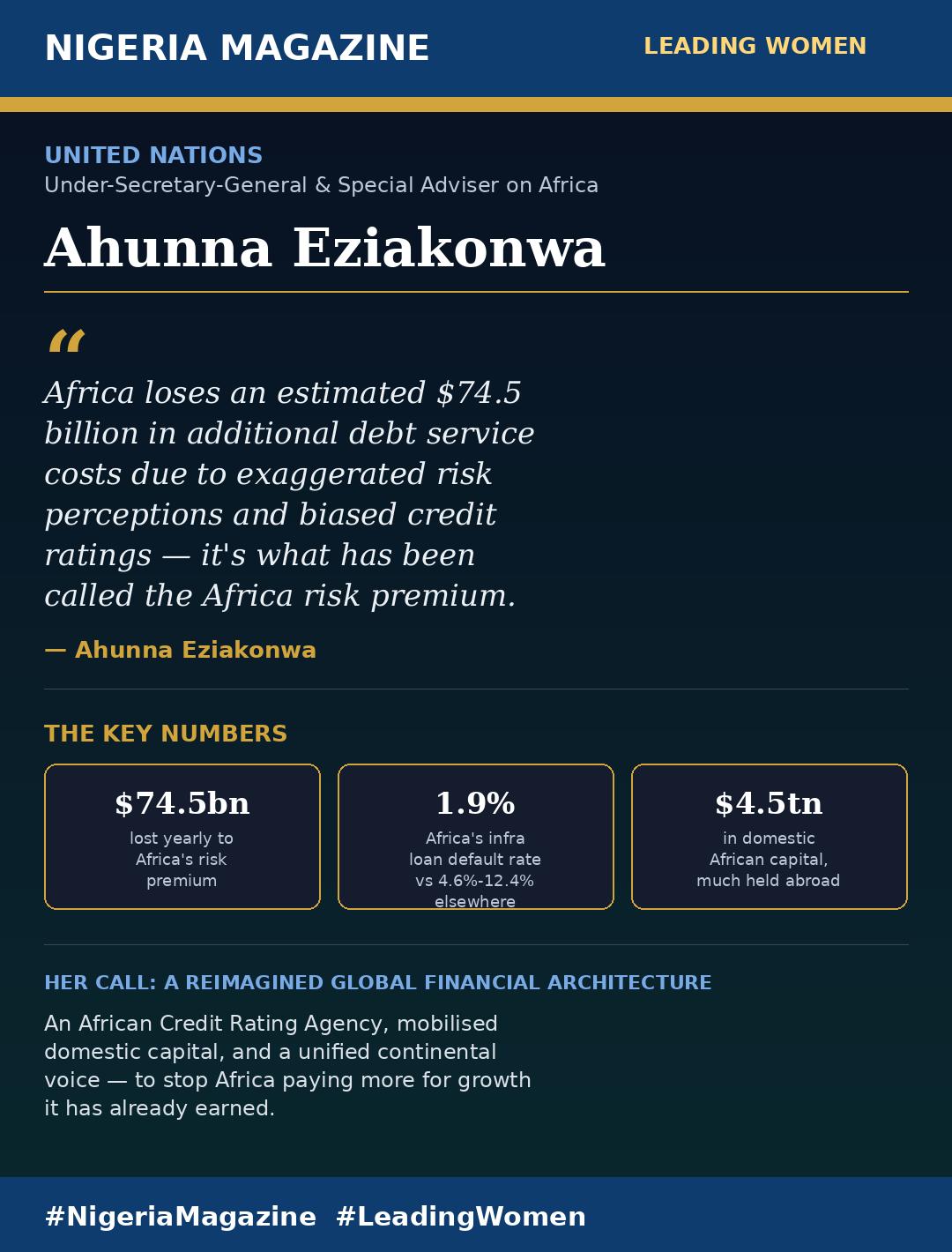
She speaks softly, but the message lands with force: Africa is paying a steep, largely undeserved premium simply because the world has decided to see it as risky. That is the case Ahunna Eziakonwa; the Nigerian diplomat now serving as the United Nations Under-Secretary-General and Special Adviser on Africa; has been making to global finance, and it’s reshaping conversations about how the continent borrows, grows, and negotiates its place in the world economy. Who Is Ahunna Eziakonwa? Appointed by UN Secretary-General António Guterres in June 2026 and in office since August 1, Eziakonwa brings nearly three decades of United Nations leadership to the role, succeeding Cristina Duarte of Cabo Verde. Before this appointment, she served as UN Assistant Secretary-General and Director of UNDP’s Regional Bureau for Africa, where she guided the organisation’s support for 46 African countries pursuing the Sustainable Development Goals and the African Union’s Agenda 2063. Her résumé reads like a tour of the continent’s toughest and most transformative moments — UN Resident Coordinator and Humanitarian Coordinator postings in Ethiopia, Uganda, and Lesotho, senior humanitarian roles during critical periods in Liberia and Sierra Leone, and a stint overseeing UN humanitarian operations across 15 African countries. A multilingual diplomat fluent in English, Igbo, and Yoruba with working French, she holds a master’s in International Affairs from Columbia University and a bachelor’s degree from the University of Benin, Nigeria. The Cost of Being Called “Risky”At the centre of Eziakonwa’s advocacy is what she calls Africa’s risk premium — the extra cost African nations pay to borrow money simply because global markets perceive the continent as unstable, regardless of actual repayment behavior. She has put a number on it: Africa loses an estimated $74.5 billion annually in additional debt service costs tied to inflated risk perceptions and skewed credit ratings. What makes the premium especially galling to her is that it isn’t backed by the data. She points to research showing African infrastructure loans default far less often than comparable loans elsewhere — yet borrowers on the continent still pay more than peers with similar risk profiles in other regions. The practical effect, she argues, is a vicious cycle: inflated borrowing costs eat into government budgets, leaving less money for schools, clinics, and electricity access, even a modest reduction in borrowing costs could free up enough money to power tens of millions of homes or hire hundreds of thousands of teachers. Fixing the Narrative, Not Just the NumbersEziakonwa traces much of the problem to what she calls a “narrative premium” — a persistent global habit of framing Africa as fragile and volatile while glossing over its demonstrated resilience through crises like the 2008 financial crash and the COVID-19 pandemic. Her prescription starts with data: a proposed African Credit Rating Agency, designed to bring broader datasets and more rigorous, locally-grounded analysis into how the continent’s sovereign risk is assessed, rather than relying on brief external visits and thin data sets.Reimagining Global Financial ArchitectureHer critique goes beyond credit ratings to the deeper architecture of global finance. She notes that Africa holds trillions in domestic capital — pension funds, reserves, and sovereign wealth — much of it parked outside the continent, unavailable to fund the very development it could finance. Efforts like the New African Financial Architecture for Development (NAFAD), adopted through the Abidjan Consensus in April 2026, aim to change that by mobilizing domestic savings, lowering the cost of capital, and strengthening Africa’s voice in global financial governance. Eziakonwa is candid that reforming a decades-old global system won’t happen quickly, and that shareholders of that system haven’t moved much despite years of advocacy. Her answer is for African nations to stop negotiating alone — pointing to platforms like the new Borrowers’ Platform, where countries in debt distress can coordinate strategy together rather than face creditors individually, as Zambia was forced to do. Owning the Story: Perhaps her most striking point is also her simplest: Africa, she argues, has too often let others tell its story — and in doing so, has lost leverage over its own financial future. Reclaiming that narrative, backed by better data and a unified continental voice, is at the heart of her vision for a fairer global financial system.

