


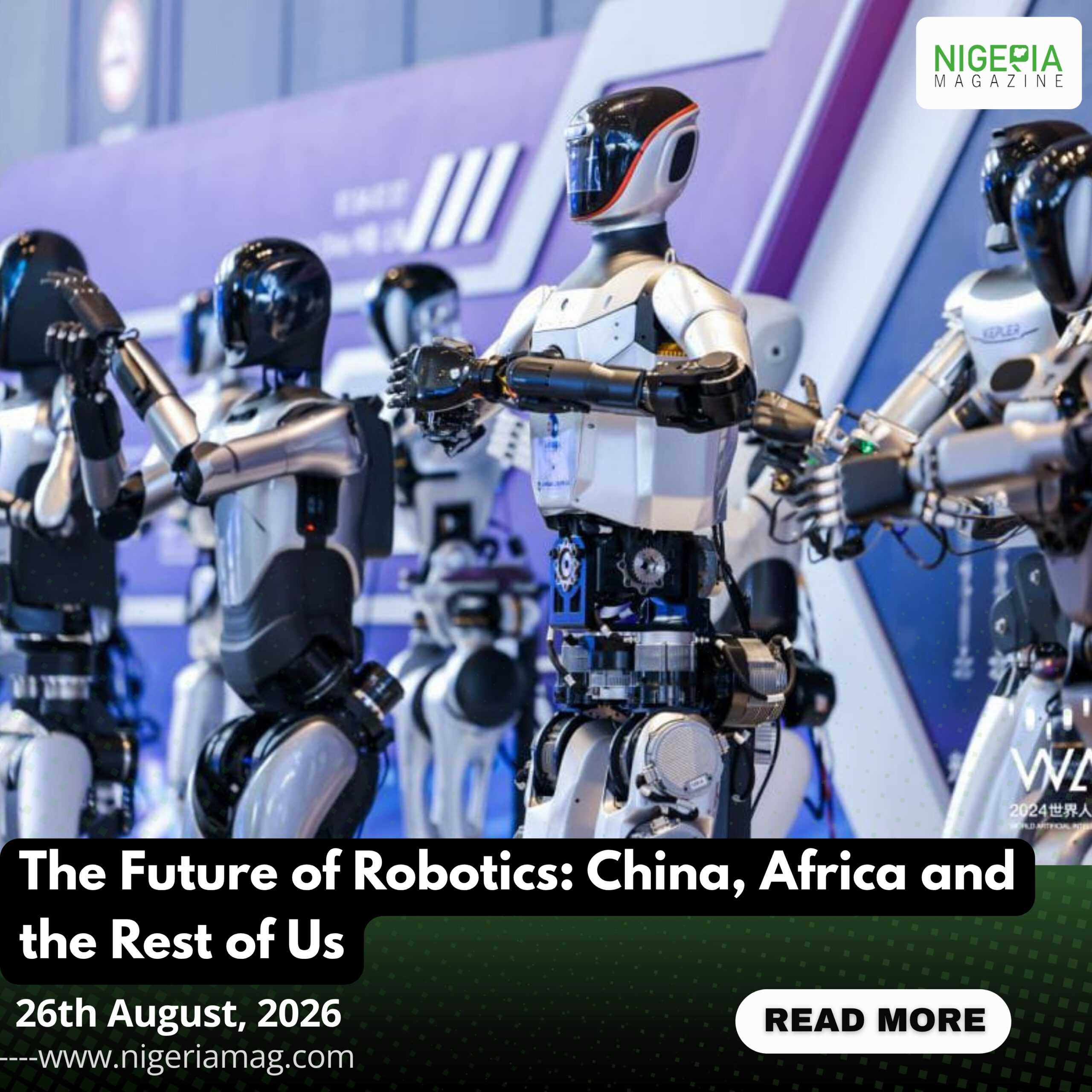
The Future of Robotics: China, Africa and the Rest of US
China has just given the world another glimpse of the future, not through a science-fiction film or a demonstration in a technology laboratory, but on the streets of one of its major cities. In the eastern Chinese city of Hangzhou, 15 robot traffic officers have been deployed to assist with traffic management. Since May, the robots have issued more than 170,000 warnings, according to their developer, and are said to have contributed to a more than 40 per cent reduction in some violations, including helmetless riding and vehicles crossing stop lines. Reuters, however, noted that the company’s figures could not be independently verified.The robots do not carry guns, cannot make arrests and are not designed to replace human police officers. Their role is to assist by monitoring traffic, detecting certain violations, issuing warnings, providing directions, answering questions and operating for long periods without the physical exhaustion that affects human workers. Yet, beyond the novelty of seeing a machine perform duties traditionally associated with a police officer, the development represents something much bigger: the gradual movement of robotics from laboratories, exhibitions and science-fiction imagination into the ordinary routines of everyday life.The future of robotics is therefore no longer a distant conversation about what may happen several decades from now. It is already beginning to take shape at traffic junctions, in factories, hospitals, warehouses and public spaces, as governments and companies increasingly find practical uses for machines that can see, process information and respond to their environments. China appears to understand the importance of this transition and is investing heavily in ensuring that it is not merely a consumer of the technologies of the future, but one of the countries actively designing, manufacturing and deploying them.The question for Africa is whether it is preparing for the same future.
More than a robot story
The T2 robots operating in Hangzhou are equipped with cameras, radar and onboard computing systems that enable them to identify certain traffic violations, including riding without helmets, carrying passengers on some e-bikes and crossing stop lines. They can also provide information about parking and traffic rules and, in emergency situations, connect members of the public with human police officers. Their significance, therefore, does not lie simply in the fact that they look futuristic or attract public attention, but in the fact that they are being applied to solve a repetitive and practical problem.That is where the real robotics revolution may be found. For decades, popular imagination has focused on robots that look and behave like humans, often picturing them walking through futuristic cities, performing dramatic tasks or appearing in stories about a distant technological age. The more important transformation, however, may be far less dramatic. A robot does not need to look exactly like a human to change society; it simply needs to perform a useful task more efficiently, consistently or safely.
China’s growing robotics industry appears to be moving in that direction by taking machines beyond exhibitions and demonstrations and placing them in practical roles. Robot traffic assistants are already being tested or deployed in several Chinese cities, while the Hangzhou programme is expected to expand significantly. SUPCON says nearly 50 of its robots are already operating across about eight cities in three provinces and expects deployments to approach 200 by the end of 2026.This is often how technological transformation takes place. A new idea begins as an experiment, moves into pilot programmes, attracts investment and eventually becomes part of ordinary life. What appears extraordinary at the beginning gradually becomes familiar, and what once attracted crowds can eventually become as unremarkable as a traffic light. One day, seeing a robot assisting with traffic management may no longer be considered a remarkable technological achievement, but simply another part of how a modern city works.China is not waiting for the futureThere is a significant difference between talking about the future and preparing for it. China is increasingly doing both, and the deployment of robot traffic officers is part of a much broader technological race involving artificial intelligence, robotics, automation, autonomous vehicles and what is now often described as physical AI—intelligence that does not simply exist on a computer screen but interacts directly with the physical world.At a traffic junction, several technologies come together in a single machine. The robot sees its environment through cameras and sensors, processes information through computing systems, identifies particular behaviours and responds according to its programming. It represents the meeting point of artificial intelligence, computer vision, sensors, robotics, data and automation, and it provides a simple example of how the future may increasingly involve intelligent systems operating alongside human beings in physical spaces.
China’s ambition is clearly not limited to becoming a large market for robots and other advanced technologies. It wants to be among the countries building them, manufacturing them and determining how they are used. That distinction will matter enormously in the years ahead because there will be countries that build the robots, countries that buy the robots and countries that simply watch the world change around them. Africa must begin to consider carefully which category it intends to belong to.
What does this mean for Africa?
The lesson for Africa is not that every major city should immediately rush to import humanoid robots from China. Such a response would focus on the appearance of the technology rather than its real significance. The more important lesson is about innovation, preparation and the ability to use technology to solve practical problems that already exist within African societies.Africa has some of the world’s youngest populations and some of its fastest-growing cities, but it also faces major challenges in transportation, healthcare, agriculture, security, education, logistics and public administration. These challenges should not be viewed only as obstacles to development; they should also be seen as opportunities for African scientists, engineers, entrepreneurs and governments to develop technologies specifically suited to the continent’s realities.There is no shortage of areas where robotics and intelligent machines could make a difference. Machines could assist farmers in monitoring crops and improving agricultural productivity, while robots could be used to inspect dangerous mining sites, bridges, roads and other critical infrastructure. Automated systems could help sort waste in rapidly expanding cities, while robotic assistants could support health workers by handling repetitive tasks. Intelligent traffic technologies could assist with congestion in Lagos, Nairobi, Accra, Johannesburg and Abuja, while drones and robotic systems could become increasingly useful during floods, fires and other emergencies.The question, therefore, should not simply be, When will Africa get the same robots as China? The more important question is, What kind of robotics does Africa need, and can Africans build it? That is a much more consequential conversation because the future of technology should not be limited to importing solutions designed for other societies when African problems can also become the starting point for African innovation.*Africa must avoid becoming only a market*Every major technological revolution creates a divide between those who develop the technology and those who depend entirely on it. Countries that arrive late often become consumers of machines and systems designed elsewhere, importing the equipment, paying for the software, providing the data and relying on foreign companies for maintenance, spare parts and future upgrades. By the time they fully understand the importance of the technology, much of the economic value and strategic influence may already be concentrated in the countries that built it.Africa has seen versions of this pattern before, and it cannot afford to repeat it with artificial intelligence and robotics. The continent needs universities that teach students not merely to discuss technologies developed elsewhere, but to understand how to design, build and improve them. Governments must take research and development more seriously, technology hubs must be connected to real industries, and students must increasingly learn hardware and engineering alongside software and digital skills.
Africa will also need engineers capable of designing machines for African roads, African farms, African hospitals and African cities. The continent needs institutions that can turn research into products and businesses that can manufacture, maintain and improve technology over time. Otherwise, Africa risks becoming a major market for a robotics revolution whose most valuable jobs, intellectual property and manufacturing opportunities are located elsewhere.This is because robotics is about far more than impressive machines. It is about jobs, privacy, surveillance, security, data ownership and, ultimately, power. The countries that control the technologies that shape transportation, communication, manufacturing and public services may also acquire enormous economic and strategic advantages, which is why Africa cannot treat the robotics revolution as simply another consumer trend.
The jobs question cannot be ignoredThe growing use of robots will inevitably create concerns about employment, particularly in societies where millions of people are already searching for work. Robots do not require salaries, do not become tired, do not take annual leave and can perform repetitive tasks consistently for long periods. These qualities make them attractive to businesses and governments seeking efficiency, but they also raise legitimate questions about what happens to workers when machines begin performing tasks previously carried out by human beings.If a machine can perform the work previously done by several people, what happens to those workers? This question will become increasingly important as robotics advances, particularly in sectors that depend heavily on repetitive and predictable tasks. History, however, also shows that technology does not simply destroy jobs; it changes the nature of work and creates new roles that did not previously exist.The challenge for Africa will be whether its education and training systems can prepare young people for those new opportunities. The future will require more robotics engineers, artificial intelligence specialists, technicians, data analysts, safety experts, cybersecurity professionals and people capable of maintaining increasingly sophisticated machines. There will also be a growing need for experts who understand the ethical, legal and social consequences of allowing intelligent machines to play larger roles in society.
Africa’s greatest danger may not necessarily be that robots will take all available jobs. The greater danger could be that other countries will create the technologies, establish the industries and capture the high-value jobs, while African countries remain dependent on importing the finished products. That is why education must change, because children and young people cannot be prepared only for the jobs that exist today when many of the jobs of the future are still being created.
Innovation must come with accountability
The excitement surrounding robotics should not prevent governments and societies from asking difficult questions. A robot that monitors traffic may improve safety and help authorities manage congestion, but it can also collect enormous amounts of information about citizens and their movements. As intelligent machines become more common, questions about privacy, accountability and the control of data will become increasingly important.Who controls the cameras and sensors? Where is the information stored? Who has access to it? What happens when an artificial intelligence system makes a mistake or wrongly identifies a person? Can citizens challenge decisions made with the assistance of automated systems? Can governments misuse intelligent surveillance technologies for purposes beyond those for which they were originally introduced?
These questions cannot be postponed until the technology has become widespread. Africa must avoid another mistake of importing sophisticated systems without building the laws, institutions and expertise needed to govern them. Developers of the Chinese police robots have themselves pointed to the need for integration with local law-enforcement systems, certification requirements and compliance with data-protection rules when considering deployment in other environments.
Innovation is essential, but accountability is equally important. Africa needs technologies that improve lives without unnecessarily compromising privacy, security or fundamental rights, and this will require governments to develop clear regulations while also encouraging the research and experimentation needed for innovation to flourish.*The rest of us are watching, but for how long?
The United States and China are already major forces in artificial intelligence, while China is now pushing aggressively into robotics and attempting to bring intelligent systems out of computers and into the physical world. Other countries are also investing heavily, and the global race is accelerating as governments and companies recognise that robotics could transform manufacturing, transportation, healthcare, agriculture and public services.While the world continues to debate whether robots will eventually replace humans, a more immediate reality is already taking shape: robots are beginning to change how people work. A robot traffic officer in Hangzhou may appear novel today, just as the first smartphones, online banking services and conversational artificial intelligence once seemed unusual before becoming increasingly familiar. Technology often develops gradually before reaching a point where adoption accelerates and suddenly becomes part of everyday life.The countries that benefit most from such changes may not necessarily be those that predict the future perfectly. They are more likely to be the countries that prepare for it by investing in education, research, infrastructure, institutions and industries capable of adapting to technological change.
Africa’s choice
Africa still has time to become an active participant in the robotics revolution, but time should not be confused with an excuse to delay. The continent does not need to copy China’s model because Africa has its own resources, challenges, population and opportunities. What it needs is the capacity to develop a technological future that responds to its own realities while allowing it to compete and collaborate globally.The future of robotics should not become another story about China and other advanced economies building the machines while Africa waits to import them. It should also be a story about African universities producing researchers, African engineers building useful technologies, African companies investing in innovation and African governments creating the policies and infrastructure necessary for new industries to grow.
The 15 robots deployed on traffic duty in Hangzhou have issued more than 170,000 warnings since May, according to their developer. They may not be able to make arrests, but their presence sends another kind of warning to the rest of the world: the age of robotics is moving steadily from the laboratory into everyday life.Traffic management is only the beginning. The real question for Africa is not whether robots are coming, because they are. The question is whether, when intelligent machines become more deeply integrated into economies and societies, Africa will be ready to build, manage and govern them, or whether it will once again stand by and watch others build the future.
Ubong Usoro for Nigeria Magazine

