


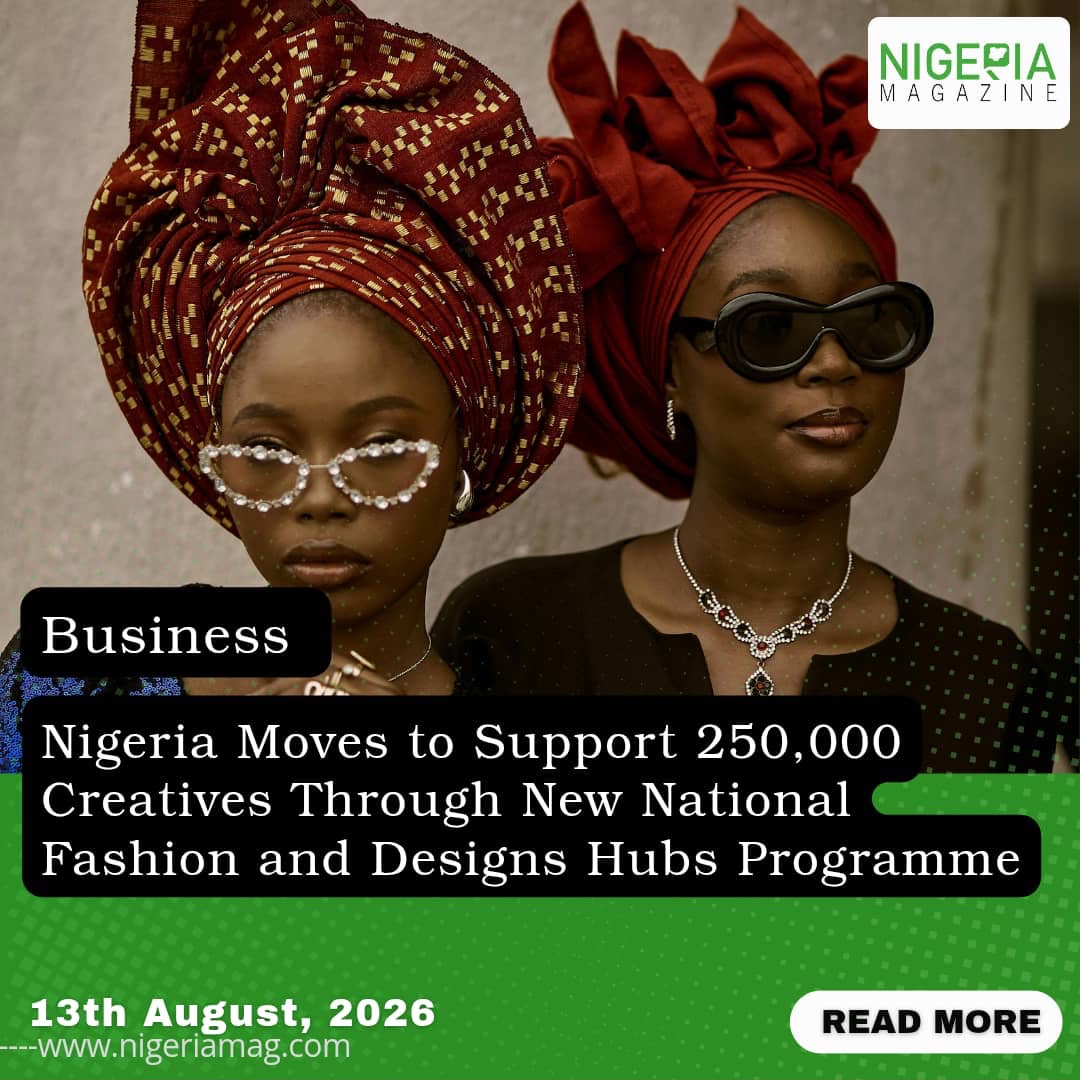
Nigeria’s fashion industry could be heading into a new phase of growth as the Federal Government moves to establish a nationwide network of fashion and design hubs aimed at supporting approximately 250,000 creatives across the country.
The initiative is being developed through a partnership between the Federal Ministry of Art, Culture, Tourism and the Creative Economy and Ananse Internet Group.
Minister of Art, Culture, Tourism and the Creative Economy, Hannatu Musa Musawa, announced the partnership in a recent LinkedIn post, revealing that both parties have signed a Memorandum of Understanding (MoU) to advance the National Fashion & Design Hubs Programme.
According to Musawa, Nigeria already has a fashion economy with significant international reach. However, one of the major challenges facing the sector is not a shortage of talent, but the lack of infrastructure and systems needed to help that talent grow into sustainable businesses.
The proposed programme is designed to address some of these gaps by providing creatives with access to world-class training, incubation programmes, production facilities and markets.
The goal is to move beyond simply celebrating individual Nigerian designers and fashion entrepreneurs and instead build an ecosystem where creatives can develop their skills, manufacture at scale, access financing and reach customers in Nigeria and international markets.
Ananse Internet Group has developed the programme’s concept, operating model and financial architecture, while the Federal Ministry is working with the Ministry of Finance Incorporated (MOFI) on the operationalisation of the Creative and Tourism Infrastructure Corporation (CTICo), which is expected to serve as an important infrastructure vehicle for the programme.
The initiative also builds on existing private-sector involvement. The Mastercard Foundation, through the Ananse Centre for Design in Lagos, has already committed support to the broader development of Nigeria’s creative ecosystem.
Why this matters
Nigeria’s fashion industry has produced internationally recognised designers, brands, models and creatives, but many businesses still struggle with access to capital, modern production facilities, skilled labour, reliable infrastructure and international markets.
For a designer with a strong creative idea, turning that idea into a scalable fashion business can therefore be much harder than simply designing good clothes.
The proposed hubs could help bridge that gap.
By bringing training, production, incubation and market access closer to creatives, particularly those outside Nigeria’s traditional creative centres, the programme could create opportunities for designers and fashion entrepreneurs who may otherwise struggle to access the resources required to grow.
The announcement has also raised questions about how creatives from different parts of the country will be selected and given access to the programme. Some responses to the minister’s announcement specifically called for a clear pathway that would allow indigenous fashion creatives to participate in the incubation programme and ensure that opportunities are not concentrated only in Lagos and Abuja.
If implemented effectively, the National Fashion & Design Hubs Programme could become more than a government-backed training initiative. It could provide part of the infrastructure needed to turn Nigeria’s fashion talent into a larger economic industry.
For the Federal Government, the bigger ambition is to position the creative economy as an engine for jobs, investment and exports.
And for Nigeria’s fashion entrepreneurs, the success of the programme may ultimately be measured by something much simpler: whether talented creatives who have struggled to find the resources to grow can finally get the support they need to build businesses that can compete globally.

