


By Moses Chibuike Ezechukwu
As nations prepare for an uncertain global economic future, sovereign wealth funds have become powerful instruments for preserving national wealth, stabilising economies, and securing prosperity for future generations. Nigeria has made commendable progress with its Sovereign Wealth Fund, but the experiences of Norway, Singapore, and Kuwait reveal that much more can be achieved through visionary leadership, disciplined governance, and long-term investment strategies.
Nigeria is often described as a country blessed with immense natural and human resources. From crude oil and natural gas to agriculture, solid minerals, and one of Africa’s youngest populations, Nigeria possesses the ingredients necessary for sustained prosperity. Yet, despite these advantages, Nigeria continues to grapple with economic instability, fluctuating oil revenues, high unemployment, inflation, and mounting public debt.
One institution that could significantly reshape Nigeria’s economic future is the Sovereign Wealth Fund (SWF). Rather than viewing oil revenues as money meant only for immediate consumption, successful nations have transformed finite natural resources into permanent financial assets that generate wealth for generations.
Countries such as Norway, Singapore, and Kuwait have demonstrated that disciplined savings, professional investment management, and political restraint can build sovereign wealth funds worth hundreds of billions—and in Norway’s case, well above one trillion dollars. Their experiences offer practical lessons that Nigeria should carefully consider.
Understanding Sovereign Wealth Funds
A Sovereign Wealth Fund is a state-owned investment fund established to invest national surpluses for long-term economic benefit. These funds typically invest in stocks, bonds, infrastructure, technology companies, renewable energy, real estate, and other productive assets around the world.
Unlike traditional government spending, a sovereign wealth fund is designed to preserve wealth while generating sustainable returns over decades.
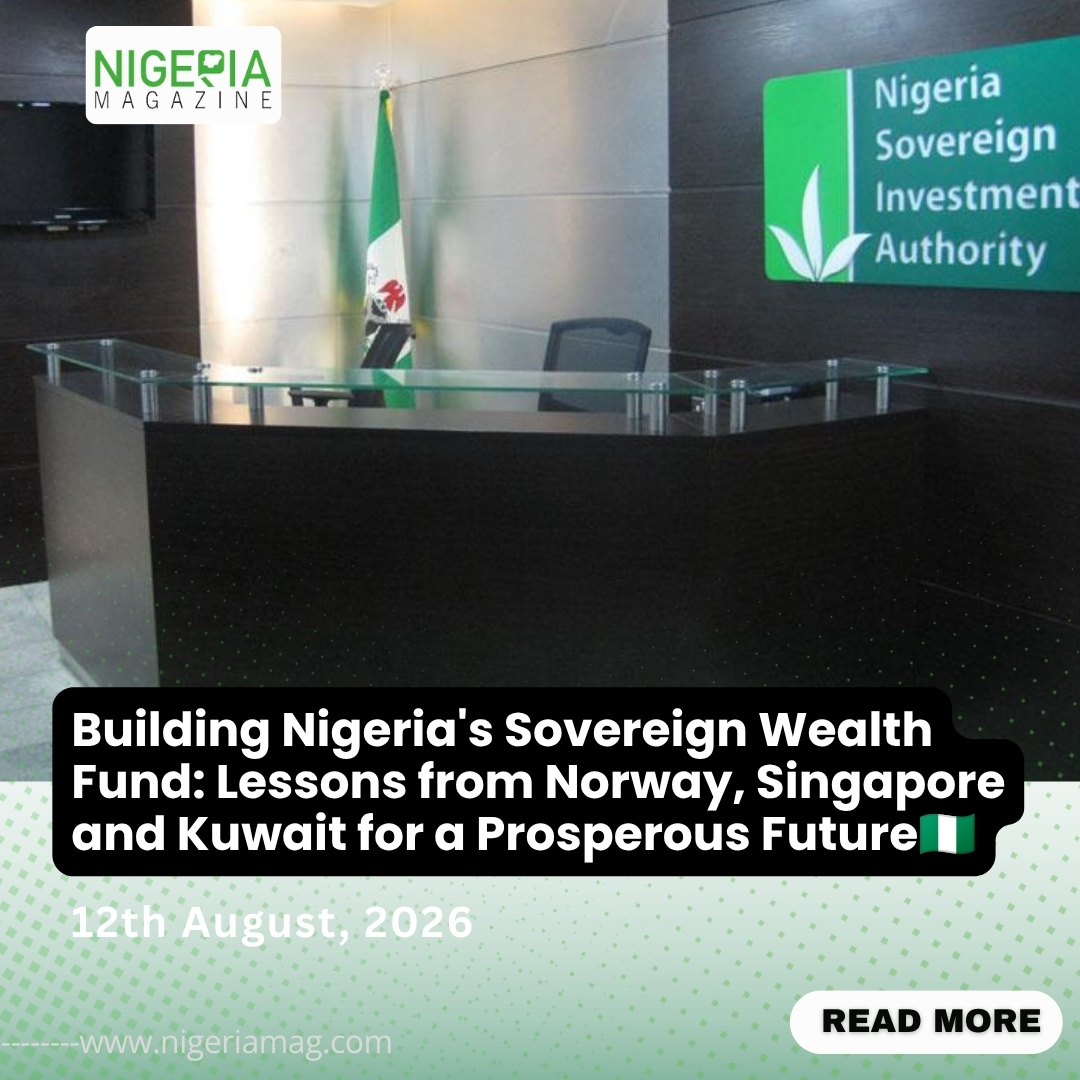
Nigeria established the Nigeria Sovereign Investment Authority (NSIA) in 2011, with three major objectives:
Stabilising the economy during periods of revenue shocks.
Saving for future generations.
Investing in critical domestic infrastructure.
While the NSIA has earned international recognition for prudent management, the size of Nigeria’s fund remains relatively small compared to leading sovereign wealth funds globally.
Norway: Turning Oil into Permanent National Wealth
Norway provides perhaps the world’s most remarkable example of responsible resource management.
Instead of spending all oil revenues, Norway channels a significant portion into its Government Pension Fund Global. Today, the fund owns investments across thousands of companies worldwide and serves as a financial safety net for future generations.
The secret behind Norway’s success is not merely oil production. Many countries produce oil. The real difference lies in discipline. Norway separates political decision-making from day-to-day investment management. Professional investment managers operate under strict governance frameworks, while politicians cannot freely dip into the fund whenever government spending increases.
Equally important is transparency.
The fund publicly reports its investments, financial performance, and governance, strengthening public confidence and international credibility.
Nigeria could benefit enormously from adopting similar principles of fiscal discipline and institutional independence.
Singapore: Wealth Through Strategy, Not Natural Resources
Unlike Nigeria and Norway, Singapore possesses virtually no significant natural resources. Yet it has built one of the world’s strongest financial systems through strategic investment. Its reserve management institutions, including GIC and Temasek, invest globally across technology, healthcare, logistics, infrastructure, finance, and emerging industries. The government’s emphasis is clear: national wealth should continuously grow through professional investment rather than idle savings.
Perhaps Singapore’s greatest lesson is governance.
Investment professionals—not politicians—make investment decisions based on long-term economic returns. Strong oversight exists without political interference, allowing investment managers to remain focused on performance and prudent risk management.
Nigeria’s growing technology ecosystem, youthful workforce, and expanding digital economy provide similar opportunities. A stronger sovereign wealth strategy could position Nigeria as a major investor in African innovation instead of relying overwhelmingly on crude oil exports.
Kuwait: Planning Beyond Oil
Kuwait was among the earliest countries to recognise that oil wealth would not last forever. For decades, it has consistently transferred portions of oil income into long-term savings through its sovereign wealth fund. The result is a substantial financial reserve capable of supporting future generations even after oil production declines. Kuwait’s experience highlights an important principle: countries rich in natural resources should treat resource income as temporary rather than permanent. Nigeria, whose economy remains heavily dependent on oil exports, faces the same challenge. Building larger long-term savings today would reduce vulnerability to future oil price crashes.
What Nigeria Must Do Differently
✔️ Increase Annual Contributions
Nigeria should commit a larger percentage of oil revenues and other extractive income to the Sovereign Wealth Fund, especially during periods of high commodity prices.
Saving during prosperous years creates protection during difficult economic periods.
✔️ Diversify Revenue Sources
The fund should increasingly benefit from non-oil sectors including agriculture, mining, manufacturing, technology, renewable energy, and digital services.
Economic diversification strengthens national resilience.
✔️ Strengthen Institutional Independence
One recurring lesson from Norway and Singapore is the importance of insulating investment decisions from short-term political pressures.
Professional fund managers should be empowered to pursue long-term investment strategies guided by transparent rules and measurable performance indicators.
✔️ Improve Transparency
Citizens deserve regular public reports detailing:
Fund performance
Investment strategy
Asset allocation
Financial returns
Governance practices
Greater transparency builds trust while discouraging misuse of public resources.
✔️ Invest in Future Industries
Rather than concentrating investments solely in traditional sectors, Nigeria should allocate capital toward:
Artificial Intelligence
Renewable energy
Biotechnology
Digital infrastructure
Advanced manufacturing
Green transportation
Agricultural technology
These industries are expected to drive global economic growth over the coming decades.
Challenges Nigeria Must Overcome
Expanding Nigeria’s Sovereign Wealth Fund will not be without obstacles.
Political pressure to spend immediately rather than save remains a persistent challenge. Governments often face urgent demands for salaries, infrastructure, subsidies, and social programmes.
There is also the issue of fluctuating oil revenues, which make consistent contributions difficult during periods of declining prices.
Public confidence is another critical factor. Citizens are more willing to support long-term savings when institutions demonstrate integrity, accountability, and measurable results.
These challenges are significant but not insurmountable. They require political courage and a shared national vision that places future generations alongside present-day priorities.
Why the Time to Act Is Now
The global economy is changing rapidly.
Oil may continue to play an important role for years to come, but the world is steadily transitioning toward cleaner energy, technological innovation, and knowledge-based industries.
Nigeria cannot afford to wait until oil revenues begin to decline before building substantial national savings.
Every year of delayed action represents lost opportunities for investment, compounded returns, and economic security.
The country’s youthful population deserves an economy capable of creating opportunities not only today but decades into the future.
Norway, Singapore, and Kuwait followed different paths, yet they all embraced the same fundamental philosophy: national wealth should be preserved, invested wisely, and protected from short-term political pressures.
Nigeria already possesses the institutional foundation through the Nigeria Sovereign Investment Authority. What is required now is greater commitment, larger contributions, stronger governance, enhanced transparency, and a long-term national consensus that saving is not a luxury—it is an investment in national survival.
If Nigeria adopts these lessons with determination, its Sovereign Wealth Fund could evolve into one of Africa’s greatest financial assets, providing stability during economic downturns, financing transformational development, and securing prosperity for generations yet unborn.
The true measure of a nation’s wealth is not merely what it earns today, but what it preserves and grows for tomorrow.

